Boxer's Nose: A Complete Guide

Updated on • Reviewed by Dr. Gustavo Sordo, plastic surgeon
Today, we know of numerous conditions that can alter both the appearance and proper function of the nose . Among them is the so-called boxer's nose , a deformity that goes far beyond aesthetics and can cause significant functional problems. Clinically related to saddle nose , it can affect breathing, nasal structure, and consequently, the patient's quality of life. In this article, we explain what a boxer's nose is, its main causes and consequences, and what treatments currently exist in 2026 to correct it.
To see what the surgery is like step by step, with cases and price (from €10.040), visit rhinoplasty in Madrid.
Before the consultation, you can see real cases according to your nose type and compare the simulation with the result obtained.
What is a boxer's nose or "saddle nose"?
A boxer's nose or saddle nose is a nasal deformity characterized by the collapse or drooping of the nasal dorsum, the upper part of the nose. This creates a concave profile resembling a saddle. This condition results from the loss of structural support, often due to trauma to the nasal septum that disrupts its blood supply, leading to its resorption or collapse.
Visible and functional characteristics
Among the aesthetic characteristics, the most obvious sign is a sunken line of the nasal bridge, which can make the nasal tip appear wider, rounded, or droopy, and the nose as a whole appear shorter. Among the functional characteristics of the condition, many patients experience nasal airway obstruction, as the collapse of the internal structure can block the airways, making breathing difficult. In severe cases, it can also affect the sense of smell.
Types or stages
The deformity is classified according to its severity, which helps determine the most appropriate treatment.
Mild deformity
It is a subtle depression of the bridge of the nose. It is usually primarily a cosmetic issue, with little or no functional impact.
Moderate deformity
It involves a clear loss of height and projection of the nasal bridge. Mild to moderate respiratory obstruction develops due to structural collapse.
Severe deformity
The nasal dorsum is completely collapsed, with a marked depression. The nasal tip is overprojected and droopy. Respiratory obstruction is significant, and there may be septal perforation.
You might be interested in: types of noses.
Causes and risk factors
Nasal trauma
It's the most common cause. Direct blows to the nose, common in contact sports such as boxing, martial arts, or American football, can fracture the septum and impair blood circulation.
You can read more about: nose trauma.
Previous nasal surgery
A previously performed rhinoplasty or septoplasty that was too aggressive and excessively weakened the structural support of the septum can result in subsequent collapse.
The so-called "boxer's nose" is almost always a post-traumatic nose : deviated or sunken bone, fractured septum, and often associated airway obstruction. The order of procedures is crucial here, because the nose follows the septum's path : if the septum isn't straightened and properly supported, any correction of the bridge will become crooked over time. That's why we always perform a functional and aesthetic rhinoseptoplasty simultaneously, not two separate surgeries.
When trauma has destroyed supporting structures or a previous surgery has failed, the cartilage of the septum itself is usually insufficient, and we resort to laminated costal cartilage grafts , integrated using techniques such as the oblique split described by Taştan, which reduces the risk of the graft warping over time (Taştan et al., 2013, JAMA Facial Plast Surg ). We perform bone work using ultrasound, which allows us to reposition and sculpt already deformed bone with much greater precision than a traditional chisel.
Inflammatory and autoimmune diseases
Diseases such as granulomatosis with polyangiitis, relapsing polychondritis, or sarcoidosis can inflame and destroy nasal cartilage.
Use of drugs
Cocaine, when sniffed chronically, is a potent vasoconstrictor that can necrotize the tissue of the septum, causing it to perforate and subsequently collapse.
Untreated infections
Severe or untreated infections in the nose or sinuses can damage the cartilage.
How do you know if you have a saddle nose?
- Look at your profile: Determine if you see a clear depression at the top of your nose.
- Difficulty breathing: You feel like air is not flowing properly through one or both nostrils.
- History of injuries: You have suffered a nasal fracture or you practice a contact sport.
- Change in the shape of your nose: You notice that the tip of your nose has become wider or droopy.
- Presence of other diseases: You have been diagnosed with a systemic inflammatory disease
Medical evaluation and diagnosis
Diagnosis is made by a facial plastic surgeon or an otolaryngologist. The evaluation includes a medical history to identify trauma, previous surgeries, or underlying conditions. A physical examination typically includes a rhinoscopy to examine the inside of the nose. Imaging tests, such as a CT scan, may be performed to assess damage to bone and cartilage structures and plan surgery. A blood test may also be performed if an autoimmune or inflammatory cause is suspected.
Consequences and risks
- Chronic respiratory obstruction, which can lead to mouth breathing, snoring, and sleep apnea syndrome.
- Dryness and crusting inside the nose due to disturbances in airflow.
- Recurrent nosebleeds.
- Recurrent sinusitis.
- Low self-esteem and social anxiety due to aesthetic impact.
- Progression of the deformity if the underlying cause is not treated.
How to correct a saddle nose deformity?
Correction almost always requires surgery, the goal of which is to rebuild the support structure and restore respiratory function.
Augmentation or reconstruction rhinoplasty
Augmentation rhinoplasty is the primary procedure. Graft material is used to fill and lift the sunken nasal bridge. Grafts can be taken from the patient's own body, using cartilage from the septum, ear, or ribs; homologous or donor cartilage, where rib cartilage from a deceased donor is used, processed to be safe; or synthetic materials such as titanium or polytetrafluoroethylene, although these are used less frequently.
Reconstructive septoplasty
A septoplasty is performed if the septum is deviated or damaged; it is reconstructed to restore central support to the nose and clear the airways.
Rhinomodelling with fillers
Only for very mild cases and of purely aesthetic origin. Rhinoplasty without surgery involves injecting hyaluronic acid dermal fillers to camouflage the depression. It is a temporary solution that lasts between 12 and 18 months and does not address functional problems. It is contraindicated if there is a perforated septum.
At Dr. Gustavo Sordo's Clinic, we do not perform this type of procedure nor do we recommend it , as we prioritize safe, stable solutions that respect both the structure and function of the nose.
How much does it cost: Prices 2026
- Reconstructive Rhinoplasty: It's the most complex procedure. Prices can range from $7,000 to $20,000 or more, depending on the severity, the surgeon's experience, and the geographic location.
- Reconstructive septoplasty: The approximate price, considering this complexity, would range between $5,000 and $8,000 USD or more, depending on the severity of the case and the material used.
- Rhinomodelling with hyaluronic acid: It's a much more affordable treatment, costing approximately $600 to $1,500 USD per session. Keep in mind that it's temporary and requires touch-ups.
Boxer's nose: before and after
In the before section, a concave nasal profile, a drooping nasal tip, and possible deviation and obstruction can be observed. The after section shows a straight and natural nasal bridge, a defined nasal tip, and a harmonious position. Most importantly, respiratory function is fully restored.

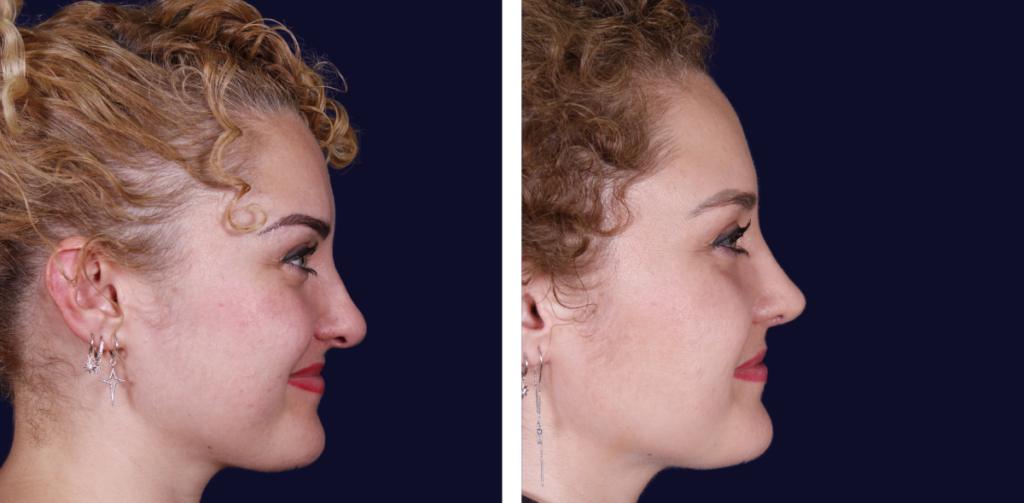


We recommend you take a look at all our before and after rhinoplasty cases.
Trust Dr. Sordo's precision and care to treat your boxer's nose.
At our Plastic Surgery Clinic in Madrid , you will find Dr. Gustavo Sordo , a plastic surgeon in Madrid , specializing in rhinoplasty , with more than 20 years of experience as a specialist in rhinoplasty procedures in Madrid and ultrasonic rhinoplasty in Madrid , and he is dedicated to offering personalized solutions for each patient, with an aesthetic and functional approach.
Recovery and postoperative care
First week
This is the period of greatest inflammation and discomfort. Splints and internal packing are used, which are usually removed after a few days. Relative rest and application of ice are crucial.
Until the fourth week
The swelling and bruising decrease significantly. The stitches and splint are removed. You can return to work and social life, avoiding physical exertion.
From 3 to 12 months
The residual swelling gradually disappears, and the final shape of the nose becomes more defined. It is essential to avoid bumps on the nose, sleep on your back, avoid wearing heavy glasses for a few weeks, and always follow up with your surgeon.
Frequently Asked Questions (FAQs)
Can boxer nose cause difficulty breathing?
Yes, definitely. Difficulty breathing is one of the most common and significant functional consequences of a boxer's nose or saddle nose. This obstruction can lead to secondary problems such as constant mouth breathing, snoring, dry mouth, and even contribute to sleep apnea syndrome.
Does a boxer nose affect your sense of smell or voice?
Yes, it can affect both senses, with smell being the most commonly affected. When the saddle deformity causes severe obstruction, air laden with odorous particles cannot reach the olfactory region. And when nasal anatomy is severely altered and the nostrils become obstructed, there is a change in how sound resonates.
Which option is better: rhinomodeling or rhinoplasty?
It depends on the severity. Non-surgical rhinoplasty is purely cosmetic, temporary, and for very mild cases without functional problems. Reconstructive rhinoplasty is the definitive solution, as it rebuilds the nasal structure, resolving both the aesthetic and functional issues.
How long does recovery last?
Initial recovery time is 1 to 2 weeks. However, residual swelling may take up to a year or more to completely resolve and reveal the final result.
What type of surgeon treats boxer's nose?
You should look for a facial plastic surgeon or otolaryngologist with a subspecialty in nasal plastic surgery and reconstruction. They are the specialists with the comprehensive training to manage the aesthetic and functional complexity of this deformity.
Conclusion
A boxer's or saddle nose is a condition that significantly impacts breathing and quality of life. Fortunately, advances in reconstructive rhinoplasty techniques offer highly effective and definitive solutions. If you identify with this condition, the first and most important step is to consult with a qualified specialist for a proper diagnosis and a treatment plan that will allow you to regain both nasal function and confidence in your appearance.
Continue reading
Dr. Gustavo Sordo
Specialist in Plastic, Aesthetic and Reconstructive Surgery. Member No. 282858125.
Content clinically reviewed by Dr. Gustavo Sordo. Last review: October 7, 2026.