Best Online Rhinoplasty Simulator

Updated on • Reviewed by Dr. Gustavo Sordo, plastic surgeon
One of my patients' biggest concerns before requesting their first consultation for rhinoplasty is knowing how their nose will look after the procedure.
Want to go beyond theory? At Rhinoplasty in Madrid we explain the technique, the cases and the price (from €10.040).
It's a completely normal concern. The nose occupies the center of the face, and any modification, however small, can significantly alter facial harmony. Therefore, many patients come to the consultation with questions like:
- Will I recognize myself after the operation?
- Will my nose still look natural?
- How can I know if I'll like the result?
- Is there any way to see the result before I have the surgery?
Fortunately, technology has revolutionized how we plan rhinoplasty. Today, it's possible to perform a computer simulation that allows the patient to visualize a very realistic approximation of how their nose might look after surgery. This tool has become a fundamental part of modern aesthetic diagnosis and helps both the patient and the surgeon to jointly design the desired result.
At the practice of Dr. Gustavo Sordo, a specialist in ultrasonic rhinoplasty in Madrid, simulation is an integral part of the initial assessment process. This is not simply a computer-generated image or a digital filter. It is a medical tool that allows for the analysis of the patient's nasal anatomy, the study of potential modifications, and the planning of a completely personalized surgery.
Dr. Sordo's philosophy has always been clear: a good rhinoplasty is not about copying someone else's nose or following passing trends. It's about designing a harmonious, natural nose that is perfectly integrated with each patient's facial features.
Therefore, before entering the operating room, we dedicate all the necessary time to studying the nose, breathing, facial proportions, and the patient's aesthetic goals. Simulation is an essential part of this process.
What is a rhinoplasty simulator?
A rhinoplasty simulator is a technological tool that allows you to digitally recreate the possible changes that could be made to a nose through surgery.
Its main objective is to help the patient visualize an approximation of the final result before undergoing the procedure.
For many years, the only way to explain rhinoplasty was by showing photographs of other patients or drawing pictures over printed images. However, these methods had significant limitations because they did not allow for a personalized representation of the changes that could be made in each individual case.
Currently, thanks to simulation software, it's possible to study a patient's face from different angles and make virtual modifications to their own photographs. This allows us to observe how certain changes might affect overall facial balance.
It is important to note that a professional simulation is not the same as mobile apps or online simulators that we can find on the internet.
Online simulators typically only modify photographs automatically using artificial intelligence or digital filters. While they can be entertaining, they don't take into account fundamental factors such as:
- The patient's actual anatomy.
- The thickness of the skin.
- The quality of the cartilage.
- The bone structure.
- Surgical limitations.
- Respiratory function.
In contrast, a simulation performed by a specialized surgeon is part of a complete medical diagnosis and is based exclusively on changes that can actually be carried out through surgery.
For this reason, at Dr. Gustavo Sordo's practice, all simulations are based on surgically feasible modifications. The goal is not to create an idealized image, but to design a realistic result that can be achieved through a properly planned rhinoplasty.
The simulator we use in the clinic for nose surgery is Kaeria , which is 2D: the simulation is done using photographs of the patient's own nose. For breast surgery, however, we use Crisalix 3D , which works on a three-dimensional model.
For us, it's primarily a surgical planning and expectation tool : it allows us to explain what it truly means to raise or lower a dorsal projection, how much tip rotation is most beneficial for that particular face—remember, around 120 degrees of nasolabial angle in women and 100 in men, although this varies from patient to patient—and why sometimes what the patient initially requests isn't the best outcome. It's quite accurate, although it's always important to emphasize that it's an approximation, not a promise: the skin and the healing process have the final say.
What is a rhinoplasty simulator used for?
Many people think that the main function of a rhinoplasty simulator is simply to show what the nose will look like after the operation. However, its usefulness goes far beyond that.
In reality, it is a communication, planning and diagnostic tool that provides enormous value to both the patient and the surgeon.
Visualize the possible results
The first benefit is obvious: to allow the patient to visualize an approximation of the result.
This helps reduce uncertainty and greatly facilitates decision-making.
Many people have been thinking about getting a nose job for years, but they never take the plunge because they can't imagine how their face might change. Simulation allows them to transform that uncertainty into a much more concrete and understandable image.
Improve communication between patient and surgeon
One of the most important aspects of any rhinoplasty is that the patient and the surgeon share exactly the same vision of the result they wish to achieve.
When a patient says:
"I want a thinner nose"
o
"I want a more elegant tip"
Each person can interpret those words differently.
Simulation allows subjective concepts to be transformed into concrete images. This greatly facilitates communication and reduces the risk of misunderstandings.
Plan the surgery more precisely
Modern rhinoplasty is not just about correcting visible defects.
It also requires meticulous planning of each nasal structure.
During the simulation, we analyze different surgical options and study how they will influence the overall harmony of the face. This process helps define the surgical strategy before the procedure.
Psychologically adapting to change
Although many people are unaware of it, psychological adaptation to a new image is an important part of the process.
Simulation allows the patient to begin familiarizing themselves with their future appearance even before surgery.
This generates greater peace of mind and security throughout the entire process.
Benefits of performing a simulation before rhinoplasty
The incorporation of simulation into the diagnostic process has been a huge advance in nasal surgery.
These are some of its main benefits.
Greater certainty before making a decision
The decision to undergo rhinoplasty is very important.
Being able to visualize an approximation of the result allows you to approach the process with greater confidence and peace of mind.
Many patients say that the simulation was one of the factors that helped them take the final step towards surgery.
It allows you to set realistic expectations
One of the main reasons for dissatisfaction in cosmetic surgery is unrealistic expectations.
Simulation helps to understand which changes are possible and which are not.
This allows for building appropriate expectations from the beginning and improves subsequent satisfaction with the result.
It facilitates a completely personalized rhinoplasty
Every nose is unique.
Every face is different.
For this reason, modern rhinoplasty must always be personalized.
Simulation allows us to design a surgery adapted to the anatomical characteristics and specific objectives of each patient.
It helps to better understand facial harmony
Sometimes, the problem isn't just in the nose.
The aesthetic perception of a nose depends on its relationship with other facial structures such as:
- The forehead.
- The lips.
- The chin.
- The cheekbones.
- The jaw.
Simulation allows these proportions to be analyzed globally to achieve more balanced and natural results.
Reduce fear of the final result
Many people delay rhinoplasty for years simply out of fear of not recognizing themselves after the procedure.
Visualizing an approximation of the result beforehand considerably reduces this concern.
The patient better understands the changes that will be made and faces the process with greater serenity.
It facilitates surgical planning
Simulation not only benefits the patient.
It also allows the surgeon to study in detail the modifications that will be necessary to achieve the desired result.
Therefore, it has become a fundamental tool within modern rhinoplasty and especially in advanced procedures such as the ultrasonic rhinoplasty that we perform in our clinic.
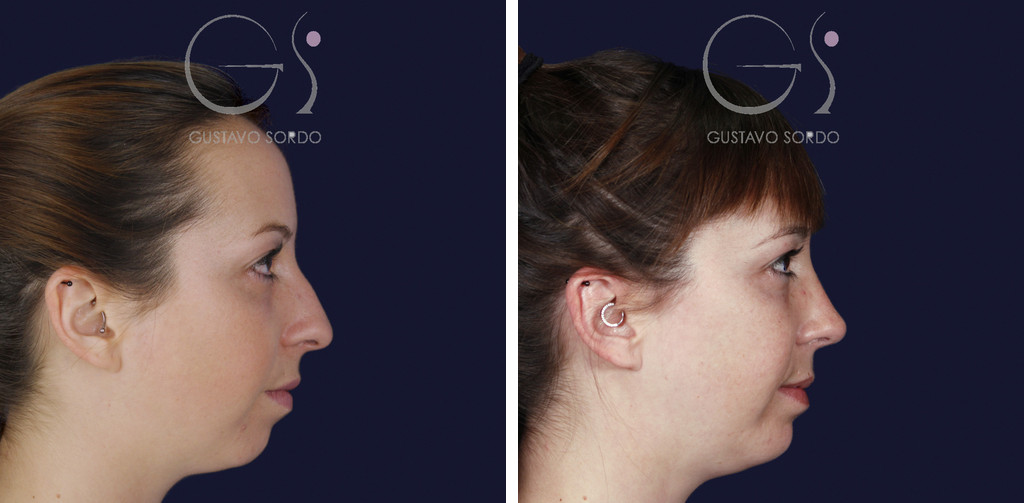
How do we perform rhinoplasty simulations at Dr. Gustavo Sordo's office?
At our plastic surgery clinic in Madrid, we understand that a successful rhinoplasty does not begin in the operating room.
It starts much earlier.
It begins with an accurate diagnosis, rigorous planning, and clear communication between the patient and the surgeon.
For this reason, we dedicate a very important part of the first consultation to the detailed study of each case and to carrying out a personalized simulation.
This computer simulation is not simply intended to show an attractive image of a possible future nose. Its purpose is to help us understand which changes can truly improve the patient's facial harmony and which are technically and anatomically feasible.
Initial medical assessment
The first consultation always begins with a complete medical interview.
During this visit we gather all the necessary information to assess whether the patient is a good candidate for rhinoplasty.
We analyze aspects related to:
- General health status.
- Medical history.
- Previous surgeries.
- Respiratory problems.
- Previous nasal trauma.
- Aesthetic expectations.
- Motivations for performing the surgery.
This phase is fundamental because it allows us to understand exactly what each patient is looking for and to determine if their goals are compatible with a natural and balanced result.
Functional analysis of the nose
One of the most frequent mistakes is thinking that rhinoplasty is only cosmetic surgery.
The nose is a complex organ whose main function is breathing.
Therefore, during the exploration we performed a detailed examination to study:
- The nasal septum.
- The cornets.
- The permeability of the nasal passages.
- The nasal valves.
- Possible deviations.
- Associated respiratory problems.
Many patients discover during this examination alterations that they were unaware of and that can be corrected simultaneously during surgery.
Facial aesthetic diagnosis
Once the functional study was completed, we began the aesthetic analysis.
This is probably one of the most important aspects of the whole process.
Most people only notice what they don't like about their nose.
However, modern rhinoplasty requires studying how the nose relates to the rest of the face.
Therefore, we analyze aspects such as:
- The shape of the nasal dorsum.
- The presence of an easel.
- The beginning of the nasal root or radix.
- The width of the nose.
- The width of the alar cartilages.
- The projection of the tip.
- The rotation of the nasal tip.
- Possible asymmetries.
- Nasal axis deviations.
- Relationship between nose, lips and chin.
Often the problem is not that the nose is too big or too small.
The problem is that there is an imbalance between the different facial structures.
That's why we emphasize so much the importance of performing a comprehensive facial diagnosis before any surgery.
Simulation creation
Once the diagnosis was completed, we began working with the simulator.
Thanks to this technology, we can show the patient an approximation of the changes that could be made to their nose.
During this phase we jointly studied different possibilities:
- Reduction of the easel.
- Definition of the tip.
- Correction of deviations.
- Improvement of asymmetries.
- Increased projection.
- Rotation modification.
- Refinement of certain areas.
Most importantly, all the modifications shown during the simulation correspond to changes that can actually be made through surgery.
We don't design impossible noses.
We don't create unrealistic expectations.
We do not use simulation as a business tool.
We use it as a medical planning tool.
Joint review with the patient
One of the most important advantages of the simulator is that it allows us to have a visual dialogue with the patient.
Often, concepts such as:
- "I want a finer point."
- "I want a more feminine nose."
- "I want a more elegant nose."
They can be interpreted in completely different ways.
Simulation eliminates much of this subjectivity.
Patient and surgeon can observe exactly the same changes and discuss together which ones are most appropriate.
This communication is key to achieving a satisfactory result.
Digital archive and pre-operative consultation
Once the simulation is completed, it is stored within the patient's digital medical record.
Subsequently, during the pre-operative consultation, we review the images obtained again.
This allows us to confirm that both the patient and the surgeon continue to share exactly the same goals before the procedure.
What aspects of the nose can be analyzed with a rhinoplasty simulator?
One of the main advantages of simulation is that it allows the study of virtually all the elements that influence the appearance of the nose.
Nasal bridge
A prominent bridge is one of the most frequent alterations that motivate rhinoplasty.
It consists of a prominence located on the nasal dorsum that creates a convex profile.
Thanks to the simulator, we can visualize how the facial profile would change after its correction.
Nasal tip
The tip is probably the most complex structure of the entire nose.
We can analyze:
- film screenings
- Definition.
- Width.
- Symmetry.
- Rotation.
Small modifications in this area can completely transform the appearance of the face.
Deviated noses
Nasal deviations affect both aesthetics and respiratory function.
Simulation allows us to assess the correction of the nasal axis and study how it will influence facial harmony.
Nasal width
Some patients have an excessively wide nose or a disproportionate nasal base.
Simulation allows for the study of possible corrections while always maintaining a natural appearance.
Projection problems
There are noses that are not very prominent and others that are excessively prominent.
In both cases, the simulation helps to visualize what the ideal balance would be for each face.
Does the simulation show exactly what my nose will look like?
This is probably the question we hear most often in consultations.
And the answer is simple.
No.
No simulator in the world can guarantee a 100% accurate result. Surgery depends on numerous biological factors that are impossible to predict completely.
Among them:
- Skin quality.
- Skin thickness.
- Healing process.
- Postoperative inflammation.
- Characteristics of cartilage.
- Individual response of each patient.
For this reason, simulation should be understood as a guiding tool and not as a promise of outcome.
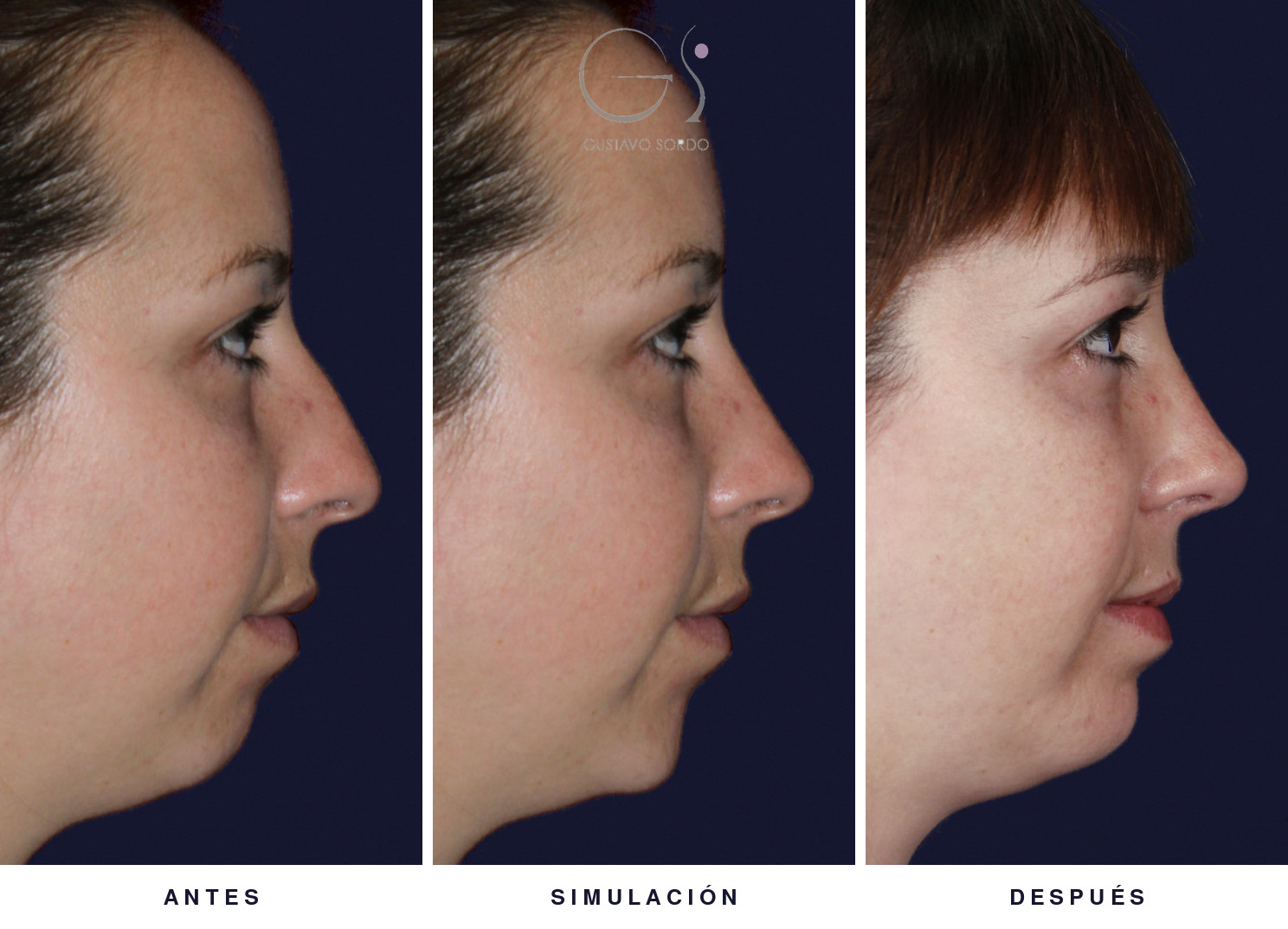
However, when the planning is correct and the surgery is performed properly, the results are usually remarkably similar to the simulations previously carried out.
That is precisely why this technology has become a fundamental tool in modern rhinoplasty.
The goal is not to predict every millimeter of the outcome. The goal is to design a clear roadmap to achieve the best possible result.
Online rhinoplasty simulator vs professional simulation with a surgeon
Currently, there are many mobile applications and online simulators that promise to show what a nose will look like after an operation.
Although they may seem interesting, they have significant limitations.
Online simulators:
- They automatically modify photographs.
- They don't study real anatomy.
- They do not analyze respiratory function.
- They don't take skin quality into account.
- They do not assess surgical feasibility.
In contrast, a professional simulation performed by a specialized surgeon is part of a complete medical process.
The difference is enormous.
Anyway, here you can see an online test of what your rhinoplasty will look like so you can see an approximation of the result.
A surgeon designs a real surgical procedure.
That's why we always recommend using online simulators only as a guide and entrusting the final planning to a specialist with experience in rhinoplasty.
Conclusion
As we have mentioned previously, during the initial consultation at Dr. Sordo 's clinic , we gather all the necessary information to assess whether the patient is a suitable candidate for the desired surgery . To do this, we collect data on their health status, as well as their aesthetic and functional desires and needs. In other words, we not only ask the patient about their aesthetic wishes but also analyze the functional condition of the nose through rhinoscopic examination . This examination allows us to evaluate the shape of the nasal septum and turbinates.
In addition, all the aesthetic aspects that we wish to modify will be analyzed, such as: the bridge, the beginning of the nasal root, the tip of the nose , the width of the nose, the width of the alar cartilages, various asymmetries that appear in the tip and in the triangular cartilages, respiratory insufficiency, dislocations or deviations of the nasal septum, problems of rotation or drooping of the tip, problems of projection, both due to lack of projection or excess of the tip itself, etc.
After the aesthetic and functional assessment, the patient will undergo a computerized simulation for nose surgery. At Dr. Sordo's practice, we believe these simulations are of vital importance. The patient will be able to visualize the result they will achieve with ultrasonic rhinoplasty and appreciate the necessary modifications to their nose, distinguishing between those that are feasible and those that are not. Furthermore, the patient will be able to gradually adapt to their new appearance.
The computer simulation will be archived in the patient's digital record , so that when they come to the second consultation (pre-operative consultation) we will again analyze the simulations performed and the possible results.
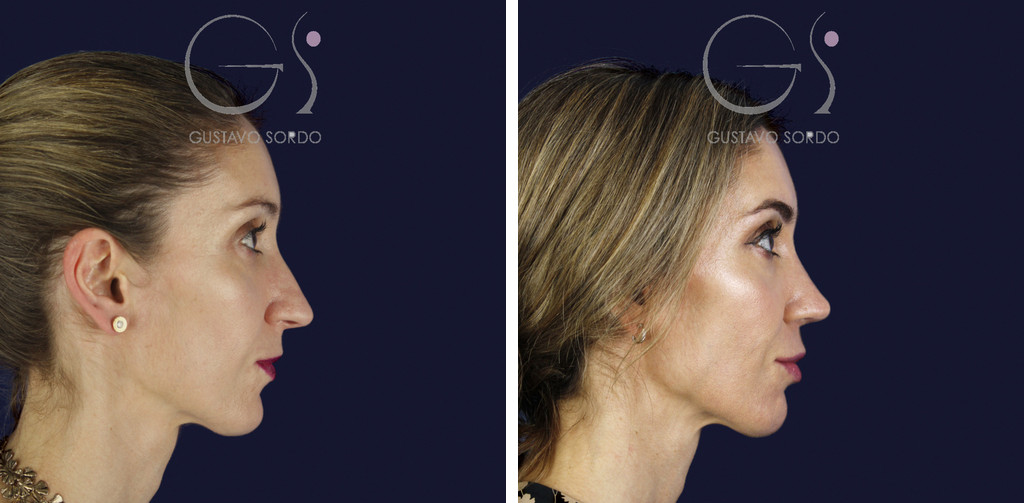
Although simulations are approximate studies of what the outcome might be, the results of the surgery are usually extremely similar to the simulations performed . In this way, patients see themselves reflected in the simulation results after the first few months of post-operative recovery from rhinoplasty, regardless of the type of nose.
All the nose simulations we perform are based on possible modifications that can be made to patients, hence their similarity to the actual result of rhinoplasty.
If you're considering rhinoplasty and would like to try computerized simulation for nose surgery, schedule a no-obligation appointment with Dr. Sordo. At our Plastic Surgery Clinic in Madrid , you'll find Dr. Gustavo Sordo , a plastic surgeon specializing in rhinoplasty . He has over 20 years of experience as a specialist in ultrasonic rhinoplasty in Madrid and is dedicated to providing personalized solutions for each patient, with both an aesthetic and functional focus.
Technology and Technique in Ultrasonic Rhinoplasty
All of these aspects must be analyzed in detail by the surgeon together with the patient, and the maneuvers that must be performed in each case to achieve an optimal result will be explained to the patient.
During this consultation, the patient will also be informed about the technique we use for nose surgery: ultrasonic rhinoplasty . This unique technique utilizes a special piezoelectric scalpel, resulting in more precise reshaping and less trauma, almost completely eliminating bruising.
Reaching an agreement with the patient and having discussed each of the possible modifications is essential when considering rhinoplasty and performing it successfully. Hence, the importance of conducting a thorough aesthetic diagnosis before rhinoplasty.
For any questions about the aesthetic diagnosis before a rhinoplasty in Madrid or any doubts about the procedure, contact the plastic and aesthetic surgeon.
Continue reading
Dr. Gustavo Sordo
Specialist in Plastic, Aesthetic and Reconstructive Surgery. Member No. 282858125.
Content clinically reviewed by Dr. Gustavo Sordo. Last review: September 27, 2026.