Facial lifting and rejuvenation
Deep Plane Lifting: A Complete Guide
Updated on • Reviewed by Dr. Gustavo Sordo, plastic surgeon
The deep plane facelift is the facial lifting technique I've been using for years, and the one I still consider the best for rejuvenating a face without looking like it's been operated on. This article explains what the "deep plane" really is, why the result isn't a "stretched" look, how I perform it, what the evidence says, and what you can expect in terms of recovery, duration, and price. No fillers: what I tell a patient in consultation.
If you are considering this procedure, at facelift in Madrid you can find out how we work, real cases and the price (€15.000-€22.000).
What exactly is the deep plane?
Beneath the skin of the face lies a layer of fibromuscular tissue called the SMAS (superficial musculoaponeurotic system). Beneath the SMAS are a series of retaining ligaments , anchors that attach the soft tissues to the bone: the zygomatic ligament in the cheekbone, the mandibular ligament along the jawline, the masseteric ligaments, and the cervical ligaments. Over time, these ligaments loosen unevenly, and the face doesn't age by sagging uniformly; instead, it droops between the points that remain attached. This is what produces the pronounced nasolabial folds, marionette lines, jowls, and loss of definition in the jawline.
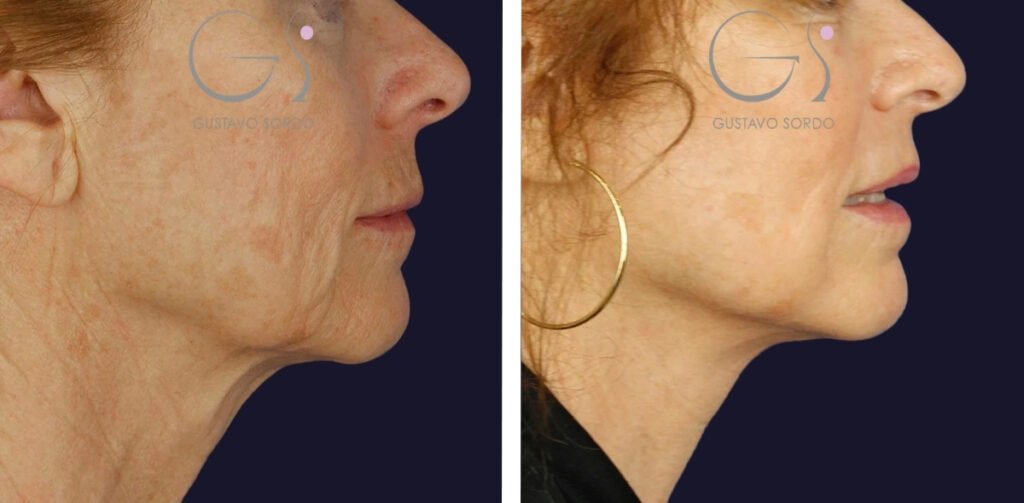
A traditional facelift detaches the skin from the SMAS (superficial musculoaponeurotic system), tightens the SMAS with a few sutures, and removes excess skin. A deep plane facelift does something different: it works beneath the SMAS, releases the supporting ligaments , and mobilizes skin, fat, and SMAS as a single unit—a composite flap that is repositioned upwards, vertically, which is the opposite of the natural aging process. The skin bears no tension: the support is in the deep plane, where it should be.
Why doesn't a "stretched face" look work?
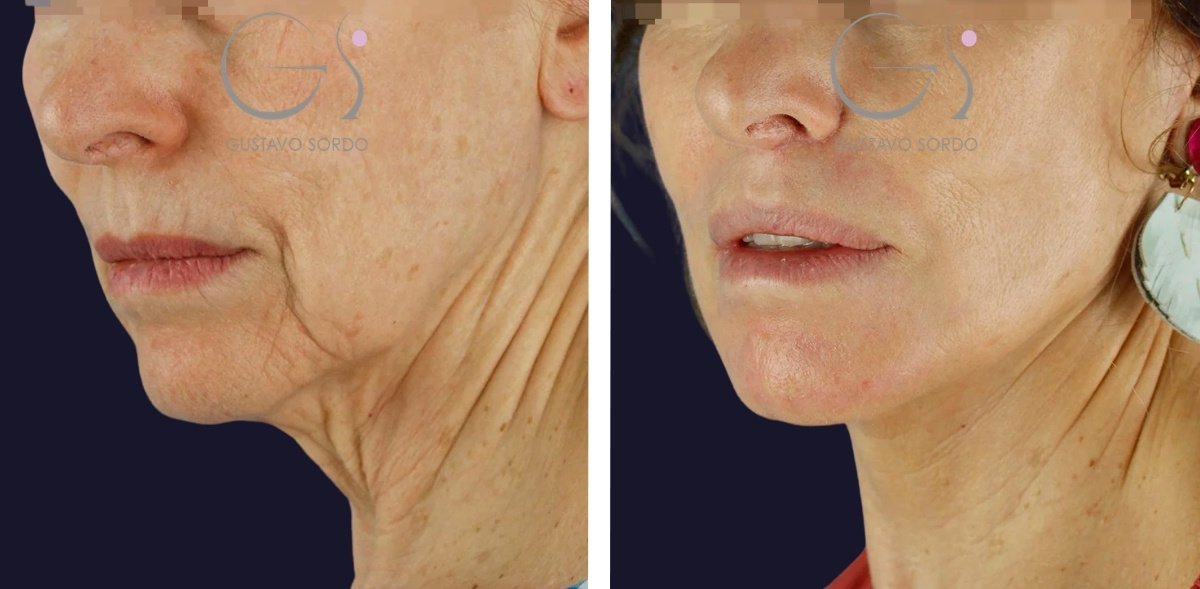
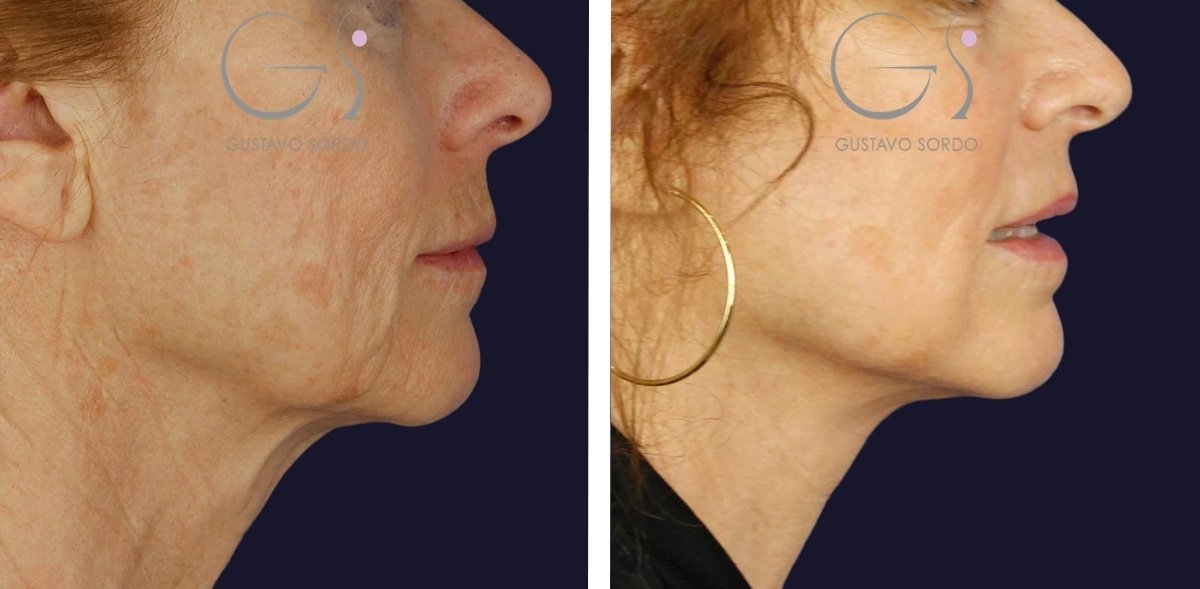
The tight, tense facial appearance that everyone recognizes comes from stretching the skin: skin is the tissue least able to withstand traction; it stretches, the scar widens, and the result is short-lived. In deep plane surgery, the skin is used as an accompaniment. Because the entire structure is repositioned without surface tension, the result is a rested face, with the nasolabial folds softened from within and the oval shape restored, retaining its natural expression. And because the correction is made where the problem lies—in the ligaments—it is more stable over time.
How do I do it?
Limited dissection, in the line of Nayak and Pavani
The deep plane technique has evolved into limited delamination variants , which is the one I practice: only what needs to be released—the ligaments that are pulling—is freed, while the rest is preserved, making the surgery safer and the recovery shorter. I follow the school of thought of Mike Nayak and Juan Pavani, two of the surgeons who have contributed most to this technique. According to PubMed, a 2024 multicenter study, in which Nayak himself participated, involving nearly 4.000 patients operated on with this variant, documented a revision rate of 0,8% and fewer skin alterations (Roskies M et al. Facial Plast Surg Aesthet Med . 2024, DOI ).
The neck is included: the platysma
Much of what patients perceive as an aged face is actually in the neck: the angle between the jaw and the neck is lost, and double chins and bands appear. In deep plane neck lifts, the neck is not an add-on; it's part of the same procedure: the platysma , the flat neck muscle, is treated and repositioned along with the rest of the neck. A properly treated neck is what makes the result visible from the side, not just the front.
Volume, eyelids and eyebrows in the same surgery
The face doesn't just sag; it also loses volume. Repositioning without restoring volume results in a taut but aged appearance, which is why I almost always combine deep plane surgery with lipofilling —using the patient's own fat—in the cheekbones, temples, or nasolabial folds. And very often, I combine it with blepharoplasty and a brow lift, whether a direct brow lift or an endoscopic forehead lift, because a face with a youthful lower third and a tired-looking appearance simply isn't harmonious. Everything is planned in the same consultation and, when appropriate, performed under the same anesthesia.

What the evidence says, with its two sides
According to PubMed, the most recent meta-analysis comparing deep plane plasty with SMAS facelift, based on 21 studies and 2.896 patients, found a 94,4% satisfaction rate with deep plane plasty versus 87,8% with SMAS facelift, concluding that both techniques yield solid and lasting results. However, the same study reported a higher overall complication rate with deep plane plasty, 17,2% compared to 10,3%, most of which were minor (Khoury S et al. Aesthetic Plast Surg . 2025, DOI ). I mention this because it's the truth about this technique: it's more demanding, involves working close to the branches of the facial nerve, and requires a thorough understanding of facial anatomy. In return, it delivers the most natural-looking results I know how to achieve. It's a surgery best performed by someone who regularly performs it.
Who it's for, and who it's not for.
This procedure is indicated when the problem is sagging skin : drooping cheeks, pronounced nasolabial folds and marionette lines, a blurred jawline, a double chin, and a flabby neck. It's usually recommended after age 45-50, but age isn't the determining factor; some 42-year-olds have more sagging than 58-year-olds. It's not the surgery for mild sagging or for those seeking only volume or improved skin texture: there are less intensive solutions for those cases. And it doesn't address other issues: blemishes, fine wrinkles, and skin quality are treated separately.
One piece of advice I always give: if you've had hyaluronic acid fillers for years , mention it during your consultation. That material is still in your face and it's advisable to treat it with hyaluronidase before surgery.
What is the operation and recovery like?
It is performed under general anesthesia in the hospital and is a lengthy surgery, lasting several hours, especially if combined with eyelid surgery, eyebrow augmentation, or lipofilling. The incisions are made in front of the ear, following its natural creases, and behind it, towards the scalp. When the neck is also treated, a small incision is added under the chin. Over time, these incisions become hidden within the skin folds and hairline.
In the first few days, there is swelling and some bruising, and a feeling of tightness is normal. Most patients are presentable for social life within two to three weeks, with any remaining swelling subsiding during the first month. The final result settles over the following months as the tissues settle and the scars mature. Our advice remains the same as always: keep your head elevated while sleeping, avoid strenuous activity and direct sunlight for the first few weeks, and refrain from smoking.
How long does it last
You'll see "10-15 years" quotes everywhere. Be honest about that number: there are no studies that accurately measure the duration of a facelift, because following patients beyond three years is difficult even for large research groups (Rohrich RJ, Narasimhan K. Plast Reconstr Surg . 2016, DOI ). What we do know is that the correction in the deep plane lasts for years, that a well-treated neck, with the platysma muscle worked along the midline, is less prone to sagging, and that faces with more fat in the neck tend to sag sooner. A facelift doesn't stop aging: it restarts it from a much younger position, and from there, aging continues normally. What I can say is that a well-done deep plane facelift doesn't need to be "repeated" after just a few years.
Risks and scars
The risks of any facial surgery include hematoma, infection, scarring problems, and temporary sensory disturbances. This technique also carries its own specific risk: the proximity of the facial nerve branches, which requires careful dissection. Any weakness that may occur is almost always temporary. Scars remain around the ear and in the hairline; they appear pinkish for the first few months and gradually blend into the skin folds.
Price of a deep plane facelift in Madrid
At our clinic, a deep plane facelift ranges from €15.000 to €22.000 , depending on whether it treats only the face and neck or includes the forehead, eyebrows, and eyelids. The price includes the operating room, anesthesia, hospital stay, and follow-up appointments, and is finalized during a consultation to discuss your specific case.
FAQ
What is the difference between a deep plane and a SMAS facelift?
The SMAS tightens the fibromuscular layer from above; the deep plane inserts beneath it, releasing the ligaments that support the tissues and repositioning the entire structure. The result is more natural in the mid-face and nasolabial folds, where the SMAS falls short.
At what age?
When there is sagging that needs correcting, it's usually from age 45-50 onwards. Anatomy dictates more than age.
Can it be combined with other surgeries?
Almost always: lipofilling, blepharoplasty, brow lift, and in some cases, rhinoplasty. The procedure is decided during the same consultation.
When can I resume my normal life?
Social life after two or three weeks; gentle exercise from the third or fourth week onwards and intense sport later on, depending on how the recovery goes.
The deep plane facelift is a surgery that requires specific training and ongoing practice. From November 11th to 13th, 2026, Dr. Mendieta and I attended the Madrid Deep Plane Facelift Masterclass , three days of live surgery and cadaver lab dedicated entirely to this technique: it's where everything I've told you here was discussed. If you're considering a deep plane facelift in Madrid , schedule an appointment at the clinic and we'll see it on your face, not just on a brochure.
Continue reading
Dr. Gustavo Sordo
Specialist in Plastic, Aesthetic and Reconstructive Surgery. Member No. 282858125.
Content clinically reviewed by Dr. Gustavo Sordo. Last review: September 27, 2026.