Nasal Stenosis: What It Is and How It Is Treated

Reviewed by Dr. Gustavo Sordo, plastic surgeon
When a patient tells me, “I can’t breathe properly through my nose,” my first step isn’t to assume it’s a stenosis, but rather to find out exactly what’s going on. Nasal stenosis is a structural narrowing that makes it difficult for air to pass through, and it can easily be mistaken for allergy-related congestion or simple rhinitis. In this article, I’ll explain how I distinguish between the two, what types of stenosis exist, and how I treat them, both medically and surgically.
If stenosis makes it difficult for you to breathe and you want to know how we address it, on the rhinoplasty page in Madrid you have the process, the cases and the price (€10.040, fixed price and all inclusive).
If you want to see how your nose would look , here are real cases sorted by nose type and a simulation of the consultation next to the result.
What is nasal stenosis?
Nasal stenosis is a structural narrowing of part of the nasal airway that restricts airflow. It is not the same as obstruction due to congestion—caused by inflammation of the mucous membrane—nor is it simply a temporary feeling of blockage: stenosis involves a structural problem, not just inflamed mucous membrane, and can affect one or both nostrils depending on its cause and location.
How do I distinguish between a true stenosis and a congestion?
When a patient comes to the consultation with respiratory difficulty, the first thing I do is examine him carefully and apply several tests.
The Cottle test involves gently pulling the lateral wall of the nose, at the level of the upper lateral cartilages, and observing whether it improves obstructive symptoms. A positive result suggests an internal valve problem that could be improved with preservation techniques or spreader grafts. However, it is important to be honest: recent scientific evidence indicates that the Cottle test, used alone, has a very high false-positive rate. According to PubMed, a study with 100 healthy volunteers—without any nasal valve problems—found that 97% reported subjective improvement in breathing with the classic Cottle test, and 98% with the modified Cottle test, which calls into question its validity as a standalone diagnostic test ( Das & Spiegel, 2020 ). Another study found low test-retest reliability for the classic Cottle test, with no significant association with the NOSE symptom scale ( Ziai & Bonaparte, 2018 ). That's why, in my practice, I never use the Cottle test as the sole test: I always combine it with the rest of the examination.
Vertical compression test. This is a different maneuver in which we manually apply vertical compression to the lower lateral cartilages (also called alar cartilages). This maneuver simulates the compression we generate when performing tip plasty to improve a bulbous nasal tip. If the patient's symptoms improve with this test, it suggests pathology related to the external nasal valve, and tip plasty—of the type I describe later—could significantly improve their breathing.
Endoscopy with a 2 mm camera. We use a portable 2 mm endoscopic camera to study the inside of the nose and detect vomerine spurs, septal deviations, bony ridges, or septal perforations.
Rhinomanometry. In selected cases, when we need to accurately determine where and how the obstruction is, we use the rhinomanometer we have in the office.
Seasonal clinical history. If the symptoms are seasonal, with a history of pollen allergy, rhinitis with constant runny nose and a good response to topical vasoconstrictors, it is more likely that we are dealing with allergic or vasomotor rhinitis, which requires a completely different management than that of a structural stenosis.

Types of nasal stenosis
Depending on its location, I distinguish between stenosis of the nasal vestibule, of the internal valve, of the external valve, cicatricial stenosis of the nasal entrance, and posterior or choanal stenosis. Based on its behavior, it can be static (constantly present) or dynamic (appearing or worsening upon inspiration, due to collapse of the lateral wall).
In my practice in Madrid, the most frequent condition I see is external valve pathology, which is clearly manifested by the vertical compression test I described earlier. This mechanism is described by Baris Çakir in his seminal book on rhinoplasty, published by Springer. I also frequently see noses with a very high dorsal bridge, which tend to be somewhat stenotic in the internal valve. By reducing this bridge with preservation techniques, the dorsum widens slightly, and the internal valve expands on its own. With structural techniques, spreader grafts perform the same function of reinforcement and expansion.
Causes of nasal stenosis
I see many cases of stenosis in secondary surgeries, where the internal valve has narrowed as a result of a previous open-roof rhinoplasty that wasn't reconstructed with sufficient structure. In these cases, my work involves laminating rib grafts using the Eren Taştan technique to reinforce the internal valve with rigid, resistant, and durable material, using hyperbaric oxygen therapy for the first five days at the Moncloa Clinic to increase graft survival.
Traumatic noses with deviations are also very common, and these can render one nostril unusable or severely reduce its functionality. With preservation rhinoplasty, we correct these deviations better than ever before: foundational low-strip techniques are the most effective in these cases.
Finally, it is surprisingly common to find a vomerine spur that the patient was completely unaware of — it is a common finding during surgery, and many patients are especially grateful that we have removed it, because they notice an improvement in breathing that they did not expect.
Problems that may resemble a stenosis
Not all breathing difficulties are structural stenosis. Turbinate hypertrophy, deviated septum, allergic or vasomotor rhinitis, nasal polyps, synechiae within the nasal cavity, and septal perforation can produce very similar symptoms without being, strictly speaking, stenosis. Hence the importance of a thorough examination before considering any treatment.
Non-surgical treatments
Nasal irrigation, topical corticosteroids (when rhinitis is present), external dilating strips, and internal nasal dilators can relieve symptoms, especially when there is an associated inflammatory component. However, it is important for the patient to understand that these measures do not correct a scar or structural weakness: they relieve symptoms, not resolve the underlying cause.
When does nasal stenosis require surgery?
When the obstruction persists despite medical treatment, when there is visible collapse of the lateral wall, scarring that reduces the vestibule, functional impairment after a previous rhinoplasty, or stenosis associated with septal deformity.
Best surgical treatments for nasal stenosis
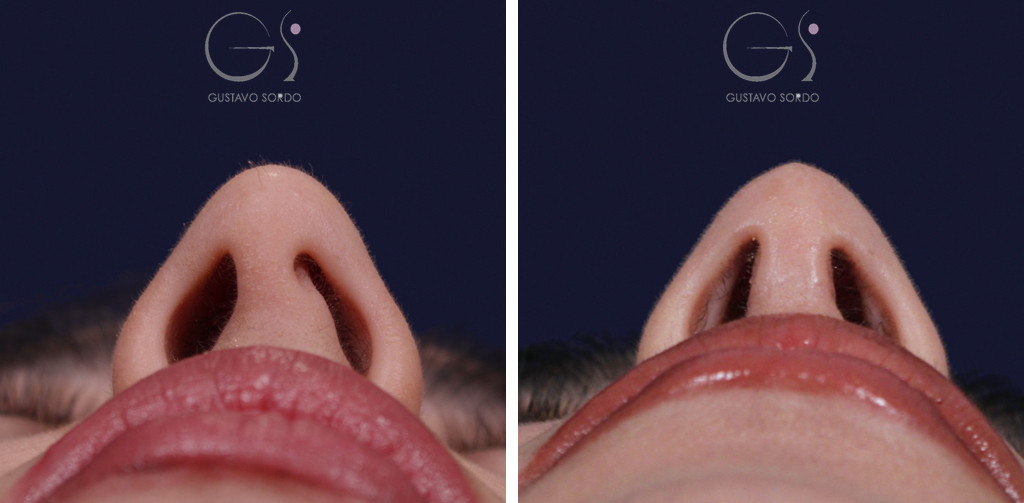
For the internal valve, my first choice is preservation techniques, which respect the keystone area and naturally widen it by reducing the hump downwards: the shoulders of the upper lateral cartilages are slightly opened, like an umbrella, enlarging the area. This makes preservation rhinoplasty particularly interesting from a functional standpoint. In cases where preservation is not possible, we recommend spreader grafts, which have proven highly effective in reinforcing this area.
For the external valve, we are very pleased with the results of the "armadillo" tip plasty, described by Froilán Páez, Cristian Cordero, and other authors. This technique allows for the tensioning and positioning of the lower lateral cartilages at a resting angle, optimizing their resistance to airflow. According to PubMed, Páez and Cordero have co-published on anchored support systems for alar rim stability ( Páez Salazar et al., 2026 ), confirming their active work in this type of structural support for the nasal tip. Before considering this surgery, a vertical compression test is essential to inform the patient about how their breathing will feel after the procedure.
Other surgical tools include scar release and vestibule enlargement, Z-plasty and local flaps, composite skin and auricular cartilage grafting, alar batten grafts to reinforce the lateral wall, anterior septum reconstruction, valve suspension sutures, and, in selected cases, temporary stents or conformers to prevent further scar contraction.
Breathe again with a nasal reconstruction by Dr. Gustavo Sordo
If you notice that you have difficulty breathing through your nose and you don't know if the origin is structural or inflammatory, I invite you to evaluate it together in a consultation, with endoscopy and the necessary tests to find the exact cause.
Make an appointment with Dr. Gustavo Sordo
Frequently Asked Questions (FAQs)
Is nasal stenosis the same as a deviated septum?
Not always, although they can coexist. A deviated septum is a common cause of stenosis, but it can also occur due to scarring or collapse of the lateral wall without septal deviation.
How can I tell if the blockage is in the nasal valve?
The vertical compression test and the Cottle test are helpful, although they should never be interpreted alone; they are always combined with endoscopy and, in selected cases, rhinomanometry.
Can nasal strips correct stenosis?
They temporarily relieve the symptom, but they do not correct a scar or a structural weakness.
What graft is used to open a narrowed nasal valve?
Spreader grafts are the most common option for the internal valve; alar batten grafts and structural tip plasties are mostly used for the external valve.
Can stenosis occur after rhinoplasty?
Yes, especially when an open roof remains unreconstructed after hump reduction in a previous surgery.
How long are nasal stents used?
It depends on the specific case and the technique used; it is assessed individually.
Can nasal stenosis recur after surgery?
It is possible if the original cause is not completely resolved, so postoperative follow-up is important.
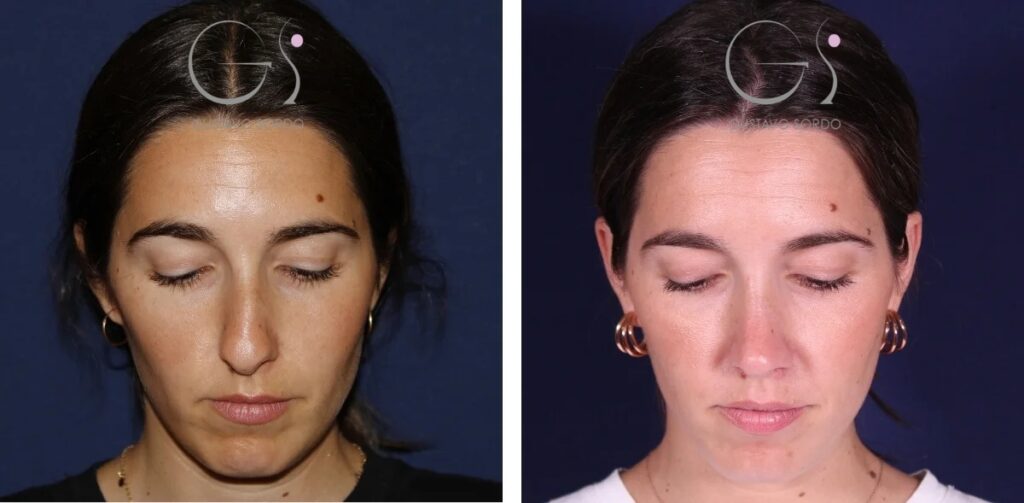
If you want to see what a nose looks like when the structural problem is truly corrected, you can check out real before-and-after cases of deviated septum and turbinate surgery.
Conclusion
Nasal stenosis is a structural problem that isn't always easily distinguishable from congestion or allergies, which is why diagnosis requires a combination of tools: manual examination, endoscopy, and, when necessary, rhinomanometry. Effective treatment demands determining whether the problem lies in the internal valve, the external valve, or both, and choosing between preservation techniques, spreader grafts, or structural tip plasty depending on the individual case. The ultimate goal is always the same: to help you breathe normally again.
Continue reading
Dr. Gustavo Sordo
Specialist in Plastic, Aesthetic and Reconstructive Surgery. Member No. 282858125.
Content clinically reviewed by Dr. Gustavo Sordo. Last review: November 14, 2026.