Rhinomodelling: What it is, Duration, Price, Advantages and Disadvantages

Updated on • Reviewed by Dr. Gustavo Sordo, plastic surgeon
In the search for options to improve the appearance of the nose, we come across rhinoplasty without surgery, popularly known as non-surgical rhinoplasty . This non-surgical technique uses dermal fillers to correct minor aesthetic imperfections, resulting in a more harmonious nose that is in proportion to the rest of the face.
Before we continue: at Dr. Sordo's clinic , we don't perform rhinoplasty without surgery, and we'll explain why —fillers aren't always reabsorbed, the nose is the area of greatest vascular risk on the face, and it doesn't change the structure. This article explains the technique so you know what it involves.
If you're looking for a permanent change in the shape of your nose, surgery is the option: here we tell you how we approach rhinoplasty in Madrid , what ultrasonic rhinoplasty involves , and who the specialist rhinoplasty surgeon is who would operate on you.
What is rhinomodeling?
Rhinoplasty without surgery is a non-surgical procedure that changes the shape of the nose using dermal fillers . Hyaluronic acid is typically used ; it's a naturally occurring substance found in the body, and it's reabsorbable and reversible. Results last approximately 6 to 18 months, depending on individual metabolism and the quality of the hyaluronic acid used.
Another product used in this procedure is calcium hydroxylapatite , and among its benefits is that it stimulates collagen production in the treated area, which helps improve skin firmness over time. Its results can last between 12 and 24 months, making it an attractive option for those who want a longer-lasting effect. It's important to note that this material is not reversible, so the procedure must be performed by a highly trained professional.
Rhinoplasty without surgery is performed in the office and helps to correct and enhance the shape of the nose, achieving greater facial harmony. This procedure is ideal for people who want to correct minor imperfections without undergoing surgery. Rhinoplasty without surgery reshapes the nose, lifting the tip and refining the bridge.
How is it the procedure?
The rhinoplasty procedure is relatively quick and is performed in the office. First, the patient's medical history and possible general illnesses are assessed; a complete examination of the facial area, specifically the nose, is performed.
Doctor and patient discuss their expectations, so that it is clear that rhinoplasty substantially improves the appearance of the nose, but does not make it smaller. Afterwards, photographs are taken to compare the long-awaited before and after.
The treatment begins with a thorough cleansing of the area to remove traces of cosmetics and make-up. An anaesthetic ointment is then used to prevent discomfort for the patient. After a few minutes, microinjections are made to shape the nose, depending on the effect desired by the patient. This may include elevating the nasal bridge, correcting a hump or sharpening the tip. The treatment is usually relatively quick, taking between 15 and 30 minutes.
Difference between rhinoplasty and rhinomodelling
Although both procedures share the goal of improving the appearance of the nose, they differ in their nature and approach. While rhinoplasty is a surgical procedure requiring general anesthesia, incisions, and a recovery period that can range from weeks to months, non-surgical rhinoplasty is a non-surgical procedure that uses dermal fillers to temporarily modify the shape of the nose. The results are immediate, with a quick recovery and no need for general anesthesia.
You might be interested in: Rhinoplasty or Rhinomodelling?
It's important to understand a technical limitation of rhinoplasty without surgery: since it involves filling, it can only add volume, never remove it. Therefore, if the goal is to reduce a nasal hump or bump, rhinoplasty without surgery doesn't eliminate it, but rather conceals it by augmenting the rest of the bridge above and below the defect to even out the profile. It's a camouflage technique, not a reduction one, and this should be clear before deciding if it's the right option for each individual case.
How do I know if I am a candidate?
Rhinomodelling is a suitable option for older people who have fully developed their face and who wish to correct minor defects in the shape of their nose, such as irregularities in the nasal tip or nasal dorsum. However, it is not suitable for cases requiring major structural changes.
It is essential to consult with a specialized plastic surgeon, who will evaluate your particular case and determine if rhinoplasty is the most appropriate option.
How long does it last?
Since hyaluronic acid is a naturally occurring substance that the body assimilates over time, the results of rhinoplasty are temporary, lasting between 6 and 18 months , depending on the technique used and the patient's individual characteristics. To maintain the results, it is recommended to have maintenance sessions periodically.
Rhinomodelling price 2026
In Spain, the price of rhinoplasty (nonsurgical rhinoplasty) generally ranges from €300 to €800 per session, depending on the surgeon's experience, the clinic's location, and the type of materials used. It's important to note that, in some cases, additional touch-up sessions may be required to achieve the desired result. This would obviously increase the cost and the time commitment, as it would necessitate more frequent follow-up appointments.
What does the nose look like after rhinoplasty?
One of the greatest advantages of rhinoplasty without surgery is that the results are subtle and reversible , and are immediately visible after the treatment. This procedure lifts the nasal tip, reshapes the nose, and straightens the bridge of the nose to improve its appearance.
In some cases, some bruising, swelling, or redness may appear at the injection site. While the results are immediate , the final effect may take a few days to appear as the material settles and the tissue adapts. However, this does not prevent the patient from resuming their normal daily activities. The final results can be seen from the third day onward.
Care after rhinoplasty
Although rhinoplasty is not a surgical procedure, it still requires a series of precautions to ensure proper recovery and obtain optimal results:
Avoid touching or massaging your nose
It is important to avoid touching or pressing on your nose in the first few hours after the procedure. Also, avoid blowing your nose vigorously at all costs, as this could affect the results. Neglecting these recommendations can alter the positioning of the injected material.
Do not expose yourself to the sun
It is advisable to avoid direct exposure to the sun for at least a week, and to use sunscreen if you go outdoors.
Avoid intense physical activities
To prevent injury or complications in the treated area, avoid strenuous physical activity or contact sports for at least two weeks after the procedure.
Maintain good hydration
Make sure you drink enough water daily, this helps your skin recover.
Consult a doctor for any unusual symptoms.
If breathing problems or persistent discomfort occur, it is important to consult a doctor.
Others
Sleep with your head elevated for the first few days, avoid alcohol and smoking or exposure to tobacco smoke, and do not wear glasses or goggles that press on your nose for the first few weeks.
Benefits of rhinomodelling
Rhinoplasty offers a number of benefits that make it an attractive option for those who wish to improve the appearance of their nose without undergoing invasive surgery. Some of its benefits include:
Effective and natural results
The results are visible immediately after the treatment, and the nose is shaped and lifted naturally.
Quick procedure
Rhinomodelling is performed in a short time, recovery is rapid, allowing patients to resume their daily activities almost immediately.
No visible scars
No incisions are required, therefore there are no visible scars.
Personalization.
Rhinomodelling allows the shape of the nose to be adjusted precisely and in a personalized manner, according to the needs and desires of the patient.
What are its disadvantages?
Despite its numerous benefits, rhinoplasty also has some disadvantages that should be considered before deciding on this procedure:
temporary results
The results of rhinoplasty are usually temporary, which means that periodic maintenance is required.
Not suitable for major corrections
Rhinoplasty is suitable for correcting small imperfections in the nose, but it is not recommended for cases of marked deformities or deviations or for every type of nose.
Possible side effects
Although they are usually mild, they may include redness, swelling, bruising, infection, or allergic reactions to the materials used.
It is important to be aware of these disadvantages and discuss them with your doctor before undergoing rhinoplasty.
What isn't always talked about: the long-term problems with hyaluronic acid
As plastic surgeons, we are increasingly encountering a problem that rhinoplasty clinics don't always explain to patients: a significant portion of the hyaluronic acid injected into the nose is never fully reabsorbed. When we surgically examine these patients, it's common to find areas of low tissue perfusion, meaning poorly vascularized tissue, as a result of repeated injections over the years. This isn't just our clinical observation: the scientific literature describes vascular complications associated with nasal fillers, ranging from ischemia and skin necrosis to septal ulcers, precisely because of the complex vascular network of the nose (Nguyen et al., 2021, J Cosmet Laser Ther ; Caranti et al., 2025, Aesthetic Plast Surg ).
This has a very real consequence: many patients who have been getting nose injections for years end up wanting to resolve their problem permanently with rhinoplasty, and at that point we are faced with more fragile and poorly vascularized tissue, with a greater risk of infection and skin necrosis during surgery. A recent systematic review on non-surgical rhinoplasty in patients who have already undergone previous surgery confirms an increased risk of skin necrosis in this context (Santamaría-Gadea et al., 2024, Facial Plast Surg Aesthet Med ).
Furthermore, there is a technical limitation that is often not well explained: non-surgical rhinoplasty can only add volume, never remove it. This means that, in the case of a nasal hump or bump, hyaluronic acid does not eliminate it, but rather camouflages it by augmenting the nose above and below the defect, which can sometimes make the nose appear larger overall. It also does not resolve any respiratory or functional problems, something that rhinoplasty can address when there is associated pathology of the septum or turbinates.
Another added risk is that, due to embarrassment or lack of awareness, some patients don't tell us during their initial consultation that they've been getting nose injections for years, which is crucial information for safely planning any subsequent surgery. At our clinic, we include every patient who has undergone rhinoplasty (non-surgical rhinoplasty) in a pre-operative protocol with hyaluronidase, generally at least two sessions, to remove as much residual hyaluronic acid as possible before surgery, although we acknowledge that in many cases it's impossible to eliminate it completely. Only after this protocol do we proceed with the surgery.
With all this information on the table, our honest recommendation is that, except for very specific and temporary adjustments, rhinoplasty offers a more definitive solution with fewer accumulated long-term risks than rhinoplasty performed repeatedly or extensively, and we believe that these drawbacks should be explained more clearly in consultations where rhinoplasty is performed routinely.
The nose is the area of greatest risk on the entire face
This is not an opinion: it is what emerges from counting published cases. In a review of ocular complications from fillers, the highest-risk procedure was rhinoplasty , followed by frown lines, and in the last three years analyzed, 35% of reported cases were nasal injections . There were no reported cases of injections in the temple or chin ( Lee W et al. J Cosmet Dermatol. 2019;19(4):772-781 ).
And the group is not small: a review of the world literature compiled 233 cases of visual loss after facial filler infiltration , with 172 patients experiencing severe visual impairment in at least one eye . The typical presentation is sudden eye pain, drooping eyelid, and limited eye movement due to vascular occlusion ( Kato JM, Matayoshi S. Arq Bras Oftalmol. 2022;85(3):309-319 ).
The reason is anatomical. The arteries of the nose originate from the internal carotid artery and connect to the eye's circulatory system. If material is forced into one of these arteries, it can travel in the opposite direction to the ophthalmic artery. This is compounded by what I've already mentioned: infection, vascular compromise, and necrosis of the skin on the tip and bridge of the nose , an area with very little margin of safety.
And the claim that it "is absorbed in a year" should be taken with a grain of salt.
It is sold as reversible and temporary. A study that reviewed 33 patients infiltrated in the mid-face using magnetic resonance imaging found product in all 33 , without complete disappearance after two years; 21 had gone between two and five years without injections, twelve had gone more than five, and in some cases filler was detected up to fifteen years later ( Master M et al. Plast Reconstr Surg Glob Open. 2024;12(7):e5934 ).
That study is about the cheekbone, not the nose, and that needs to be said. But the underlying idea remains: hyaluronic acid doesn't completely disappear just because the brochure says so . And in a nose, what's left isn't just an aesthetic detail: it's tissue I'm going to encounter when I have to operate, with layers adhered, fibrosis, and a more difficult dissection.
If you've already put it on
Don't panic: most non-surgical rhinoplasty procedures are trouble-free. However, it's important to know that hyaluronidase , the enzyme that dissolves hyaluronic acid, is the only emergency treatment if the product gets into the wrong area. It needs to be used within minutes, not the next day. We always have it available at our clinic.
And if you notice disproportionate pain in the hours following an injection, if your skin turns white or mottled, or if you notice anything strange in your vision, that's not a bruise: it's an emergency.
Clinical opinion of Dr. Gustavo Sordo, plastic surgeon, member no. 282858125.
Frequently asked questions about rhinoplasty
Is the procedure painful?
The procedure is performed under local anesthesia or by applying an anesthetic cream to the treatment area, minimizing discomfort. Most patients describe the sensation as a slight pressure or sting.
How long does recovery take?
Recovery from rhinoplasty is so rapid that most patients can resume their daily activities almost immediately, although they should avoid strenuous physical activity and sun exposure for at least 48 hours. Swelling and bruising may last a few days, and final results are noticeable after a week.
Can I bathe after rhinoplasty?
Yes, you can bathe after a rhinoplasty, but avoid hot water in the treated area for the first 24-48 hours. A warm bath is adequate, and it is important not to wet your face directly for the first few days to allow the area to heal properly.
What risks does it have?
As with any cosmetic procedure, rhinoplasty has some risks, although they are rare; these include allergic reactions to the filler material, asymmetry, infections, the formation of nodules on the skin, or tissue necrosis due to poor injection technique.
Ultrasonic Rhinoplasty vs. Rhinomodelling: Which is the best option??
Ultrasonic rhinoplasty is an innovative technique that modifies the shape and structure of the nose. It allows for adjustments to the nasal bone structure, correcting a drooping tip, deviating the septum, or reducing the size of the nostrils. The procedure is performed with greater precision and predictability thanks to the use of ultrasound. Therefore, this procedure is more suitable for any type of nose, and one of its most significant advantages is that the results of ultrasonic rhinoplasty are permanent and do not require further touch-ups.
Rhinoplasty, on the other hand, is perfect for those types of patients who are looking to modify small imperfections or who want a slightly subtle and temporary change to their nose without undergoing surgery or going through the operating room. This technique is quick and painless, but it does not guarantee the same results as ultrasonic rhinoplasty. It cannot correct structural or functional problems of the nose.
At our Plastic Surgery Clinic in Madrid , you will find Dr. Gustavo Sordo , a plastic surgeon in Madrid specializing in rhinoplasty . He has over 20 years of experience as a specialist in rhinoplasty and ultrasonic rhinoplasty in Madrid, and is dedicated to offering personalized solutions for each patient, with both an aesthetic and functional approach.
Furthermore, at our Plastic Surgery Clinic in Madrid , thanks to a computerized rhinoplasty simulator, we can make the best decision for your health and well-being. We recommend you take a look at all their before and after rhinoplasty cases.

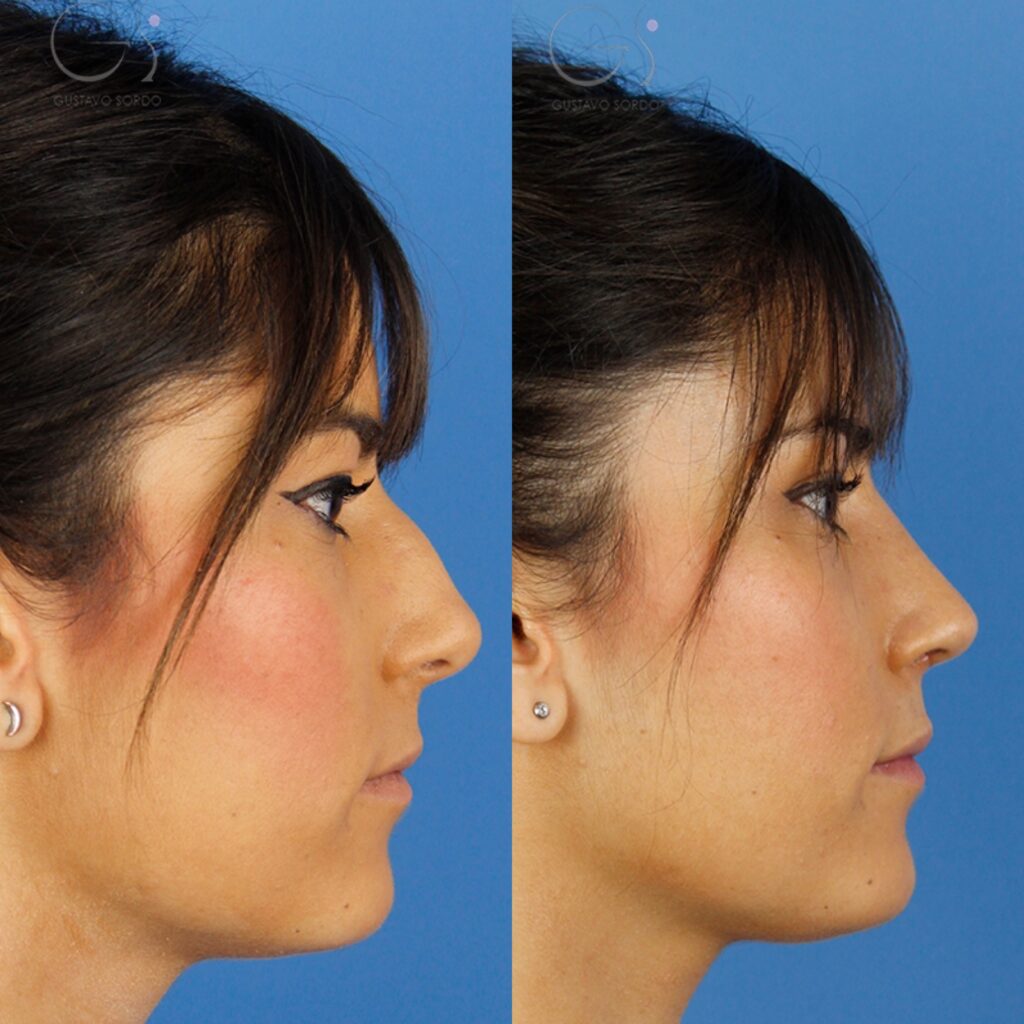
In our experience, when the patient's goal is a definitive and lasting correction, especially if there is also a respiratory or functional component, rhinoplasty remains the safest long-term option. Non-surgical rhinoplasty is a useful tool for specific and temporary adjustments, but it's important to fully understand its limitations before making a decision, particularly if it's being considered as a recurring alternative rather than a one-off solution.
Conclusion
Rhinoplasty is an attractive, minimally invasive option for those who wish to improve the appearance of their nose without the risks and expense of surgery. The effects are immediate and natural, with no long recovery periods, making it an ideal alternative for minor cosmetic corrections.