Open or Closed Rhinoplasty: Which is right for me?

Updated on • Reviewed by Dr. Gustavo Sordo, plastic surgeon
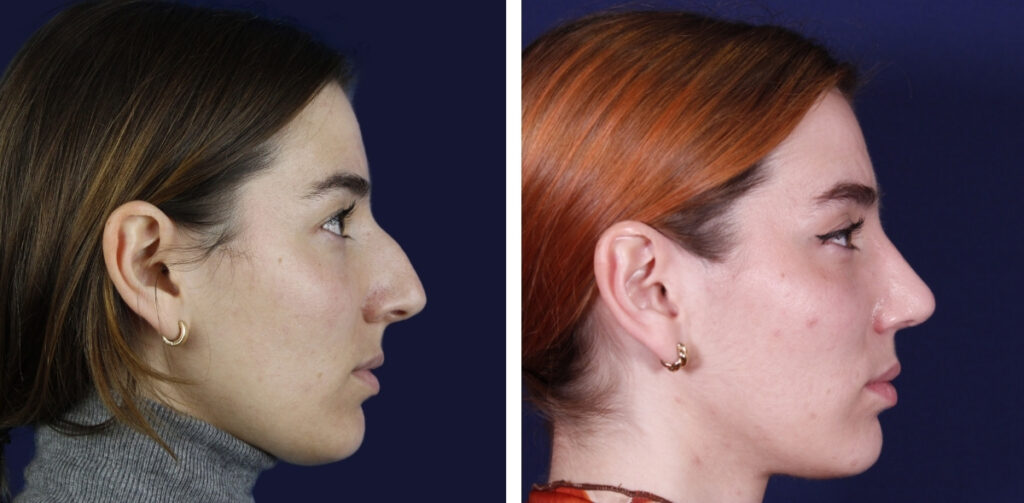
If you want to see how your nose would look , here are real cases sorted by nose type and a simulation of the consultation next to the result.
Open rhinoplasty: in which cases it is appropriate
The fundamental difference between open and closed rhinoplasty lies in how the inside of the nose is accessed. While open rhinoplasty involves a small incision at the base of the nose to lift the skin, closed rhinoplasty is performed from inside the nose, through the nostrils , without the plastic surgeon having a direct view of the area being operated on. If you're considering it, here's how we perform it at our clinic, what it includes, and how much it costs: rhinoplasty in Madrid.
In cosmetic surgery, we understand that when performing rhinoplasty, it's best to carry out all the necessary procedures to achieve optimal nasal function while simultaneously addressing all the aesthetic concerns the patient wishes to correct. Therefore, we recommend an open rhinoplasty, as it allows the plastic surgeon to directly visualize all the tissues and thus modify the nose more precisely.
When we have to do work on the tip of the nose, open rhinoplasty is usually more advantageous , as it allows us to measure with millimeter calipers, symmetrize, equalize... in short, be much more precise when modifying the nasal tip, because it is better handled in an open manner.
When there is a need to remove a very large nasal hump, it is usually best to perform an open rhinoplasty. With this type of nose surgery, in addition to allowing for greater precision, we can place spacer grafts on the bridge of the nose to avoid the aesthetic consequences of removing a large hump , such as the inverted "V" deformity, which is quite common when a hump is removed without the placement of spacer grafts.

My opinion, after many years of performing both procedures, is that the open versus closed approach debate is somewhat overrated. The columellar scar from the open approach is barely visible after a year, so the real debate isn't about aesthetics but about support . The open approach requires cutting ligaments, and if they aren't reconstructed properly, tip projection can be lost over time—up to 20% in older techniques with a columellar post. That's why, when we perform open surgery, we always restore support with a double vertical septal extension graft and the horizontal component of the Armadillo Tip (Froilán Páez).
In practice, we choose based on the procedure: if the work primarily involves the dorsum and can be resolved with preservation —lowering the bridge en bloc through impaction—the closed approach is ideal and the postoperative period is more manageable. If a complex tip needs to be reconstructed, a subtle asymmetry corrected, or it's a secondary rhinoplasty, the open approach offers a level of control that the closed approach cannot. The important thing is that the surgeon is proficient in both techniques and chooses based on anatomical criteria, not on habit.
Closed rhinoplasty: in which cases it is appropriate
From our point of view, closed rhinoplasty is used for cases where only a dorsum needs to be reduced discreetly, without creating a large bridge, and for rhinoplasties that do not require very complex tip manipulation.
Therefore, we reserve closed or endonasal rhinoplasty for simple cases where only a slight reduction of the bridge and narrowing of the nose are necessary. In other words, cases that do not require overly complex work on the nasal tip. Similarly, we reserve closed rhinoplasty for minor touch-ups or refinements of previous open rhinoplasties that require a small adjustment to correct a minor imperfection or irregularity remaining from the initial procedure. This is an infrequent situation that may arise in exceptional cases , for example, in complex rhinoplasties requiring numerous modifications.

We recommend you take a look at all our before and after rhinoplasty cases.
Comparative advantages and disadvantages of each technique
To make an informed decision about which rhinoplasty technique is most appropriate, it is essential to objectively understand the advantages and limitations of each surgical approach.
Advantages of open rhinoplasty:
- Full live display: The surgeon can view all nasal structures unobstructed, allowing for accurate assessment of the anatomy and necessary modifications.
- Millimeter precision: Possibility of measuring and adjusting with precision instruments, especially crucial in nasal tip work
- Surgical versatility: It allows performing all types of maneuvers, from the simplest to the most complex, including structural grafts.
- Better symmetry control: Direct vision facilitates comparison and balance between both sides of the nose during surgery.
- Access for grafts: Facilitates precise placement of cartilage grafts when needed to maintain or create structural support
Disadvantages of open rhinoplasty:
- External incision: Although minimal, there is a small scar on the columella that may concern some patients.
- Greater initial inflammation: Lifting the skin may cause more swelling in the first few weeks, especially at the nasal tip.
- Surgical time: It generally requires a little more operating time due to the exposure and subsequent closure of tissues.
Advantages of closed rhinoplasty:
- No external scars: All incisions are intranasal, completely invisible from the outside.
- Less initial inflammation: By not lifting the skin of the tip, there may be less immediate swelling
- Operating time: It can be faster in simple cases by avoiding the exposure time and closure of the columella
- Preservation of anatomy: Keeps the supporting ligaments of the nasal tip intact
Disadvantages of closed rhinoplasty:
- Limited vision: The surgeon must work "blindly" in many maneuvers, especially at the nasal tip.
- Compromised accuracy: Difficulty achieving perfect symmetry and exact measurements without direct visualization
- Technical limitations: It does not allow certain complex procedures to be performed or grafts to be placed with the same precision.
- Higher risk of irregularities: Lack of direct visual control can result in asymmetries or imperfections
Technical criteria for choosing the surgical technique
The decision about which technique to use should not be based on patient preferences regarding scarring, but on objective medical criteria that determine which offers the best chance of success.
Case complexity assessment: The most determining factor is the complexity of the necessary modifications. Cases requiring subtle, localized changes can be handled through a closed approach, while those needing multiple or extensive modifications benefit from an open approach.
Analysis of the nasal tip:
- Significant bulbous tip: Requires open rhinoplasty for precise cartilage remodeling
- Tip asymmetry: Correction of asymmetries requires direct visualization to achieve balance.
- Dropped toe: Tip elevation and projection is best performed with an open technique.
- Minor refinements: Small adjustments can be made on closed track
Considerations of the nasal dorsum:
- Large humps: They require open rhinoplasty to place spacer grafts and prevent deformities.
- Small humps: They can be treated effectively by closed approach
- Wide noses: Significant narrowing benefits from direct visualization
Specific anatomical factors:
- Skin thickness: Very thick skins require more precise maneuvers (open)
- Weak cartilages: They need reinforcement with grafts (open)
- Septal deviations: Complex corrections are best performed with open technique
Previous surgical experience: Revision rhinoplasties almost always require an open technique due to the need to evaluate and correct previous work, identify scar tissue, and perform complex reconstructions.
You may also be interested in: types of noses.
Realistic expectations and communication with the surgeon
Effective communication between patient and surgeon is essential to establish realistic expectations about the possible results with each surgical technique.
Key questions for the patient to ask:
- Why do you recommend this technique specifically for my case?
- What limitations would the alternative technique have in my situation?
- How will my skin type affect the final result?
- What percentage of your cases do you perform with each technique?
- Do you have equivalent experience in both approaches?
Information the surgeon should provide: The surgeon must clearly explain why they recommend one technique over another, based on specific anatomical and technical criteria for the case. They should not allow the patient to choose a technique based solely on fear of scarring, but rather educate them about the functional and aesthetic advantages of each approach.
Expectations about results:
- Open rhinoplasty: It allows for more predictable and precise results, especially in complex cases. The small scar is a small price to pay for the precision achieved.
- Closed rhinoplasty: Ideal for simple cases where objectives can be achieved without compromising precision. It should not be chosen for complex cases simply to avoid scarring.
Managing anxiety about scarring: Many patients initially reject open rhinoplasty due to fear of scarring. The surgeon should show photographs of mature scars (12-18 months post-surgery) to demonstrate that they are barely visible. It is important to emphasize that a small, almost invisible scar is worth the price for a superior surgical result.
Decision-making process: The final decision regarding the technique should always rest with the surgeon, based on their experience and technical assessment. The patient's role is to understand the medical reasons for this decision and trust the professional judgment. An ethical surgeon will always recommend the technique that offers the best chance of success, regardless of the patient's initial preferences.
Second opinion: If the patient has doubts about the recommended technique, seeking a second opinion is valid. However, they should ensure that both surgeons have equivalent experience with both techniques to receive objective and comparable assessments.
The key is to understand that the choice of surgical technique is a medical decision based on technical criteria, not the patient's aesthetic preference. Trust in the surgeon and understanding the technical reasons for their recommendation are essential to the success of the procedure.
Conclusions: open rhinoplasty or closed rhinoplasty?
Therefore, to the question of What type of nose surgery is right for me?
In our Plastic Surgery Clinic in Madrid, will be the Deaf Doctor, plastic surgeon in Madrid, specialized in rhinoplasty the one who responds after making a prior study of the patient, analyzing his/her needs.
Dr. Sordo is an expert in rhinoplasty procedures in Madrid , including ultrasonic rhinoplasty. Once the initial assessment is complete, the patient will be given a detailed explanation of the rhinoplasty procedure and the specific technique that will be used. At our clinic, we utilize the most advanced technology for rhinoplasty, specifically the innovative ultrasonic rhinoplasty technique . This unique technique replaces the chisel and hammer with a piezoelectric scalpel, a tool that allows us to sculpt with maximum precision while minimizing postoperative swelling and bruising.
If you want to know which type of rhinoplasty is best suited to resolve an aesthetic or functional problem with your nose , contact a plastic, cosmetic, and reconstructive surgeon . They will personally conduct a study of your case and determine whether open or closed rhinoplasty is more appropriate.
Continue reading
Dr. Gustavo Sordo
Specialist in Plastic, Aesthetic and Reconstructive Surgery. Member No. 282858125.
Content clinically reviewed by Dr. Gustavo Sordo. Last review: October 7, 2026.