A bumpy nose: How to correct it? A guide
Updated on • Reviewed by Dr. Gustavo Sordo, plastic surgeon
The nose is one of the most prominent facial features, and its shape plays a crucial role in the harmony and balance of our face. Among the various nasal characteristics, the presence of a dorsal hump or bridge is one of the most common aesthetic concerns. Many people feel that this protrusion affects their facial profile, giving it a harsher or more rugged appearance than they would like. Fortunately, aesthetic medicine and plastic surgery now offer effective and safe solutions to smooth this feature and achieve a more harmonious nose. Here you will find a guide to understanding what a dorsal hump is, why it appears, and what all the available options are for correcting it. Removing a dorsal hump is not done separately; it is part of a rhinoplasty procedure. You can find rhinoplasty prices in Madrid for all options.
What is the bridge of the nose?
The nasal bridge, also commonly known as the hump, is a bony and cartilaginous protuberance visible on the back of the nose. It interrupts the straight or gently curved line that should ideally run from the nasal root to the tip. This elevation is a perfectly normal anatomical variation.
However, aesthetically, it can be a source of self-consciousness for those who have it. Anatomically, the bridge is composed of bone in its upper part, and in its lower and middle parts, it is formed by the septal cartilage (the partition that divides the nasal passages) and the upper lateral cartilages.
The combination of an excess of both tissues is what creates that "hump" appearance in the profile.
Why does the nasal hump grow?
Genetics and ethnic factors
This is the most common cause. The shape of our nose is largely determined by genetics. If one or both parents have a humped nose, their children are very likely to develop it as well. Certain ethnicities have a genetic predisposition to more commonly develop this nasal characteristic.
Nasal trauma or fractures
A severe blow to the nose, especially during childhood or adolescence, can disrupt the normal growth of bones and cartilage. A nasal fracture that did not heal properly or caused displacement of the structures can lead to the formation of a visible hump as the nose completes development.
Development and growth
During puberty, the nose undergoes significant growth. In some cases, uneven or excessive development of the cartilaginous septum and nasal bones can cause them to protrude outward, forming the bridge. This growth usually stabilizes by late adolescence.
Aging
As we age, the skin loses elasticity and the supporting tissues of the nose weaken. The nasal tip tends to droop slightly, and this change in angle can make the bridge of the nose appear more prominent, accentuating a hump that was previously less noticeable.
You might be interested in: types of noses.
How to remove a nasal hump?
Rhinoplasty
Open or closed rhinoplasty is the gold standard procedure for permanently removing a nasal hump with natural-looking results. It is the most versatile and comprehensive option.
The surgeon makes small incisions to access the bone and cartilage structure. Then, using specialized instruments, he or she files and reshapes the excess bone and cartilage to create a straight, smooth back. Additional tip refinement techniques are often required.
Ultrasonic rhinoplasty
Ultrasonic rhinoplasty is an evolution of traditional rhinoplasty that uses ultrasound technology to cut the bone in a millimeter-precise and controlled manner, without damaging the surrounding soft tissues.
Provides greater precision, less trauma, significant reduction in postoperative swelling and bruising, and faster recovery.
Rinomodelación
It is a non-surgical procedure that involves injecting high-density hyaluronic acid to camouflage the hump.
The filler is injected above and below the bulge to create an illusory straight line. It is a temporary, reversible solution and is only suitable for small to moderate humps with predominantly cartilaginous humps. It does not correct large bony humps.
septoplasty
Septoplasty is a functional surgery that corrects a deviated septum to improve breathing. It is not designed to remove a cosmetic hump. However, a hump is very commonly associated with a deviated septum.
Rhinoseptoplasty
Rhinoseptoplasty is a combined procedure that solves both problems at once: the aesthetic aspect with rhinoplasty and the functional aspect with septoplasty. It is the most recommended option when the patient suffers from difficulty breathing and desires an aesthetic change.
How is it the procedure?
Pre-surgery preparation
The process begins with a preoperative consultation where the surgeon assesses the nasal anatomy and expectations and explains the surgical plan. Photographs and digital simulations of the expected outcome are usually taken. A series of guidelines are given, such as quitting smoking, avoiding anti-inflammatory and anticoagulant medications, and performing blood tests and preoperative screening.
Filing steps
Anesthesia is used, the chosen incisions are made (open or closed), and the skin and soft tissue are gently separated from the underlying osteocartilaginous framework.
Then, using specialized instruments, the excess bone and cartilage that forms the bridge is removed and, if necessary, small controlled cuts are made in the nasal bones to narrow and reposition them, closing the "roof" opened after removing the hump.
The cartilage of the toe is treated to refine and slightly elevate it, harmonizing it with the new back. The incisions are closed, and an external splint or cast is applied to protect the new structure and minimize swelling. Internal packing (less commonly used) or splints are also often used.
Type of anesthesia and intervention time
Depending on the complexity, it may be local anesthesia with sedation or general anesthesia. The anesthesiologist will decide on the case.
The time for a humpback rhinoplasty usually lasts between 1,5 and 3 hours.
How much does a ridge filing cost?
The price varies greatly and depends on multiple factors such as the complexity of the case, the technique used, the experience of the surgeon, and the reputation of the clinic.
At our clinic, a primary rhinoplasty starts at €10.040 : the bridge reduction is not done separately, it's included in the rhinoplasty, and you can find the complete breakdown on our rhinoplasty page in Madrid . Non-surgical rhinoplasty with fillers is not part of what we do, and we explain why in this article.
You may be interested in: nose bridge filing price.
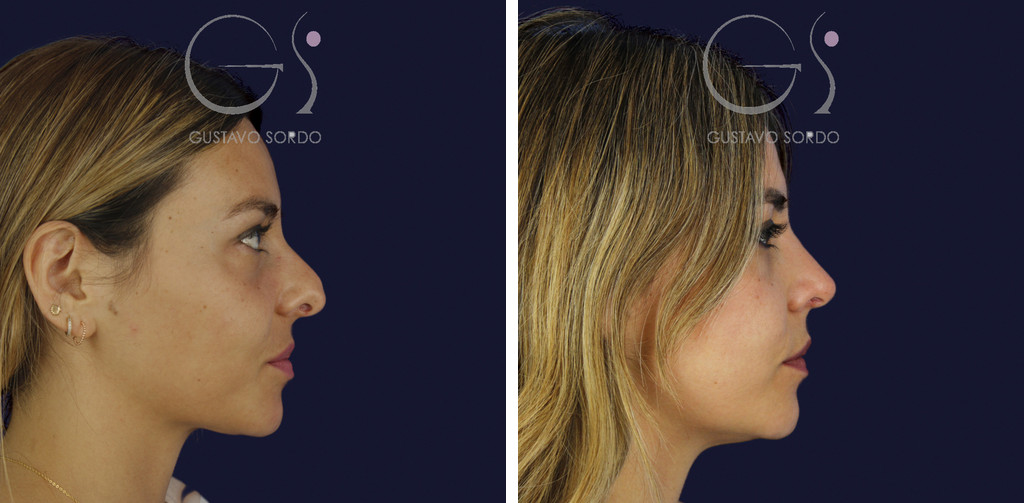
Before and after: what to expect from treatment
The results of a rhinoplasty are permanent, but you need to be patient to see the final outcome.
Immediately afterward, the nose will be very swollen and may appear upturned, especially the tip. This is normal and does not represent the final result.
In the first few months, the swelling will gradually subside. After 2 to 3 months, 80% of the swelling will have disappeared, and you'll see a shape very close to your final shape.
The final result may take up to 12 to 18 months to be fully evident.
We recommend you view all our before and after rhinoplasty cases.
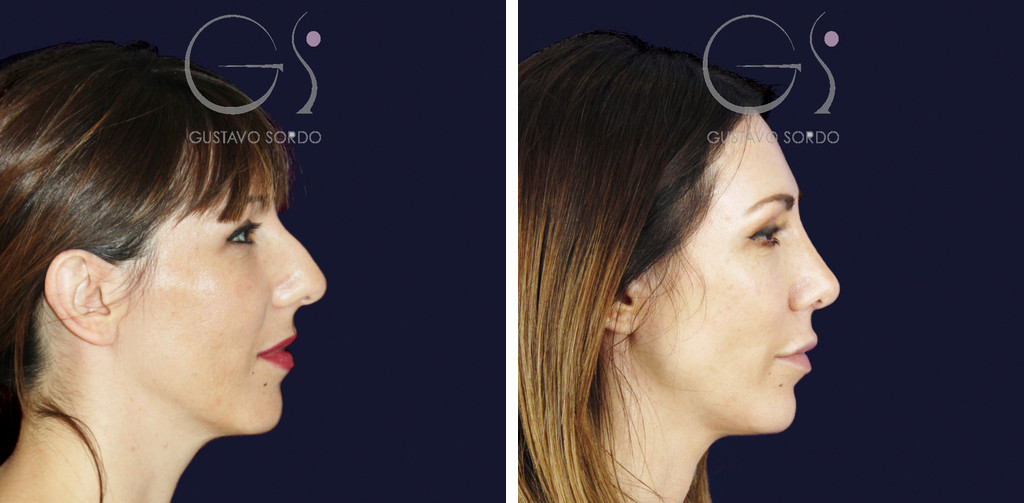
A large hump doesn't always occur alone. In this case , the V-shaped dorsum, thick skin, and width of the nose required, in addition to hump removal, width control with spacer grafts and support of the tip with a septal extension graft. The "after" photos were taken two and a half years later.


Recovery and postoperative care
First week
It's normal to experience swelling, bruising around the eyes, and a feeling of congestion. Keep your head elevated, even while sleeping, gently apply cold to the eyelid area, and carefully follow the medication and cleansing instructions.
Protection and rest
Any strenuous physical activity, bending, lifting, or nose blowing should be avoided for at least 3 to 4 weeks. The splint should be kept dry and protected. It is crucial to avoid impacts or wearing glasses.
Food and habits
You should eat a soft, cold diet for the first few days, drink plenty of water, and avoid direct sunlight on your nose for several months. Smoking is not recommended, as it greatly delays healing.
How to choose the best option for you?
Evaluate the case and expectations
If you're looking for a permanent solution and your hump is significant, rhinoplasty is the only option. If it's small and you want to try a non-surgical change, rhinomodeling may be a good option.
Consult with a specialist
He or she must be a plastic, aesthetic, and reconstructive surgeon or an otolaryngologist with extensive experience in rhinoplasty.
At our Plastic Surgery Clinic in Madrid , you'll find Dr. Gustavo Sordo , a plastic surgeon specializing in rhinoplasty . With over 20 years of experience in rhinoplasty and ultrasonic rhinoplasty , he is dedicated to providing personalized solutions for each patient, focusing on both aesthetics and function. Furthermore, at our Plastic Surgery Clinic in Madrid , thanks to a computerized rhinoplasty simulator, we can help you make the best decision for your health and well-being.
Analyze the pros and cons of each technique
Factors such as the permanence of the result, cost, recovery time, and associated risks must be considered. Rhinoplasty involves a longer recovery time but a lifelong result. Rhinomodeling is quick but temporary and has limitations.
Frequently Asked Questions (FAQs)
Can a bridged nose be corrected without surgery?
Yes, but only temporarily and illusorily, using hyaluronic acid rhinoplasty. This technique doesn't eliminate the hump, but rather camouflages it.
Which option is better: rhinoplasty or rhinomodeling?
There is no absolute best option, but rather the one that best suits each individual. Rhinoplasty is definitive, versatile, and resolves any type of humpback. Rhinomodeling is temporary, less invasive, and only suitable for mild cases.
Does the nasal bridge reappear after treatment?
No. In a well-performed rhinoplasty, the removed bone and cartilage do not grow back. The result is permanent.
What is the approximate price of the treatments?
At our clinic, a primary rhinoplasty starts at €10.040; non-surgical rhinoplasty with fillers is not part of our services. These prices are indicative until a final quote is provided during the initial consultation.
Does nasal bridge correction hurt?
During surgery, there is no pain from the anesthesia. Postoperatively, a feeling of discomfort, pressure, and congestion is more common than sharp pain.
Conclusion
A humped nose is a common anatomical feature that doesn't pose a health problem, but it does affect a patient's self-esteem. Currently, there are multiple effective treatment options. Taking the step to correct a humped nose can mean, for many, finding new facial harmony and greater self-confidence.
Continue reading
Dr. Gustavo Sordo
Specialist in Plastic, Aesthetic and Reconstructive Surgery. Member No. 282858125.
Content clinically reviewed by Dr. Gustavo Sordo. Last review: September 28, 2026.