Turbinoplasty: what it is and when it should be performed

Updated on • Reviewed by Dr. Gustavo Sordo, plastic surgeon
Turbinoplasty is a functional nasal surgery designed to improve breathing when the nasal turbinates become enlarged and obstruct airflow . Although it is a common procedure, it's normal to have questions about when it's indicated, how it's performed, and what the recovery process entails. In this article, we explain what turbinoplasty is, in which cases it's recommended, how long the procedure takes, what the postoperative period is like, and what its main benefits and potential risks are.
If you want to see how your nose would look , here are real cases sorted by nose type and a simulation of the consultation next to the result.
What is turbinoplasty?
Turbinoplasty is surgery to remove the nasal turbinates . The nasal turbinates are two structures located on the lateral wall of the nose , composed of bone and highly vascularized spongy tissue (filled with blood). This tissue forms a mucous membrane that covers the underlying structure.
You might also be interested in seeing: Turbinate Surgery Before and After
Function of the nasal turbinates
These lateral structures, primarily the superior, middle, and inferior turbinates , play a crucial role in the quality of breathing , as they function as the nasal air conditioner. Because they are so vascularized and covered with spongy mucosa, the turbinates are responsible for warming and humidifying the air as it enters the nasal cavity.
Heating and humidifying the air : They prepare the air for entry into the respiratory system.
Particle filtration : They help capture dust and other harmful elements present in the air.
Airflow regulation : They facilitate adequate airflow with each breath.
Symptoms that you may need turbinoplasty
Persistent nasal congestion that does not improve with medication or conservative treatments.
Difficulty breathing through the nose , especially on one side.
Frequent headaches caused by nasal obstruction.
Snoring or sleep apnea due to reduced airflow.
Recurrent nasal infections that affect quality of life.
Chronic irritation of the turbinates (chronic rhinitis).
Dysfunctions of the nasal turbinates
We often encounter the problem of enlarged or hypertrophic turbinates , a condition known as turbinate hypertrophy . In these cases, they can obstruct the nasal passages by pressing against the septum and preventing airflow within the nasal cavity.
It is also common for the turbinates to experience chronic irritation and problems such as compensatory hypertrophy . This second case occurs when a deviated septum within the nose creates an internal deformity in the nasal cavity , which is filled by the turbinate in its wider area. In the narrower area, there is a collision between the septum and the turbinate. In other words, when the septum is crooked , the turbinates also suffer friction and obstructions that can make breathing difficult.
In summary:
- Hypertrophy of turbinates: Enlarged or hypertrophic turbinates can obstruct the passage of air.
- Chronic irritation: Swollen turbinates can cause constant discomfort.
- Compensatory hypertrophies: They arise as a consequence of a deviated septum, where the turbinate compensates for the space.
How to correct nasal turbinates with plastic surgery:
In the context of functional surgery , at Dr. Sordo's clinic we always perform a partial removal of the most deviated portions of the septum , which are obstructing breathing and often interfere with the turbinates. Simultaneously, if the turbinates are enlarged , we perform ultrasonic rhinoplasty and turbinoplasty to reduce the size of these lateral structures, known as turbinates, so they can fulfill their function of humidifying and warming the air without physically obstructing nasal airflow. A common issue among our patients is difficulty breathing.
We can conclude that turbinoplasty is another step in the functional aspect of nasal surgery and should be performed concurrently with the cosmetic procedure . It's crucial to remember that the turbinates play a vital role in respiratory function, a fundamental function that must be addressed in conjunction with the aesthetic outcome.
How is turbinoplasty performed?
Turbinoplasty is usually performed in conjunction with septoplasty (correction of the nasal septum) to optimize respiratory function. During the procedure, the surgeon reduces the size of the turbinates to free up air passage and restore their normal function.
There is a reason for consultation that almost no one associates with the turbinates and that we see frequently: headaches . When the septum deviates, the turbinate on the side towards which it deviates tends to atrophy and the one on the opposite side hypertrophies in a compensatory manner; this large turbinate can come into contact with the nasal wall and trigger rhinogenic headaches that the patient suffers for years, treated as migraines without success (Gupta et al., 2019, Indian J Otolaryngol Head Neck Surg ).
That's why we always assess the turbinates along with the septum and, when appropriate, perform turbinoplasty during the same surgical procedure as the rhinoseptoplasty. In the postoperative period, it's normal to have some residual swelling of the turbinate for a few weeks: we manage this with nasal irrigation (such as a rhinodouche) and, if necessary, with a topical corticosteroid (Flixonase or Nasonex). Breathing improves gradually and doesn't reach its maximum until the third or fourth month.
How long does turbinoplasty last?
The turbinoplasty procedure typically lasts about 30 to 60 minutes. However, if performed in conjunction with rhinoplasty or septoplasty, the total time can extend to 2-3 hours.
Types of turbinoplasty techniques
The technique isn't chosen solely based on the severity of the case, but rather on which part of the turbinate is enlarged : whether the problem is primarily the mucosa covering it or the bone inside. Confusing the two is the most frequent reason why turbinate surgery fails. These are the options:
- Mechanical reduction: Removal of a portion of the turbinate tissue.
- Cauterization or laser: Use of energy to reduce the size of the turbinates without removing tissue.
- Submucosal radiofrequency: An electrode is inserted into the turbinate, and the heat retracts the tissue from within, leaving the surface mucosa intact. This is the preferred option when the hypertrophy is primarily mucosal.
- Outfracture with electrocautery: This is my standard technique in rhinoplasty. I laterally reposition the turbinate and apply controlled coagulation to conservatively reduce its volume.
- Endoscopic turbinoplasty: Camera-guided procedure. More than a separate technique, it's the way of performing the previous ones while seeing what is being done, which also allows access to the middle and posterior portion of the turbinate.
How do I choose the technique for each patient?
The first thing I assess during the examination—using endoscopy and, when necessary, a rhinomanometer—is whether the hypertrophy is mucosal , osseous , or mixed. According to PubMed, a 2026 review proposes an algorithm based on four structural phenotypes of the inferior turbinate: in predominantly mucosal hypertrophy, radiofrequency ablation is the preferred first-line option because it preserves the mucosa; in predominantly osseous hypertrophy, turbinoplasty is needed to address the osseous component; and treating a turbinate with an osseous problem using only a mucosal technique is a poorly matched treatment for the disease (Pennacchi A, Landis BN, Soyka MB, Spasiano R, Trimarchi M. Personalized Selection of Inferior Turbinate Surgery Based on Structural Phenotyping . J Pers Med. 2026;16(6):310. DOI: 10.3390/jpm16060310 ).
According to PubMed, a randomized clinical trial with 70 patients further confirms that submucosal approaches reduce turbinate size and improve symptoms while preserving the nasal mucosa, with comparable long-term functional results across different technologies (Maniaci A, et al. Eur Arch Otorhinolaryngol. 2022;279(9):4397-4406. DOI: 10.1007/s00405-022-07267-0 ). In other words, the difference lies not in the specific technology, but in choosing the right approach and avoiding excessive dryness.
It's also important to know that reducing the turbinate doesn't cure the underlying cause . If there's active allergic rhinitis, the turbinate may grow back over time, so medical treatment is continued after surgery. You can find complete details, including how to prevent empty nose syndrome, in the article on nasal turbinates.
What is the postoperative period like after turbinoplasty?
The postoperative period is usually well tolerated by patients. It is normal to experience:
Slight nasal congestion during the first few days due to inflammation.
Mild discomfort controlled with prescription painkillers.
Nasal crusts that disappear after 2-3 weeks.
Postoperative recommendations
- Avoid strenuous physical activities during the first few weeks.
- Perform nasal washes with physiological saline solution to keep the area clean.
- Follow the surgeon's instructions to the letter
Frequently asked questions about turbinoplasty
- Is turbinoplasty painful? No, the surgery is performed under local or general anesthesia, so you will not feel pain during the procedure.
- How long does full recovery take? Initial recovery takes between 1 and 2 weeks, but full recovery may take up to 6 weeks.
- Does turbinoplasty change the appearance of the nose? No, turbinoplasty focuses on functionality and does not affect nasal aesthetics. However, it can be combined with rhinoplasty if the aesthetics are also desired.
- Is it a permanent surgery? Yes, the results are usually long-lasting. In rare cases, the turbinate tissue may regenerate slightly.
When is turbinoplasty performed?
Turbinoplasty is generally performed at the beginning of nasal surgery , along with septoplasty , as these are the two key components of functional or respiratory nasal surgery. Before the operation, in addition to the simulation we perform during the initial consultation, the patient will be given a complete explanation of the procedure.

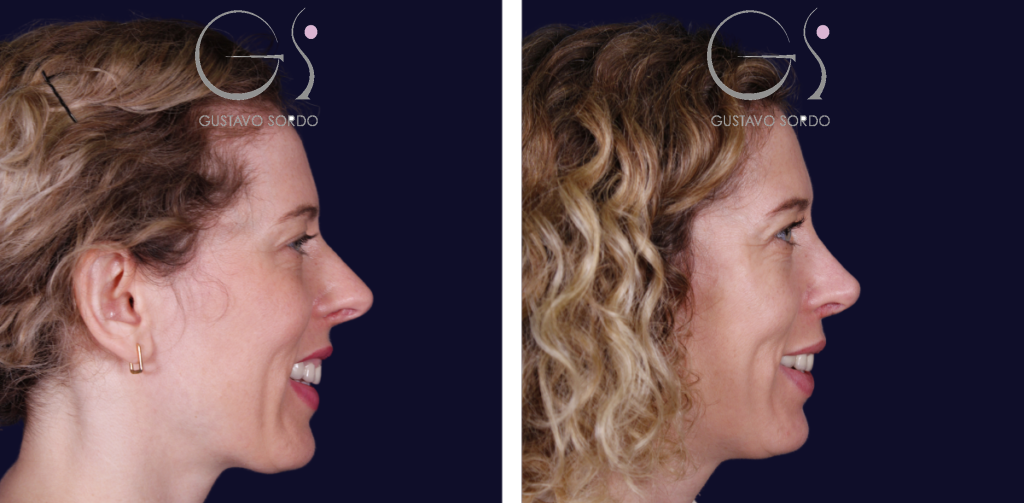

We recommend you view all our before and after rhinoplasty cases.
Conclusion
Turbinoplasty is an effective solution for those who suffer from breathing problems due to dysfunctions in the nasal turbinates. If you have difficulty breathing, constant congestion or snoring, this procedure may be the answer.
For more information about turbinoplasty, don't hesitate to contact Dr. Gustavo Sordo, a plastic surgeon in Madrid and one of the world's best rhinoplasty surgeons . With over 20 years of experience specializing in rhinoplasty and ultrasonic rhinoplasty in Madrid, he is dedicated to providing personalized solutions for each patient, with both an aesthetic and functional focus.
Dr. Gustavo Sordo
Specialist in Plastic, Aesthetic and Reconstructive Surgery. Member No. 282858125.
Content clinically reviewed by Dr. Gustavo Sordo. Last review: October 7, 2026.