Cosmetic surgery , facelift and facial rejuvenation
Nasolabial folds: why they don't get better with fillers and what we can do

Updated on • Reviewed by Dr. Gustavo Sordo, plastic surgeon
Nasolabial folds, the two creases that run from the sides of the nose to the corners of the mouth, are the most frequent reason for facial consultations among people between 40 and 60 years old. They are also one of the most poorly treated, because the solution almost always offered—filling the folds with hyaluronic acid—is based on a misconception of what nasolabial folds actually are. This article explains what they really are, why fillers don't solve the problem, and what we do in the clinic depending on the severity of each patient's condition.
The crease isn't the problem: it's the cheek that has fallen over it.
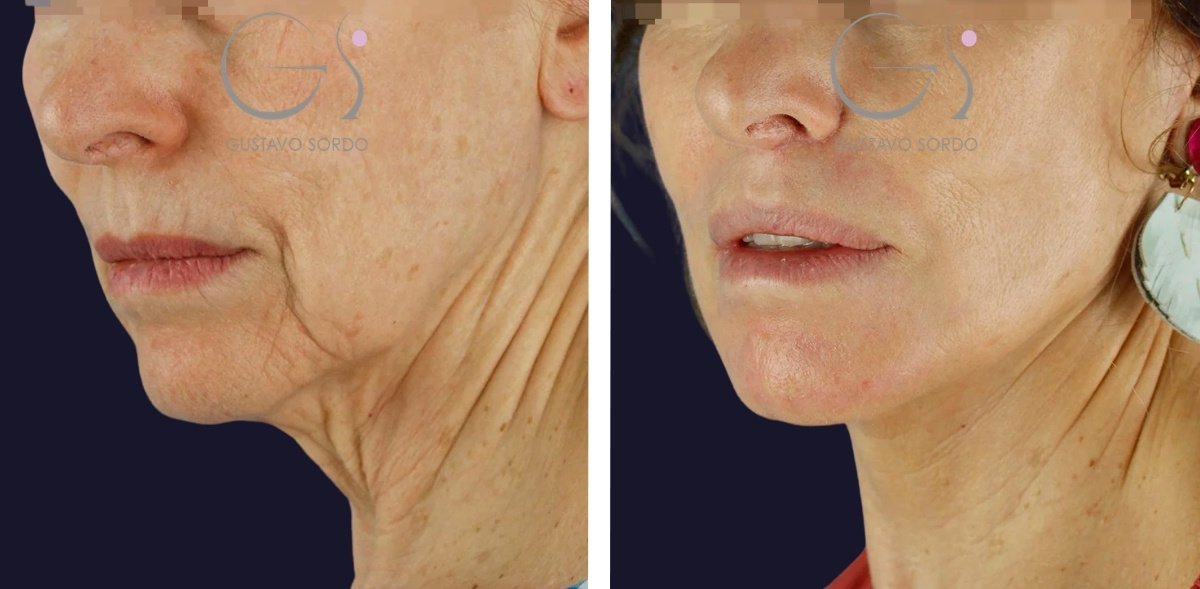
Everyone has a nasolabial fold, even a twenty-year-old's face: it's the boundary between the upper lip, which is attached to the bone, and the cheek, which is free. What changes with age isn't the fold itself. It's the cheek: the cheekbone shifts downward and inward, the ligaments that held it in place loosen, and this sagging tissue rests on the edge of the fold, which remains in place. The crease becomes more pronounced because there's more tissue hanging above it, not because there's a lack of tissue within it.
Understood in this way, the treatment changes completely. If the crease is more pronounced because the cheek has sagged over it, the solution is not to inject material into the crease: it is to reposition the cheek.
In a face where the cheek has drooped, that's what the deep plane facelift does : it repositions the tissues in depth instead of filling the crease.
Why filling the groove doesn't work (and what happens when you persist)
Hyaluronic acid in the nasolabial fold does what it's supposed to: it fills the depression and flattens it for a few months. The problem is that the tissue that had sagged remains, on top, and when the effect wears off, the patient returns for more. Each session adds volume precisely where it's already lacking, in the lower part of the face, and over the years the result is that heavy, puffy face we all recognize: the nasolabial fold slightly flatter and the entire lower cheek fuller than it ever was. It doesn't correct aging; it adds weight. And the material, as I explain in the article on facial harmonization , isn't reabsorbed as promised.
There is also a safety reason. The nasolabial fold is one of the areas where the facial artery passes, and filler injections there have been linked to skin necrosis: according to PubMed, a series of 12 cases of skin ischemia after filling of the fold found that in 75% the necrosis affected the fold and the entire nose, due to the path of that artery (Liao Z et al. Aesthetic Plast Surg . 2025, DOI ). It is uncommon, but it is good to know this before getting on the operating table.
What we do in the clinic, according to the degree
Slight crease, cheek that is beginning to hollow out: volume in the cheekbone, not in the crease
When the sagging is minor and the main issue is volume loss in the cheekbone, the most effective treatment is to restore that lost volume higher up, where it has been lost, using lipofilling : the patient's own fat, which integrates seamlessly and doesn't require repeat procedures every six months. By filling the cheekbone, the cheek regains support and the nasolabial fold is softened indirectly, without directly altering it.
Deep crease with drooping cheek: deep plane lifting
When the tissue has truly sagged, with the deep crease, marionette lines, and blurred oval shape, the only solution that restores the cheek to its proper position is surgical. Today, the technique I use is the deep plane facelift : it releases the supporting ligaments and repositions skin, fat, and SMAS as a single unit, vertically, without tightening the skin. It's the best technique currently available for the mid-face, which is precisely where the traditional facelift falls short. I almost always combine it with lipofilling in the cheekbone area because the face not only sags, it also loses volume.
An honest warning, because the literature says so: the nasolabial fold is the most difficult area to correct with any facelift, and a recent review of published techniques concludes that there is a lack of objective data demonstrating that any specific technique erases it in the long term (Atiyeh B et al. Plast Reconstr Surg Glob Open . 2026, DOI ). What the deep plane procedure does very well is remove the cheek tissue above the fold and rejuvenate the entire midface; the fold itself is softened, not eliminated. And it shouldn't disappear: a face without nasolabial folds doesn't look young, it looks stuffy.

If you already have fillers: first, hyaluronidase
Many patients come to our clinic with years of hyaluronic acid injections in their wrinkles and cheeks. Before assessing the case, we dissolve it with hyaluronidase, in one or more sessions, to see the true appearance of the face and to avoid operating on accumulated material.
What we don't do
We don't repeatedly fill wrinkles, we don't use threads as a substitute for a facelift when the cheek has already sagged, and we don't promise that a device will lift sagging tissue. Energy treatments have their place in improving skin quality; threads, in very mild cases of sagging and for a short time. Neither of them will restore a cheek to its original position.
FAQ
At what age do nasolabial folds appear?
The crease is always there. It begins to appear between 35 and 45, when the cheek starts to sag, and becomes more pronounced after 50. Genetics and sun exposure accelerate the process.
Does hyaluronic acid work for wrinkles?
It flattens them for a few months, but it doesn't correct the underlying cause; the effects accumulate with repeated use, and that area is at risk of vascular damage. We don't offer it as a treatment for wrinkles at our clinic.
And what about thread lifts?
They can provide a subtle and temporary improvement in very mild sagging. Once the cheek has already sagged, they don't provide support.
Does a deep plane facelift eliminate wrinkles?
It softens them in a lasting way, because it repositions the cheek that creates them, and rejuvenates the entire mid-face. It doesn't erase them, nor should it: a youthful face has nasolabial folds.
If you're concerned about wrinkles, the consultation will assess how much your cheeks have sagged and how much volume has been lost: this will determine whether lipofilling is sufficient or if a deep plane facelift is necessary . You can see more facelift cases from the clinic.
Continue reading
Dr. Gustavo Sordo
Specialist in Plastic, Aesthetic and Reconstructive Surgery. Member No. 282858125.
Content clinically reviewed by Dr. Gustavo Sordo. Last review: October 2, 2026.