Rotated Breast Implant: Why It Happens and Symptoms

Reviewed by Dr. Gustavo Sordo, plastic surgeon
One of the questions our patients often have before undergoing breast augmentation surgery in Madrid is: do anatomical breast implants rotate or turn? It's normal for breast implants to have some movement, since they aren't anchored to a structure but rather housed in a dual-plane breast pocket that the surgeon creates specifically for the implant.
What does a rotated prosthesis mean?
When a breast implant is rotated , it means the implant has shifted position within the pocket that holds it in the breast. This shift can alter the implant's original orientation, which can lead to aesthetic changes and, in some cases, physical discomfort.
Causes of rotation
If the pocket we've created is much larger than the implant, the implant may rotate ; hence the importance of creating a pocket the correct size for the breast prosthesis. It 's not true that one type of implant rotates more than another . Both anatomical and round implants can rotate, but because they have different shapes, the aesthetic effect will be different.
To understand this, it's necessary to know the shape of an anatomical implant and the shape of a round implant. Round breast implants , as their name indicates, are round, so if they rotate, there is no aesthetic change for the patient, as they will always maintain the same shape.
Just as when we turn a ball we cannot tell which is the top and which is the bottom or which is right and which is left, in the same way the patient will not be able to tell if her prosthesis has turned. However, anatomical breast prostheses are shaped like a teardrop or a pear and only have a correct position when we place them in the pocket we have created to house them.
If this pocket is not made with the utmost precision and the anatomical prostheses are rotated, an undesirable aesthetic effect will occur, making it appear as if the breast is upside down if it has been rotated 180º or sideways if it has been rotated 90º.
Why do breast implants rotate?
As we have indicated above, the main cause of rotation or twisting of breast prostheses is that they are placed in an excessively large pocket. But there are also other causes:
- Smooth implants: prostheses that do not have a rough cover have greater mobility as there is no friction with the tissues.
- Trauma or high intensity sports: The increased risk of rotation is associated with patients who have suffered severe trauma to the pectoral area or who practice high-intensity sports (boxing, competitive swimming, etc.). Moderate exercise is not associated with increased rotation of breast prostheses.
- Poor adhesion of the prosthesis to the tissues: Sometimes, even when using rough implants, the patient's body creates a thin layer of mucous-like fluid around the implant, which prevents it from adhering to the tissues and therefore from moving or rotating further. This situation is due to an individual predisposition and cannot be predicted before surgery.
Rotation is the classic Achilles' heel of anatomical implants, which is why our choice depends heavily on the specific case. When we recommend an anatomical implant—for example, for tuberous breasts, narrow bases, or breast reconstruction—we typically use one with a micropolyurethane coating : it acts like Velcro, adhering to the surrounding tissue and virtually eliminating the risk of the implant rotating within the pocket.
The other option, currently the most common for cosmetic breast augmentation, is to use ergonomic implants . These implants change shape with the body's position, and rotation is no longer a conceptual problem because there is no rigid "up" and "down." However, with ergonomic implants, it is essential to reconstruct the inframammary fold with a continuous suture, like an internal bra. These implants move and require a well-stabilized lower pole, or they will settle too far down.
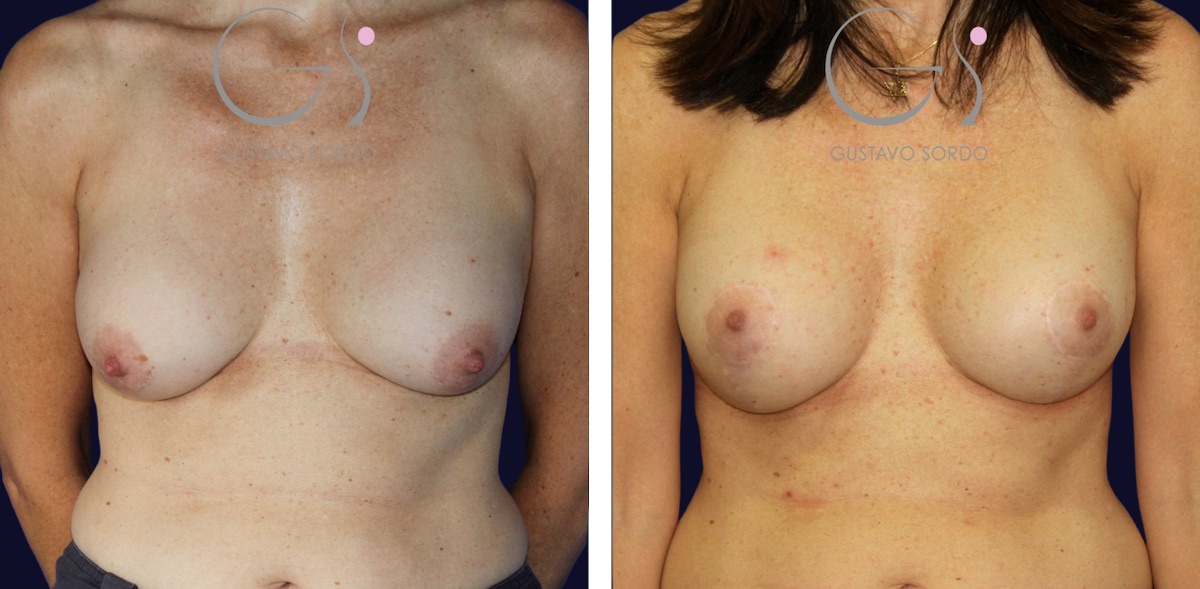
Symptom
When a breast prosthesis rotates, the signs are usually quite clear: change in the shape of the breast, asymmetry that did not exist before, empty lower pole of the breast and sometimes the rotation is accompanied by inflammation, pain and a feeling of mobility in the breast. More specifically:
- Change in breast shape:
When an anatomical implant rotates, the breast may appear disproportionate or unusually shaped. For example, the breast may appear "upside down" if the rotation is 180° or shifted to one side with a 90° rotation. - Asymmetry:
If there was previously symmetry between both breasts, the rotation of an implant can generate a visible imbalance, making one breast look different from the other in size, shape or position. - Empty lower pole:
In some cases, implant rotation causes the lower breast to deflate or appear less full, due to the displacement of the implant volume. - Sensation of abnormal mobility:
The patient may notice that the breast moves more than usual when touched or during certain activities. - Pain or discomfort:
Although not always, rotation may be accompanied by pain, increased tenderness or inflammation in the affected area. - Inflammation:
In more severe or recent cases, there may be noticeable swelling in the chest area, which may be a sign that the implant is putting pressure on the surrounding tissues.
What to do if the implant has rotated?
If the patient believes that one of her breast implants has rotated, she should go to the plastic surgeon's office so that he can examine her and diagnose whether rotation has actually occurred. Depending on the type of displacement that has occurred, the surgeon may perform:
- A manual placement in consultation: There are techniques that your surgeon can perform in consultation to try to reposition the implant. Sometimes you just have to move it into place and rest for a couple of weeks until the implant re-adheres. It is important to have a follow-up check to ensure that this does not happen again.
- Replace anatomical implants with round ones. When the cause of implant rotation is the patient's individual predisposition to the implant not adhering correctly, this is the best solution. To choose round prostheses, a personalized 2D simulation must be performed with the patient's parameters. We tell you more about this here. breast enlargement simulator.
Conclusion
If you notice changes in the shape or symmetry of your breasts, or if you feel discomfort, it is essential to consult a surgeon. In most cases, this can be resolved with manual techniques or surgical adjustments, guaranteeing a satisfactory and natural result.
If you're looking to have a second breast augmentation or breast implant replacement in Madrid , you can contact Dr. Gustavo Sordo , a plastic surgeon in Madrid . He has over 20 years of experience specializing in breast augmentation and is dedicated to providing personalized solutions for each patient, with both an aesthetic and functional focus. You can see his cases here: breast augmentation before and after.
What do I see with the ultrasound scanner in my office?
What follows is my clinical judgment, not a catalog of data. I publish it because it's what I think and what I apply.
At the clinic, we have an ultrasound machine and we check the implants right there in the office. What I'm seeing is that anatomical implants rotate much more than is commonly reported: over 20 or 30% of cases . I've seen many examples of rotated anatomical implants, and it's clearly visible on the ultrasound.
My explanation is mechanical. Every time the pectoral muscle contracts, it pushes the implant outward and tends to rotate it. This pressure doesn't last just a season; it lasts for the fifteen or twenty years the patient has the prosthesis. In patients with a very active lifestyle who train intensely, this repeated effort eventually takes its toll.
What does literature say when viewed with ultrasound?
The turnover rate that is usually cited is between 0 and 8,2%. But that figure comes from clinical examination. When you look at it with high-resolution ultrasound, the number is different.
A study published in the Aesthetic Surgery Journal examined 69 patients and 138 anatomical implants using high-resolution ultrasound. Any implant deviated more than 30° from the midline was considered rotated. Thirty-seven of the 138 implants (27%) and 29 of the 69 patients (42%) were found to be rotated . Independent evaluators, using only photographs, detected rotation in 2 out of 40 cases (5%). The authors concluded that anatomical implants rotate up to 25 times more than previously thought, and that most of these rotations have no clinical consequences ( Sieber DA et al. Aesthetic Surgery Journal. 2017;37(3):290-296 ).
The fact that it has turned and that it is noticeable are two different things.
Most breast rotations are subclinical: they are present, visible on ultrasound, and do not change the shape of the breast. The patient notices nothing, and there is nothing that can be done.
When the twist approaches 90°, things change. That's when it becomes noticeable in the shape of the chest, and further surgery is necessary.
What do I do when re-intervention is necessary?
In the case of a rotated anatomical implant causing symptoms, my usual solution is not to replace the same implant; it's to replace it with a round one, utilizing the patient's existing pocket. A round implant has no orientation, so the problem disappears by definition.
To adjust that pocket I use the popcorn capsulorrhaphy, which I explain below.
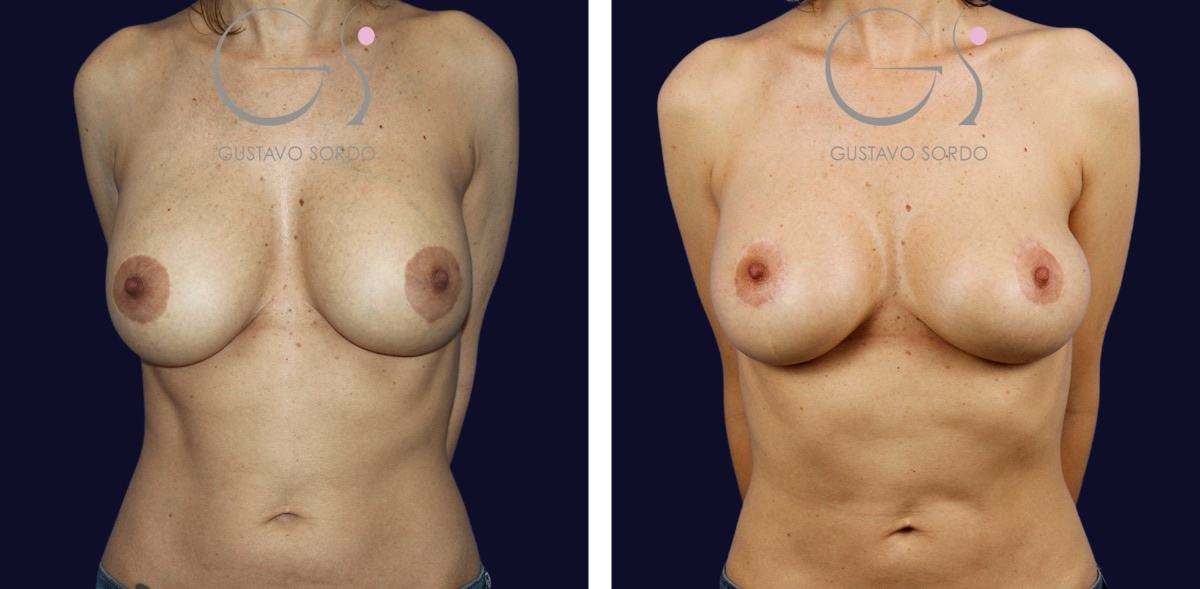
Popcorn capsulorrhaphy: closing the pocket without sutures
When an implant has shifted within its pocket—outward, downward, or toward the center—the problem is almost never the implant itself. It's the space that contains it, and that space needs to be closed where it's excess.
The classic methods involve capsular sutures, capsular flaps, or mesh. The technique I use is called popcorn surgery, developed by the Swedish surgeon Charles Randquist: instead of suturing, the capsule is coagulated in small, pointed sections using a protected forceps and an electrocautery knife. The capsule retracts upon itself—hence the name—and the pocket is closed where needed.
The practical advantage is significant: the pocket is adjusted without sutures, without traditional capsulorrhaphy, and without raising capsular flaps . This greatly simplifies revision surgery, which is why it is constantly used in implant replacements, displacement corrections, and explants.
Regarding its performance, there is a published series of 149 patients and 266 breasts. The indication was implant malposition in 61,3% of the breasts. Complications occurred in 14,7%, and 6% required some surgical revision. The authors conclude that the technique provides pocket control and stability with low complication and revision rates ( Calobrace MB et al. Aesthetic Surgery Journal. 2020;40(1):63-74 ).
It's not a straightforward technique, because no revision surgery is. It's a cost-control tool with reasonable costs for what's required.
Clinical opinion of Dr. Gustavo Sordo, plastic surgeon, member no. 282858125.