Pectus excavatum and breast augmentation: what the implant corrects and what it doesn't
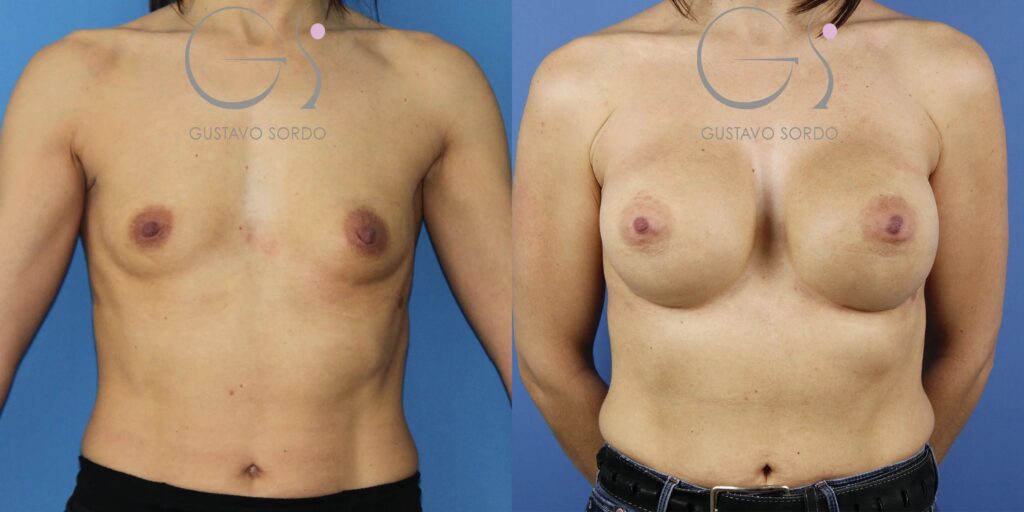
Pectus excavatum is a sunken chest: the center of the chest is deeper than normal, and the breasts, resting on this chest, appear separated and protruding. It is the most common chest wall deformity, and it is seen more frequently in breast augmentation consultations than one might think: in a series of 406 patients who underwent augmentation surgery, 5,4% had some degree of pectus excavatum (Ors, 2017). Many of these women don't come in for chest problems, but rather for breast issues, and they discover during the consultation that one condition influences the other.
What an implant does for pectus excavatum, and what it doesn't.
It's important to state this from the outset: the implant does not correct the bone . The sternum remains sunken even after surgery. What the implant does is fill the space in front, and with that volume, the central depression becomes less noticeable. The visual effect is real and clearly visible in photos, but it's a filling effect, not a correction of the chest wall. Anyone seeking to correct the chest itself requires a different surgery, performed by a different specialist.
This distinction matters because it sets expectations. Breast augmentation in a patient with pectus excavatum results in fuller breasts, closer together, and a décolletage that conceals the central depression. It does not achieve a flat chest.
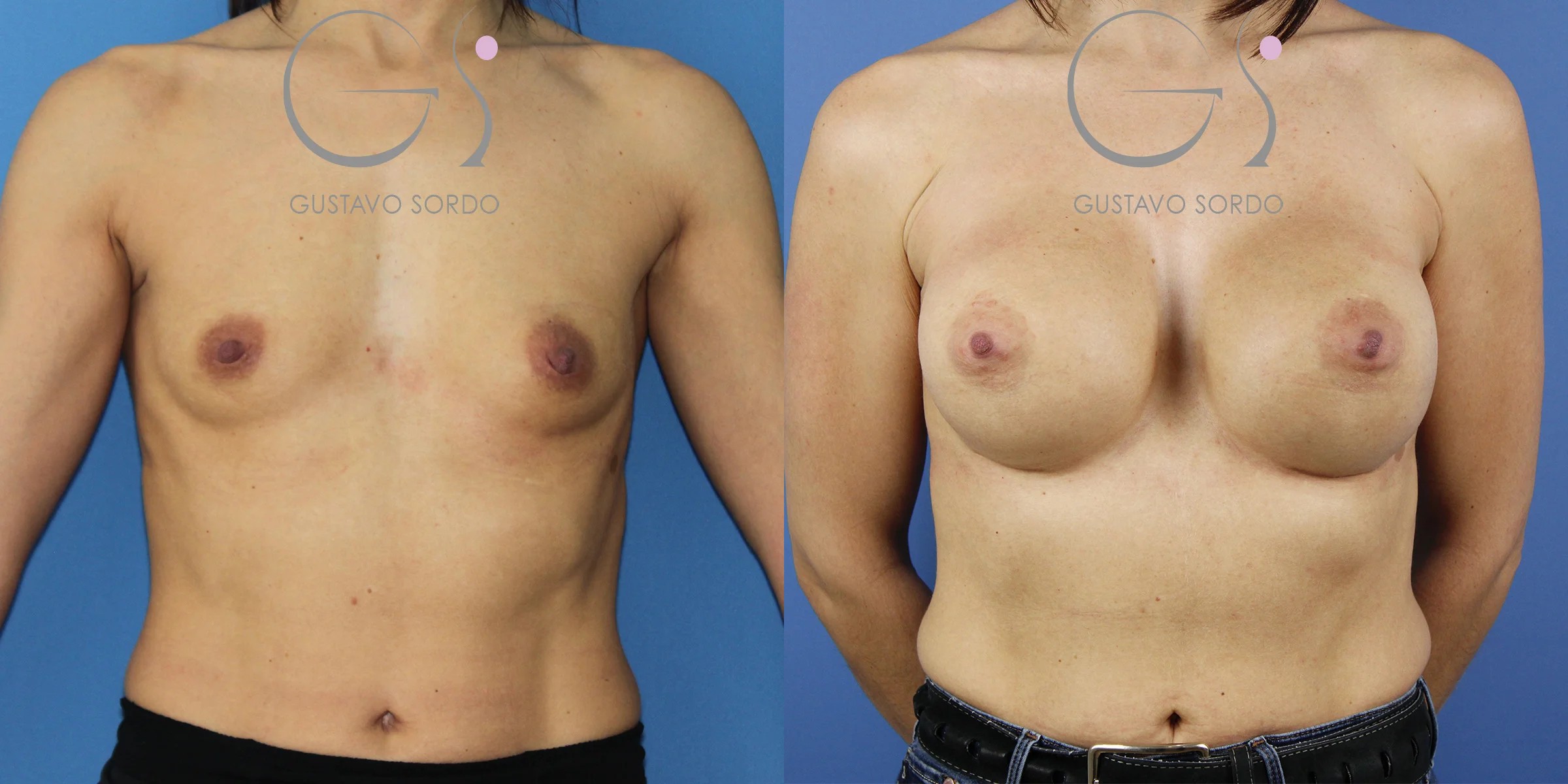
One case: 545 cc anatomical implants in a woman of 1,85 m
The patient in the photos had a clear pectus excavatum and was 1,85 m tall. I placed 545 cc anatomical implants through the inframammary fold, in the subpectoral dual plane I, with an internal bra , respecting the lateral fascial triangle for the push-up effect. Laser treatment was performed on the incision at the end.
Two decisions explain the case. Why 545 cc isn't excessive here: because of her height. A large implant in a woman who is 1,85 m tall is in proportion to her chest and body. The same volume in a woman who is 1,60 m tall would be a different story. Why anatomical implants: to lengthen the distance from the nipple to the inframammary fold, which was short in her case. Anatomical implants distribute the volume downwards and achieve precisely that.
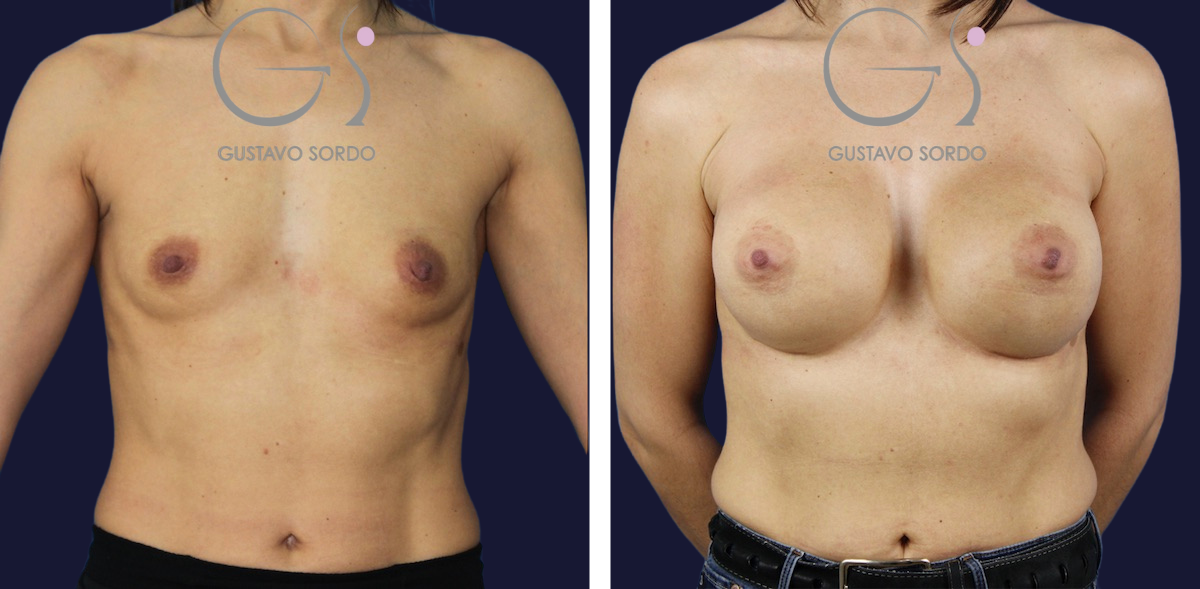
More cases of this type, in breast augmentation in pectus excavatum: before and after.
What does literature say?
It's not just a clinical impression. A prospective study of 28 patients with pectus excavatum who underwent breast augmentation with submuscular dual-plane implants found improvement in the appearance of the deformity and asymmetry, with high satisfaction measured by BREAST-Q at 24 months and no complications (Keramidas, 2024). In a larger series of 132 patients with a tendency toward pectus excavatum or carinatum, the inframammary approach was the most frequently used, in 71% of cases, and there were no cases of symmastia, which is the specific risk when the two breasts are too close together in the center (Byun and Park, 2023). And in Ors's series, implants with a wider base best cover the deformity; that same study observed that, even with good planning, an asymmetry of about one centimeter between the two sides could remain, which the patients did not perceive as a problem.
That fits with what I do: a subpectoral plane, an incision in the crease, and an implant whose base covers the central hollow well without crossing the midline. The pocket has to stop before the sternum. If it's opened too wide to "bring" the breasts together, there's a risk that the two pockets will communicate.
What I look for in a consultation if you have pectus
- The depth of the sinkhole and its symmetry. Many pectus carcasses are asymmetrical, and then the two breasts start from a different base. An augmentation corrects the width and base, not the position of the nipple.It's good to know this beforehand.
- The width of the breast base. This determines the maximum width of the implant. In pectus excavatum, it's advantageous to maximize this width, because a wider-based implant fills the center more effectively.
- The covering fabric. The pinch test determines the placement. With little tissue, the implant goes under the muscle, regardless of its size.
- The 3D simulation. In a sunken chest it is especially useful, because the patient can see on her own body how much the center is concealed with each volume, and what remains.
If you have pectus excavatum and are considering breast augmentation , the initial consultation is where all the decisions are made based on your measurements. What I won't tell you is that your chest will be completely flat, because that's not true.
Highlighted
- Keramidas E, Rodopoulou S, Gavala MI. Can a Breast Augmentation Procedure Improve the Appearance of Pectus Excavatum Deformity in Female Patients? A Prospective Study. Plastic Reconstruction Surgery Globe Open. 2024; 12 (6): e5926. doi:10.1097/GOX.0000000000005926
- Byun IH, Park SH. Basic Strategies of Augmentation Mammoplasty in Patients with Tendencies of Pectus Excavatum and Carinatum. Aesthetic Plast Surg. 2023;47(1):54-60. doi:10.1007/s00266-022-02991-8
- Ors S. Incidence and Classification of Chest Wall Deformities in Breast Augmentation Patients. Aesthetic Plast Surg. 2017;41(6):1280-1290. doi:10.1007/s00266-017-0953-5
Continue reading
Dr. Gustavo Sordo
Specialist in Plastic, Aesthetic and Reconstructive Surgery. Member No. 282858125.
Content clinically reviewed by Dr. Gustavo Sordo. Last review: September 27, 2026.