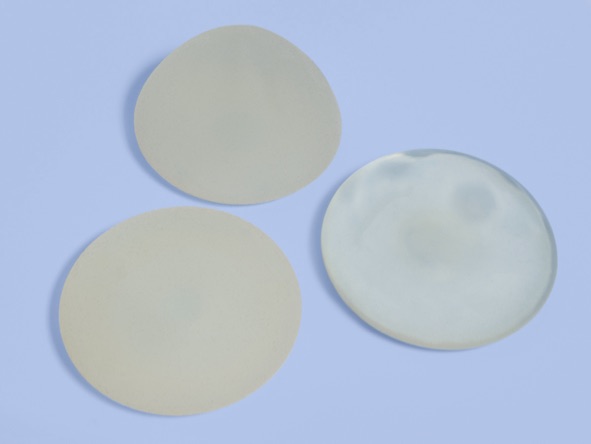
Round or anatomical prostheses?
Reviewed by Dr. Gustavo Sordo, plastic surgeon
Patients who come to our clinic for breast augmentation often have this question: round or anatomical implants? The answer is much simpler than it seems. The main difference lies in the transition between the collarbone and the beginning of the breast. In other words, the upper portion will look different depending on which implant we choose . This is an important concept that I thoroughly understood during my visit to Stockholm with Dr. Heden at the Akademikliniken.
Which one suits you best is decided in consultation, with 3D simulation; here you have the complete process and the price of the increase (€6.400, fixed price and all included).
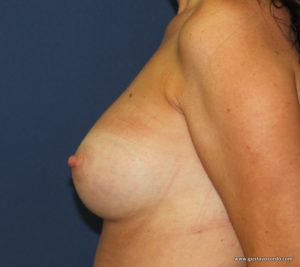
As a picture is worth a thousand words, you can compare both shapes in the photos below. On the left we see a breast operated on with a 300cc round implant, while on the right we see an anatomical implant of the same size.
Round prosthesis:

Anatomical prosthesis:
VIDEO: Differences between round prostheses and anatomical prostheses
The transition at the top of the breast is smooth , progressive, increasing in volume as the breast moves downwards.
With the evolution of implants, this discussion has changed considerably. Today we frequently use Motiva ergonomic implants , which behave in an intermediate way: they adopt a more anatomical shape when the patient is standing and a more rounded shape when lying down, following the natural movement of the breast. Their gel and shell also give them a feel and naturalness that have demonstrably improved compared to previous generations (Szychta, 2024, Aesthetic Plast Surg ).
Classic anatomical implants still have their place in specific cases—tuberous breasts, narrow bases, reconstruction—where we often combine them with a micropolyurethane shell , which adheres to the tissue like Velcro and precisely avoids the classic problem of anatomical implants: rotation. And an important technical point: with ergonomic implants, it is essential to reconstruct the inframammary fold with a continuous suture, like an internal bra, because these prostheses move and require a well-stabilized lower pole.
Factors to consider when choosing a type of implant for breast augmentation:
Taking these two general points into account, there are several factors to consider when choosing a breast prosthesis :
- If the patient is not thin and has a significant amount of skin and fat in the upper part of the breast, there will be no difference between the two prostheses. It will be the same whether you have a round prosthesis or an anatomical one, since they will look the same from the side.
- If the patient is thin it will be noticeable profile what type of implant you have chosen. In this way, the round prosthesis will give a more marked transition at the beginning of the prosthesis, at the top.
- If the patient has an underlying abnormality in the shape of the breast (tuberous breast, for example), it is recommended that she select an anatomical implant with the idea of normalizing the shape of her breast as much as possible. Anatomical prostheses simulate the shape of the normal breast.
- If the patient seeks to have a natural result, it is advisable to opt for an anatomical implant. Due to the shape of this type of prosthesis, the appearance will be more similar to that of an unoperated breast.
- There is no prosthesis that is more neckline than the other. That will depend on the final size, the distance between the breasts, the width of the sternum and the type of bra used afterwards.
In my usual practice, I use anatomical implants in 95% of cases , keeping in mind that the patient is fully involved in the implant selection . This occurs once she has understood, considered, and reviewed the explanations about the different types of implants . She has also participated in a 3D simulation where she visualizes her new figure with the chosen implants.
It is essential to provide patients with adequate and comprehensive information when choosing a prosthesis, as this will positively impact the ultimate goal of cosmetic surgery: patient satisfaction through the fulfillment, with maximum medical safety, of their desires and their desired change of appearance. Only a qualified plastic, cosmetic, and reconstructive surgeon can provide the patient with informed advice.
Continue reading
Dr. Gustavo Sordo
Specialist in Plastic, Aesthetic and Reconstructive Surgery. Member No. 282858125.
Content clinically reviewed by Dr. Gustavo Sordo. Last review: November 2, 2026.