Breast Ptosis: What it is and how to correct it

Reviewed by Dr. Gustavo Sordo, plastic surgeon
Have you heard of breast ptosis? This term might not be familiar to everyone, but you've probably heard of "sagging breasts" in women, and you may even know many women who experience it. In this article, we'll explain what causes breast ptosis and how it can be corrected.
To see what the surgery is like step by step, with cases and price (€7.500-€10.400), visit mastopexy in Madrid.
Before the consultation, you can see real cases according to your breast type and compare the simulation with the result obtained.
What is breast ptosis?
Breast ptosis is the sagging or drooping of the breasts, a condition in which the breast loses its firmness and shape, descending from its normal position. This occurs when the breast's supporting tissues, such as ligaments and skin, lose elasticity.
The main causes of breast ptosis include aging, hormonal changes during pregnancy and breastfeeding, weight fluctuations, and genetic predisposition. As these factors affect the skin and breast tissue, the breasts may lose volume and shape, leading to sagging.
What causes breast ptosis?
The cause of breast ptosis is none other than the loss of elasticity in the skin fibers of the breast area. But why do these fibers lose elasticity? To find the answer to this question, we must consider several factors :
- Pregnancy and breastfeeding: Often, the age at which breasts begin to sag coincides with pregnancy and breastfeeding. During pregnancy, breast volume increases, which causes the ligaments that support the breasts to give way and little by little we notice a sagging of the breasts. Once pregnancy and breastfeeding are over, the breasts return to their initial size, and this change in volume also affects breast sagging.
- The gravity: Women's breasts are no exception. Due to their own weight, especially when it comes to large breasts, they tend to sag since this area of the female anatomy does not rest on any muscle.
- Weight loss:When we go on a diet, we not only lose weight in our legs or abdomen, the chest is made up of fat, so we also lose weight in this area, which can produce a feeling of emptiness and detachment in it.
- Pathological processes such as breast hypertrophy (an increase in an organ due to an increase in the SIZE of the cells) or hyperplasia (an increase in an organ due to an increase in the NUMBER of cells).
- Hormonal changes: and menopause affect the sagging of the breast.
- Cutaneous aging which can be increased by excessive sun exposure.
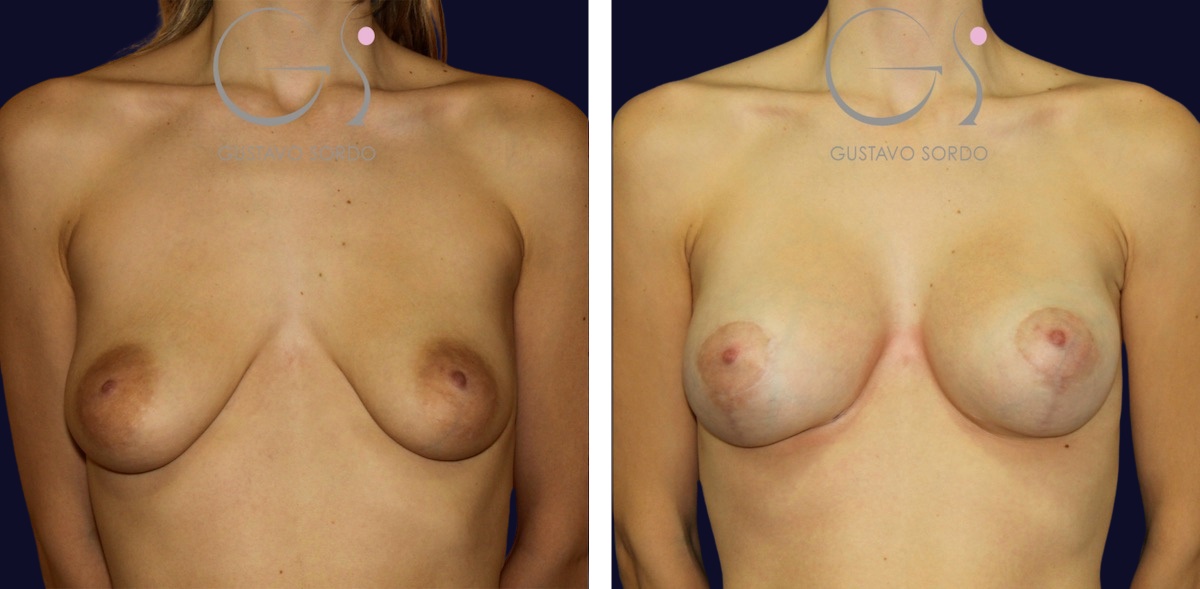
Degrees of breast ptosis
We can distinguish 4 degrees of breast ptosis:
- Grade I breast ptosis or breast pseudoptosis: This grade is usually found in small breasts. The areolas are located at the level of the submammary fold.
- Grade II breast ptosis: This degree also usually occurs in small breasts but in this case the areolas are located below the submammary fold.
- Grade III breast ptosis: This is a more pronounced case, caused by aging or significant volume loss. The areolas are located well below the submammary fold.
- Grade IV breast ptosis: This case is usually accompanied by significant hypertrophy with a pronounced drop of the breast with respect to its initial position (>40cm).
The surgical decision for nipple ptosis depends on two things: how much the nipple needs to be lifted and how much of the patient's own tissue remains . In mild cases of ptosis, a periareolar mastopexy, or even a well-chosen implant, may suffice; from grade 2-3 onward, a vertical or inverted T incision is necessary, and forcing a small scar in these cases guarantees a poor result in the medium term. It's important to know this beforehand: here, the scar is altered by its shape, and that's the real negotiation.
Regarding the implant placement, when available, we use the pinch test : if the pinch at the upper pole is fine, we opt for a submuscular placement with a microtextured implant, which provides coverage; if it's thick, we choose a subfascial placement with micropolyurethane , whose Velcro-like behavior effectively supports the sagging tissue. For those who prefer not to have implants, we create an autologous implant using the Ribeiro technique and a prepectoral Vicryl mesh, adding some lipofilling to augment the upper pole. An important caveat: significant ptosis is not a candidate for the Preserve technique.
Is breast ptosis bad?
Breast ptosis is not a dangerous condition from a health standpoint, but it can cause aesthetic and emotional discomfort for some people. While it doesn't affect breast function, some women may experience discomfort due to feeling uneasy about the appearance of their breasts. In such cases, surgery can be a solution to improve both aesthetics and self-esteem.
How is breast ptosis corrected?
There are many exercises to strengthen the pectoral muscles that can produce a slight improvement, but as we mentioned earlier, the pectoral muscles alone cannot provide firm support for a woman's breasts. To effectively correct breast ptosis, plastic surgery is necessary . The specific procedure will depend on the degree of breast ptosis the patient has.
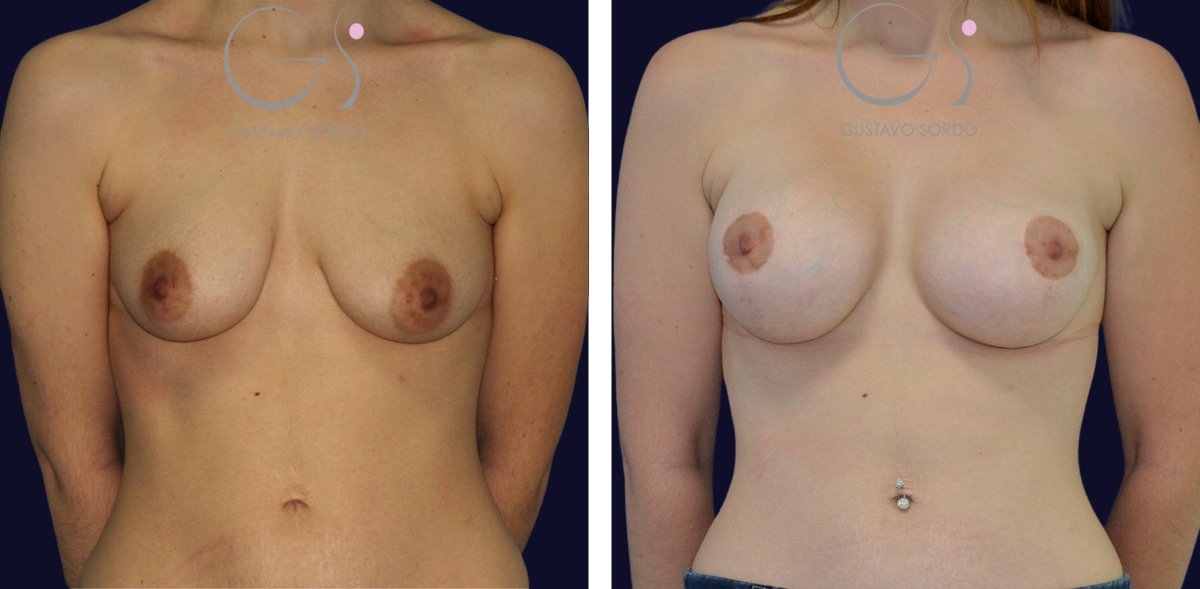
In cases of grade I and II breast ptosis, breast augmentation is recommended , which may be combined with a periareolar lift in the latter case . For grade III breast ptosis, a mastopexy (breast lift) is recommended. Grade IV breast ptosis is corrected with a breast reduction.
At Dr. Sordo's clinic, a plastic surgeon in Madrid , we analyze each patient's case individually. Only in this way can the plastic, aesthetic, and reconstructive surgeon make an accurate aesthetic diagnosis and offer the appropriate solution for each case.
For more information about breast ptosis, contact our plastic surgery clinic in Madrid.
Conclusion
Although non-surgical options such as creams and exercises exist, plastic surgery remains the most effective solution for correcting breast ptosis . Depending on the degree of ptosis, significant results can be achieved, restoring the shape and position of the breasts and improving both the aesthetics and self-esteem of those who desire it.
Continue reading
Dr. Gustavo Sordo
Specialist in Plastic, Aesthetic and Reconstructive Surgery. Member No. 282858125.
Content clinically reviewed by Dr. Gustavo Sordo. Last review: November 1, 2026.