Sagging Breasts: Best Procedures
Updated on • Reviewed by Dr. Gustavo Sordo, plastic surgeon
What causes breast sagging?
Genetic factors and natural aging
Genetics dictates the size and shape of your breasts and the quality of your skin. With age, there is a decrease in the production of collagen and elastin, the proteins responsible for skin firmness and elasticity.
If you are considering this operation, at mastopexy in Madrid you can find out how we work, real cases and the price (€8.600-€10.400).
Weight fluctuations, pregnancy and breastfeeding
Sudden weight changes are especially damaging to breast tissue. During pregnancy and breastfeeding, the skin and ligaments stretch. After this period, the volume decreases, but the stretched skin remains, resulting in sagging breasts.
Bad habits and external factors
Not wearing a proper bra causes cumulative damage to the supporting tissues. Excessive sun exposure damages the elastin in the skin of the décolletage. And smoking and constantly slouching weaken the pectoral muscles and accelerate skin aging.
You might be interested in: types of breasts.
How do you know which procedure you need based on the degree of hair loss?
To prioritize the options, we use two very practical criteria. The first is how much the nipple needs to be lifted : in mild cases of ptosis, a well-placed implant or a periareolar mastopexy may suffice; from grade 2-3 onwards, a vertical or inverted T incision is necessary. The second is the pinch test : if the pinch of the upper pole is thin, a submuscular placement with a microtextured implant is recommended, as it provides coverage; if it is thick, a subfascial placement with micropolyurethane is recommended, as it adheres like Velcro and holds the sagging tissue very well.
To see real cases with a similar sagging to yours, use the breast simulator : choose the type of breast and it shows you the before and after photos of patients operated on at the clinic.
And for those who don't want implants, there's an alternative we frequently use: creating an autologous prosthesis using the Ribeiro technique . This involves reshaping the glandular tissue itself and securing it with a resorbable Vicryl mesh in the prepectoral plane, combined with a small amount of lipofilling to prevent the upper pole from appearing empty. Regardless of the technique, we always reconstruct the inframammary fold with a continuous suture, acting as an internal bra: this is what maintains the result over time.
Mild, moderate and severe hair loss: what changes in each case
In mild ptosis ( Grade I), the nipple is positioned approximately at the level of the inframammary fold but above the lower half of the gland. In moderate ptosis (Grade II), the nipple is below the inframammary fold and points forward or slightly downward. In severe ptosis (Grade III), the nipple and areola are well below the inframammary fold and point downward.
Why a personalized assessment is key
A common mistake is confusing "sagging breasts" with "empty breasts." In empty breasts, the nipple is in the correct position, but there is a loss of volume in the upper pole that gives a false impression of sagging; this can only be corrected with implants. True ptosis requires a mastopexy (breast lift).
Do sagging breasts always require surgery?
No. For very mild sagging or to prevent it, non-surgical treatments can offer subtle improvements. But these cannot reverse breast sagging once the ligaments have stretched and the skin has lost elasticity. Surgery is the only effective solution.
Mastopexy: the most effective procedure for correcting sagging breasts
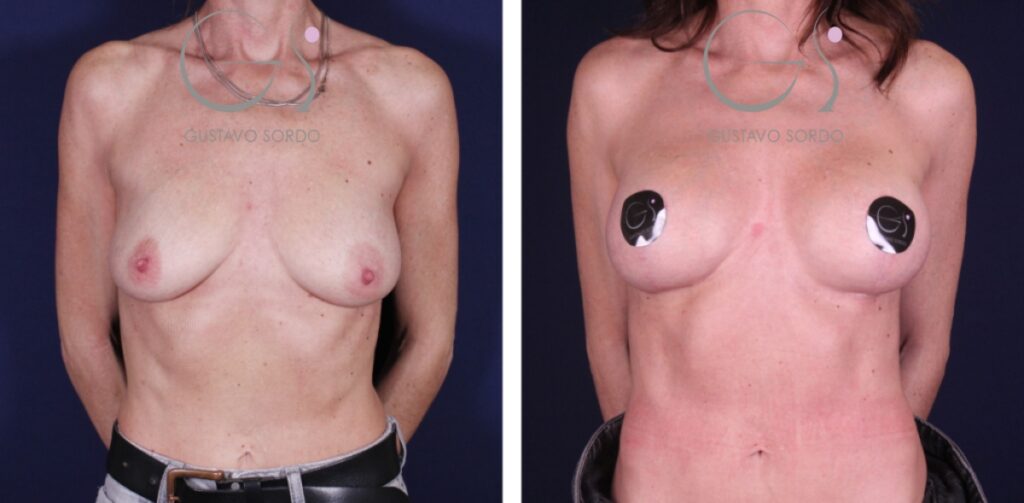
What is a mastopexy?
Mastopexy, or breast lift, is a surgical procedure to correct sagging breasts, reposition the nipple-areola complex, reshape glandular tissue, and remove excess skin. It is performed under general anesthesia and lasts between two and three hours.
Advantages
The effects can last between 10 and 15 years with proper care, offering an overall improvement by lifting the breasts and centering the areola. It can be combined with implants or lipofilling to add volume.
When is it usually recommended?
It is indicated for women with grade II or III ptosis, with loose skin and who are satisfied with their breast volume or desire a moderate increase.
Mastopexy with or without implants: Which to choose?
Mastopexy without implants
It's ideal for women who simply want to correct sagging, are satisfied with their current breast volume, or have large breasts that need lifting. Only skin is removed and the glandular tissue is reshaped. No external volume is added; it provides firmer, more youthful-looking breasts, but with the same or slightly smaller size.
Mastopexy with implants
It is ideal for women with small to medium-sized breasts that have lost volume and are sagging. An implant is placed to restore projection and volume, as well as lift the breasts, increasing their size, improving their shape, and providing a comprehensive breast lift.
Which option usually gives a more natural result?
The most natural option is the one that best suits your anatomy. For a woman with small, sagging breasts, a mastopexy without implants can result in even smaller, flatter breasts, making implants a better option. Conversely, implants are usually unnecessary for large, sagging breasts.
You may also be interested in: scarless mastopexy.
Preserve Technique: an innovative option for mild sagging or empty breasts
The Preserve technique is an advanced form of breast augmentation that allows for restoring volume in a way that is gentler on breast tissue. It is performed without general anesthesia in many cases and results in a faster and more comfortable recovery.
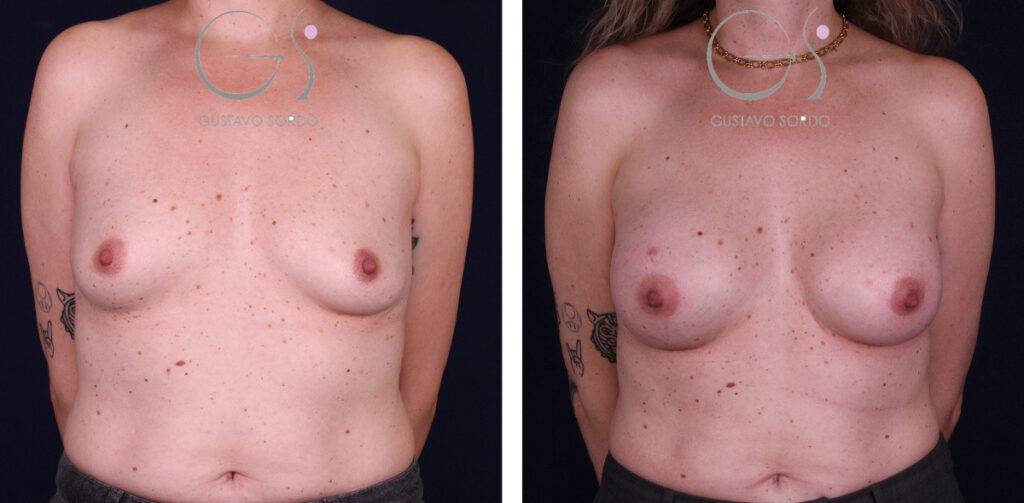
In which cases is it indicated?
It is especially interesting in patients with:
- Mild drooping (grade I ptosis)
- "Empty" breasts after pregnancy, breastfeeding, or weight loss
- Loss of volume at the upper pole
In these cases, the nipple is usually well-positioned, but the lack of volume gives the appearance of drooping. Here, more than lifting, what we need is to fill and project.
what results can be expected?
The Preservé technique allows the breasts to regain their shape and projection naturally, without the need for a mastopexy in selected cases.
The result is a fuller, more harmonious and rejuvenated chest, with a more comfortable recovery.
It's important to consider
When there is excess skin or moderate to severe sagging (grade II or III ptosis), mastopexy remains the treatment of choice. In these cases, the Preserve technique can be combined with, but does not replace, a breast lift.
Breast lipofilling: an increasingly sought-after alternative
What is lipofilling?
It is a technique that uses the patient's own fat (extracted by liposuction from areas such as the abdomen or thighs) to inject it into the breasts.
In what cases is it usually recommended?
To correct mild to moderate sagging breasts where volume is lacking but there is no significant excess skin, to improve shape, fill the upper pole and camouflage irregularities after a mastopexy.
what results can be expected?
The results are a subtle and natural increase in volume, improving texture and shape. It cannot correct excess skin or severe sagging. Furthermore, not all of the injected volume is retained; some is reabsorbed.
Breast reduction with lift
How is it the procedure?
This surgery combines a mastopexy with a volume reduction. The surgeon removes excess glandular tissue, fat, and skin, and then repositions the nipple and areola.
When is it recommended?
It's the ideal option for women with large, heavy, and sagging breasts. The goal is to relieve physical symptoms such as back pain, shoulder creases from the bra, or irritation in the inframammary fold.
Differences with mastopexy and lipofilling
A pure mastopexy lifts, maintains, or does not change breast size. Lipofilling adds subtle volume, does not correct moderate/severe sagging, and does not remove skin. And reduction with lift reduces size, relieves weight, and lifts the breasts in a single procedure.
What is the best procedure for sagging breasts according to your aesthetic goal?
If you want to lift, but not increase in size
Choose a mastopexy without implants if you like your current volume or if you have large breasts that need to be repositioned.
If you want to increase and regain volume
Opt for a mastopexy with implants to restore a breast that has "emptied and sagged" after motherhood or weight loss.
If you're looking for a more subtle and natural change
Consider breast lipofilling only if your sagging is very mild and your main concern is lack of volume. For more defined results, it is sometimes combined with a minimal mastopexy.
How much does breast lift surgery cost?
Prices vary depending on the clinic, the surgeon's experience, the geographical location, and the complexity of the case. At our clinic, the price of a mastopexy in Madrid ranges from approximately €8.600 to €10.400. The final price is always personalized and tailored to each individual case, so an initial consultation is necessary.
Post-operative care and recovery after surgery for sagging breasts
Rest and support
After surgery, you will need to wear a surgical or compression bra for approximately four weeks. It is normal to experience swelling, bruising, and some discomfort. You should also avoid raising your arms above your shoulders and strenuous activity.
Physical activity and return to normal
My protocol is one of early mobilization , not rest: at 24 hours, raise your arms overhead and approximate your shoulder blades for 30 seconds, once an hour; from the third day onward , also walk for 30 minutes a day. From day 7, the 1 kg weight limit is lifted, and mobility is unrestricted: move your arms whenever you want, without repeating the exercise every hour. Sports are postponed for the first month ; after a month, begin with gentle, progressive cardio and isometric exercises that don't involve the pectoral muscles . Intense isometric pectoral exercises are postponed for six months , except when the implant is in the subfascial plane , where they can be started after a month.
Scar care
The scars become barely visible. Applying laser or silicone products post-operatively, protecting the scars from the sun for a year, and maintaining good hydration are key to optimal healing.
2026 Trends in Breast Surgery for Sagging Breasts
The search for a more natural result
The desired breast shape is one that doesn't appear surgically altered, with a gentle upper slope and a subtle lower drop.
More comfortable recoveries and more modern protocols
The use of advanced anesthetic techniques and ergonomic post-operative bras shortens recovery time. Short incisions are prioritized to minimize scarring.
Less artificial volume and more body harmony
The trend is towards moderately sized implants that integrate with the patient's morphology.
Better balance between shape, size, and body harmony
The ultimate goal is a bust that is in proportion to the shoulders, waist, and hips. The surgery is conceived as part of an overall body harmonization.
Risks, scars, and realistic expectations
What kind of complications can these procedures cause?
As with any surgery, there are risks: bruising, infection, altered sensation, asymmetry, or poor healing. In mastopexies with implants, the specific risks associated with the implants are added.
Are there risks of scarring?
Yes, mastopexy and reduction leave scars. The surgeon will place them in the least visible areas. With time and proper care, they fade significantly, but they don't disappear completely.
Importance of choosing a qualified surgeon
Choosing a surgeon who is a member of SECPRE (Spanish Society of Plastic, Reconstructive and Aesthetic Surgery) guarantees that they are specialized and qualified. A good surgeon will honestly inform you about the risks, show you real results from previous cases, and help you have realistic expectations.
Frequently Asked Questions (FAQs)
What is the best procedure for sagging breasts?
The best option is the one that suits your degree of sagging, current breast volume, and aesthetic goals. A mastopexy with implants is the most versatile for sagging with volume loss. A mastopexy without implants is ideal if you only need a lift.
How many years does a mastopexy last?
The results last between 10 and 15 years. However, natural aging and gravity continue to take their toll. Maintaining a stable weight and wearing a supportive bra helps prolong the results.
Which is better, a breast lift or implants?
These aren't mutually exclusive options, just different ones. If your nipple is low-set, you need a breast lift (mastopexy). If your nipple is in good condition but lacks volume, you need implants. If you have both problems, you need both procedures.
How long is the recovery period after breast surgery?
At least two weeks of rest from daily activities and driving are needed. A return to sedentary work is possible after two to three weeks. High-impact sports can be resumed after two months.
Take the first step towards a chest in harmony with you
Choosing the right treatment is not just an aesthetic issue; it is a decision that should be based on your anatomy, your goals, and a specialized medical opinion.
At the Plastic Surgery Clinic in Madrid , Dr. Gustavo Sordo, a plastic surgeon in Madrid , will assess your case in a personalized way to recommend the option that best suits you, whether it is a mastopexy in Madrid , a Preserve breast augmentation technique in Madrid or a combination adapted to your needs.
Conclusion
Today, plastic surgery offers a range of precise and personalized solutions. Investing in information and a good professional is the first step to regaining firmness, harmony, and confidence in your own body.
Dr. Gustavo Sordo
Specialist in Plastic, Aesthetic and Reconstructive Surgery. Member No. 282858125.
Content clinically reviewed by Dr. Gustavo Sordo. Last review: October 7, 2026.