Post-operative care after breast augmentation: The definitive guide

Reviewed by Dr. Gustavo Sordo, plastic surgeon
The postoperative period for breast augmentation using the “24h Recovery” technique is simple, although we must follow a series of recommendations to achieve an optimal and complication-free recovery from breast augmentation.
If you want to see how your breasts would look , here are real cases sorted by breast type and a simulation of the consultation next to the result.
Timeline of the surge recovery
of breasts:
Breast augmentation recovery in Madrid for my patients is a rapid process that is completely different from the post-operative period of traditional breast augmentation techniques. This is the typical recovery time for a patient who has undergone the "24h Recovery" technique:
What is the actual postoperative period like at our clinic, to help you manage your expectations? When the patient is a candidate for the Preserve technique —subfascial plane, 2,5 to 3 cm incision, space created with a balloon without cutting the muscle—the procedure is performed under local anesthesia and sedation . The patient can move their arms the same day and goes home without being admitted, or after a short time in an outpatient setting. We don't use drains : with careful hemostasis, there is nothing to evacuate.

When and how do the arms move after breast augmentation?
Yes, the post-operative orthopedic bra we provide during your consultation—from the Crisvi brand in Madrid— is essential . It supports the implant while the pocket heals. Medication is sent home in advance, so you don't need to bring pills to the hospital. When the augmentation is performed submuscularly , because the pinching of the upper pole is minimal, the immediate post-operative period is somewhat more uncomfortable due to the strain on the muscle. In both cases, gentle exercise is recommended starting at one month, and high-impact exercise or weightlifting after two to three months.
Leaving the operating room
All my patients leave the operating room wearing a post-operative bra , without the need for drains or bandages. They can return to their daily lives within 24 hours of the surgery. Even if the patient feels well and can resume normal activities, I always recommend taking 4 to 7 days off work. This way, we avoid putting the body under unnecessary stress.
24 hours after the operation
Although this surgery can be performed on an outpatient basis, all my patients stay overnight at the Moncloa Hospital in Madrid . The following morning, I will conduct the first follow-up appointment in the patient's hospital room. At this time, we will gradually move the patient's arms, eventually raising them fully. Once we confirm that everything is progressing well, we will discharge the patient. The patient will experience breast discomfort similar to the pressure of a postpartum milk coming in. To manage this discomfort, she will need to take prescribed pain medication every four hours. This discomfort should disappear completely within a week.
First week postoperatively
Thanks to the analgesic treatment, the discomfort will gradually disappear. During this week you should sleep on your back and should not lift anything over 1kg.
One week after breast augmentation
The patient will come to our clinic for a second check-up. At this time, the scar will be treated without pain and a small dressing will be applied, which she will have to remove at home after 2 or 3 days. She will begin to take care of the scar with the cream that we will prescribe.
The chest discomfort will have disappeared and the patient will be able to lift weights of more than 1kg with her arms, which is the maximum weight that can be lifted in the first week after surgery. One of the doubts that often arise for patients who have children is when will i be able to hold my child? At this point, they can do so as long as the child weighs less than 11kg and the movements they make to lift him are in blocks. This week they can already sleep on their side.
One month after breast surgery
We will conduct the third follow-up appointment. At this point, you will no longer need to wear the post-operative bra you have worn for 30 days. You can resume light, progressive cardio exercise —cycling, elliptical training, brisk walking—and isometric exercises that do not involve the pectoral muscles . High-impact activities (running, spinning, step aerobics, horseback riding) are reintroduced gradually, and intense isometric pectoral exercises should be postponed until six months , except for subfascial exercises, which can be performed now. In addition, after another two weeks, you will be able to sleep on your stomach.
At 6 months after breast surgery
Fourth check-up at Dr. Sordo's office. At this point, the breast will have lost all of the initial swelling. In addition, the touch will be natural and the sensitivity will be completely normal. We will check the state of the scar to continue with the most appropriate treatment.
At 12 months after breast augmentation
The breast augmentation scar has now fully matured and will go completely unnoticed. The patient can now sunbathe in this area. We carry out the final check-up with the post-operative photos to include them in the patient's medical record.
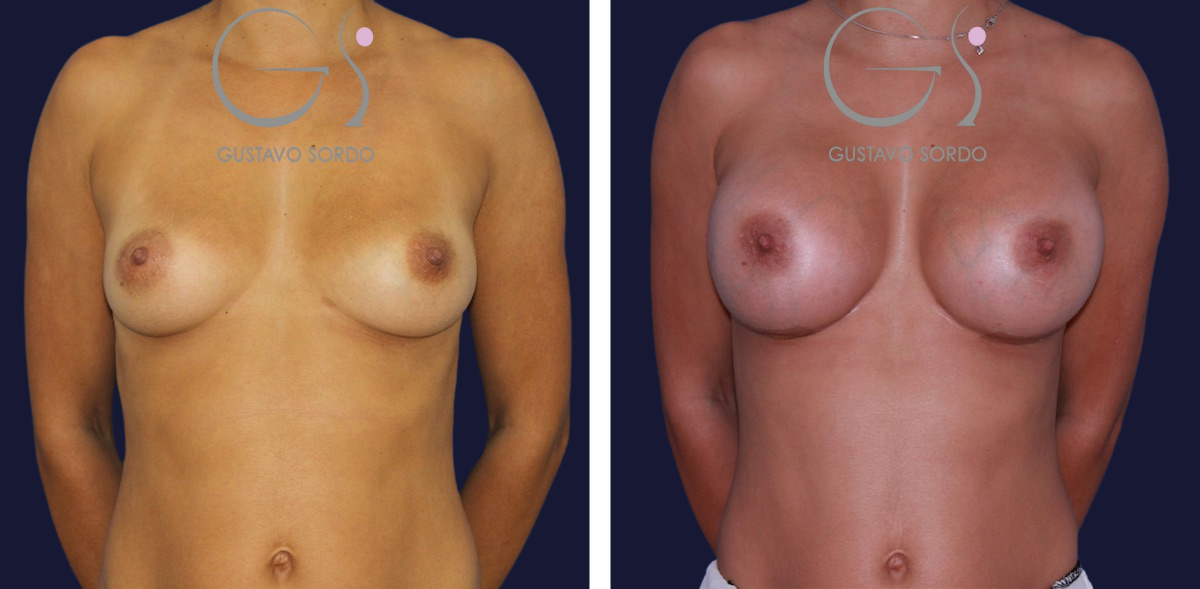
Postoperative characteristics and recovery from breast augmentation with the “24h Recovery” technique
- The patient will feel discomfort in the breast similar to the feeling of pressure from a post-partum milk surge. This discomfort will be controlled with the prescribed painkiller.
- You will be able to move, use your arms, lift weights using your legs (going up and down in blocks). Do any type of movement that does not cause pain.
- Inflammation and bruising vary from person to person.
- At the beginning of the month, you start with gentle and progressive cardio (elliptical trainer, stationary bike) and strength training that doesn't strain the chest muscles. Powerful isometric chest exercises are avoided for six months; in the subfascial plane, already a month later.
- After 5-6 days you will be able to sleep on your side.
- At 6 weeks, your baby can sleep on his stomach.
- It is not necessary to remove stitches (they are absorbable), drains or bandages (we do not use them).
- It is not necessary to massage them (“so that they do not become encapsulated”), in fact it is formally contraindicated with some implants.
- You must wear a sports bra for 30 days.
- The breasts swell at first and gradually decrease over the next 6 months.
- From the sixth month onwards, the touch is more natural and softer.
- The incision first turns red (inflammatory phase) and then whitens over the first year. In addition to the surgical laser that we use to reduce the scar by 35%, we will prescribe the patient a series of products that help with the scarring so that it is as unnoticeable as possible. In the end, the breast augmentation scar is usually a thin white line 1 mm thick.
- Sun exposure on the scar should be avoided for the first year.
For more information about post-operative care and recovery from breast augmentation, do not hesitate to contact Dr. Sordo, a plastic surgeon in Madrid.
Essential care after undergoing breast augmentation
The essential care that a person must follow after undergoing breast augmentation surgery is the following:
arm movements
Move your arms following the instructions of the medical staff who treated you and at the frequency indicated by them.
My protocol is specific: at 24 hours , raise your arms overhead and approximate your shoulder blades for 30 seconds, once every hour ; from the third day onward, also walk for 30 minutes daily . From day 7, the weight limit is increased to 1 kg, and mobility is unrestricted: your arms can be moved whenever you want, without repeating the exercise every hour. This approach is a clear differentiator: by mobilizing early and according to a plan, postoperative comfort increases. Most techniques require immobilizing the patient's arms, which negatively impacts their recovery. Here, I follow the philosophy of the 24h Recovery protocol and adapt it to the technique: in primary augmentation, the arms are raised at 24 hours; in Preservé, on the same day as surgery; and in secondary surgery with capsulectomy, micropolyurethane implants, and drains, we wait until the drains are removed.
Avoid efforts
Avoid everyday activities that strain the pectoral muscles for the first two weeks—such as pushing a heavy door or dragging a suitcase—as this is different from chest exercises at the gym. Heavy isometric chest exercises should be postponed for six months , except for subfascial exercises, where they can be resumed after a month. If you need to lift weights, move your body as a unit, using your legs, as explained in occupational health and safety guidelines. In other words, do not use your pectoral muscles to initiate the movement of your entire body.
Wearing a bra
Wear a sports bra that fits the patient for approximately one month. This garment must be worn 24 hours a day, even when sleeping. It should only be removed when showering.
Water care
Avoid letting water fall on the incisions during the first week, that is, before the patient comes for the first dressing. After this first visit to the clinic, we can shower with gel and allow water to fall on the scars.
Postoperative exercise
Exercise is put on hold for the first month . After a month, we begin with gentle, progressive cardio —stationary bike, elliptical, brisk walking—and isometric exercises that don't involve the pectoral muscles : core, legs, and glutes. Impact and vibration are reintroduced gradually from then on, not abruptly. What is put on hold is heavy isometric chest exercises, until six months . Important exception: if the implant is in the subfascial plane —Preservé, and in most polyurethane cases— isometric exercises can be performed as early as one month , because there is no pectoral muscle repair to protect.
Scar care
Take care of scars by following the routines indicated by the plastic surgeon. It is advisable to apply healing creams or ointments, avoiding direct exposure to the sun and using sunscreen on the scar area once it has completely closed.
How is breast ptosis corrected?
There are many exercises to strengthen the pectoral muscles that can produce a slight improvement, but as we mentioned earlier, the pectoral muscles alone cannot provide firm support for a woman's breasts. To effectively correct breast ptosis, plastic surgery is necessary . The specific procedure will depend on the degree of breast ptosis the patient has.
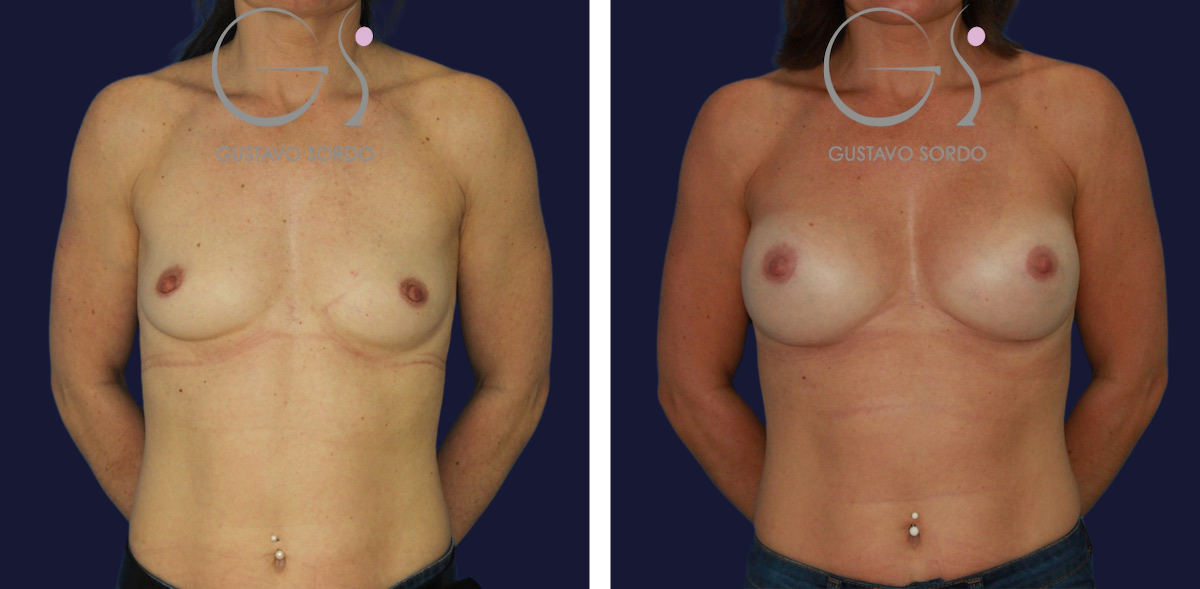
In cases of grade I and II breast ptosis, breast augmentation is recommended, which may be combined with a periareolar lift in the latter case . For grade III breast ptosis, a mastopexy (breast lift) is recommended. Grade IV breast ptosis is corrected with a breast reduction.
At Dr. Sordo's clinic, we analyze each patient's case individually. Only in this way can the plastic, cosmetic, and reconstructive surgeon make an accurate aesthetic diagnosis and offer the appropriate solution for each case.
For more information about breast ptosis, contact our Plastic Surgery Clinic in Madrid.
Continue reading
Dr. Gustavo Sordo
Specialist in Plastic, Aesthetic and Reconstructive Surgery. Member No. 282858125.
Content clinically reviewed by Dr. Gustavo Sordo. Last review: October 7, 2026.