Breast Reconstruction: Everything You Need to Know
Updated on • Reviewed by Dr. Gustavo Sordo, plastic surgeon
Breast reconstruction is a surgical procedure that seeks to restore the shape, volume, and symmetry of the breast after a mastectomy (a surgery in which the partial or total removal of the breast is performed) or due to a congenital malformation. This process not only has an obvious physical impact but can also have a significant emotional impact, as it has helped many women regain their sense of femininity, self-esteem, and confidence.
In this article, we will be exploring in depth what types of breast reconstruction exist today, what their main benefits are, and what the possible disadvantages and risks of each are, what their prices are, and what care is necessary to guarantee a good recovery and an optimal result.
The breast simulator has real cases sorted by breast type and examples of simulation versus real result.
What is Breast Reconstruction?
Breast reconstruction is a plastic or cosmetic surgery in which the breast is recreated using prostheses, the patient's own tissue (skin flaps), or a combination of both. This procedure can be performed immediately after a mastectomy (in which case it is considered immediate reconstruction) or even years later (in which case it is considered delayed reconstruction).
The main objective of this surgery is to achieve a natural and symmetrical appearance of the breasts, adapting to the needs and expectations of each patient and allowing them to regain a natural, feminine silhouette.
You may be interested in: breast asymmetry treatment.
Benefits of the procedure
Body Image Recovery
This procedure is a great help for women, allowing them to feel more comfortable and confident in their own bodies after a mastectomy. This, in turn, improves the patient's self-esteem, having a very positive psychological impact.
It does not require the use of external prostheses
By undergoing breast reconstruction, the patient no longer needs to wear padded bras or removable implants in her daily life, which provides greater comfort and less worry in her daily life.
natural results
The techniques that have been developed today allow for a reconstruction very similar to the original breast, with results in which it is difficult to notice that surgery has been performed.
Breast symmetry
Breast reconstruction can be combined with some surgeries on the contralateral breast to achieve a very appropriate aesthetic balance.
Immediate or delayed: what we saw in a study of 526 women
The question I'm most frequently asked isn't which technique is used, but when to perform reconstruction: during the same mastectomy surgery or later. I don't answer based on hearsay. During my time in the Plastic Surgery Department at La Paz University Hospital, I participated in a study published in the Annals of Oncology that evaluated 526 women who had undergone mastectomies, comparing immediate reconstruction, delayed reconstruction, and no reconstruction.
The results were clear on two points. First, women who did not undergo reconstruction experienced significantly more psychological problems than those who did. Second, the order of preference after the procedure was clear: 94,8% of those who had immediate reconstruction would choose it again; among those who had delayed reconstruction, 87,3% would have preferred immediate reconstruction; and among those who did not undergo reconstruction, 56,1% would have preferred immediate reconstruction as well. Regarding aesthetic satisfaction, 63,5% of those who underwent reconstruction were quite or very satisfied, compared to 22,8% of those who did not.
That's why, when the oncology team allows it, I propose immediate reconstruction. It's not always possible—it depends on the type of tumor, whether there will be radiotherapy, and the condition of the tissues—and that needs to be discussed on a case-by-case basis. But it's important to know that the decision to "I'll look into it later" has a cost that is measured.
According to PubMed: Fernández-Delgado J, López-Pedraza MJ, Blasco JA, Andradas-Aragones E, Sánchez-Méndez JI, Sordo-Miralles G , Reza MM. Satisfaction with and psychological impact of immediate and deferred breast reconstruction. Ann Oncol. 2008;19(8):1430-4. DOI 10.1093/annonc/mdn153.
Types of breast reconstruction
There are several options for breast reconstruction, each with its own advantages and considerations.
In breast reconstruction, a decision must be made before the technique: what will be used for reconstruction . Will it be the patient's own tissue, an implant, or a combination of both? When there is insufficient tissue to cover the breast—common after radiotherapy— lipofilling is an extremely useful tool because it improves skin quality and thickness, as well as adding volume, and is usually performed in several sessions.
When using an implant, the choice of shell matters: in irradiated areas or those with a history of contracture, we use micropolyurethane , whose Velcro-like properties make it difficult for the capsule to organize and contract. To achieve symmetry with the opposite breast, we use a Crisalix 3D scanner for planning , which allows for fairly precise volume calculations. Reconstruction is almost never completed in a single surgical procedure, and stating this from the outset prevents frustration.
Reconstruction with prosthesis
This type of reconstruction uses silicone or saline implants to recreate the appearance of the breast. This is a less invasive technique than autologous tissue reconstruction and also has a shorter recovery time.
Its advantages include a faster surgery, shorter recovery time, and no additional scarring beyond that left on the breast. Its disadvantages include the risk of capsular contracture (i.e., hardening of the tissue around the implant) and the possible need for implant replacement in the future.
Reconstruction with autologous tissue (flaps)
In this type of reconstruction, tissue from other parts of the body, such as the abdomen, back, buttocks, or thighs, is used to reconstruct the breast. Different types of flaps can be used. For example, the TRAM flap uses muscle and fat from the abdomen; the DIEP flap uses only fat and blood vessels, without damaging the muscle. The latissimus dorsi flap uses muscle and skin from the back.
The advantages include more natural and long-lasting results and a reduced risk of rejection, as the patient's own tissue is used. However, the disadvantages include the longer surgical procedure time and the risk of scarring in the donor area.
Fat reconstruction
Also known as lipofilling, this technique involves extracting fat from another area of the body (such as the abdomen or thighs) and then injecting it into the breast. This method is often used for small volumes or for touch-ups after another breast reconstruction.
Its advantages include being a less invasive technique that provides very natural results, but its disadvantages include the fact that several sessions may be required and that it is not a suitable method for complete reconstructions.
Hybrid reconstruction
This type of reconstruction combines the use of implants with autologous tissue or the patient's own fat to achieve a better result, with a very natural appearance and good symmetry.
Why consider this surgery?
Overcoming breast cancer
For many women, breast reconstruction is also part of an emotional recovery process, which can symbolize having completely won the battle against breast cancer.
Correction of malformations
Some patients are born with breast abnormalities, such as Poland syndrome, and breast reconstruction can be very useful and practical for them.
Improves quality of life
Regaining a healthy figure can even help improve one's social and personal life. Furthermore, by no longer having to rely on external prostheses on a daily basis, the patient will experience greater comfort in their daily life.
Permanent results
Unlike external implants, breast reconstruction is a definitive solution, although it should be noted that some implants may need to be replaced after a certain number of years.
How much does breast reconstruction cost in 2026?
Prices may vary depending on the type of technique used, the location and clinic where it is performed, and the surgeon in charge.
At our clinic, the price for breast reconstruction with implants is around 6.400.
The final price is always personalized and adjusted to each case, so it is necessary to attend an initial consultation.
Additionally, in some countries, social security may cover part or all of a post-mastectomy breast reconstruction.
How long does recovery last?
In reconstruction with implants, I follow the same protocol as in the rest of the breast surgery : after 24 hours, the arms can be raised overhead and the shoulder blades brought together for 30 seconds, once an hour, along with a 30-minute walk each day. From day 7 onward, the weight limit is increased by 1 kg, and mobility is unrestricted: the arms can be moved whenever desired, without repeating the exercise every hour. The first month is spent without exercise, and after a month, gentle and progressive cardio is introduced.
There's an important difference to know beforehand: reconstruction always involves prolonged drainage , for more days than cosmetic augmentation. This isn't a sign that anything is wrong; it's a normal part of this surgery—and the same applies to polyurethane, which is often what we use here.
For flap reconstruction, a 4 to 6 week initial recovery period is required, and up to 3 months for full recovery.
When the reconstruction is done with lipofilling , that is, with the patient's own fat, it does not involve drainage and the same mobility pattern I just described is followed.
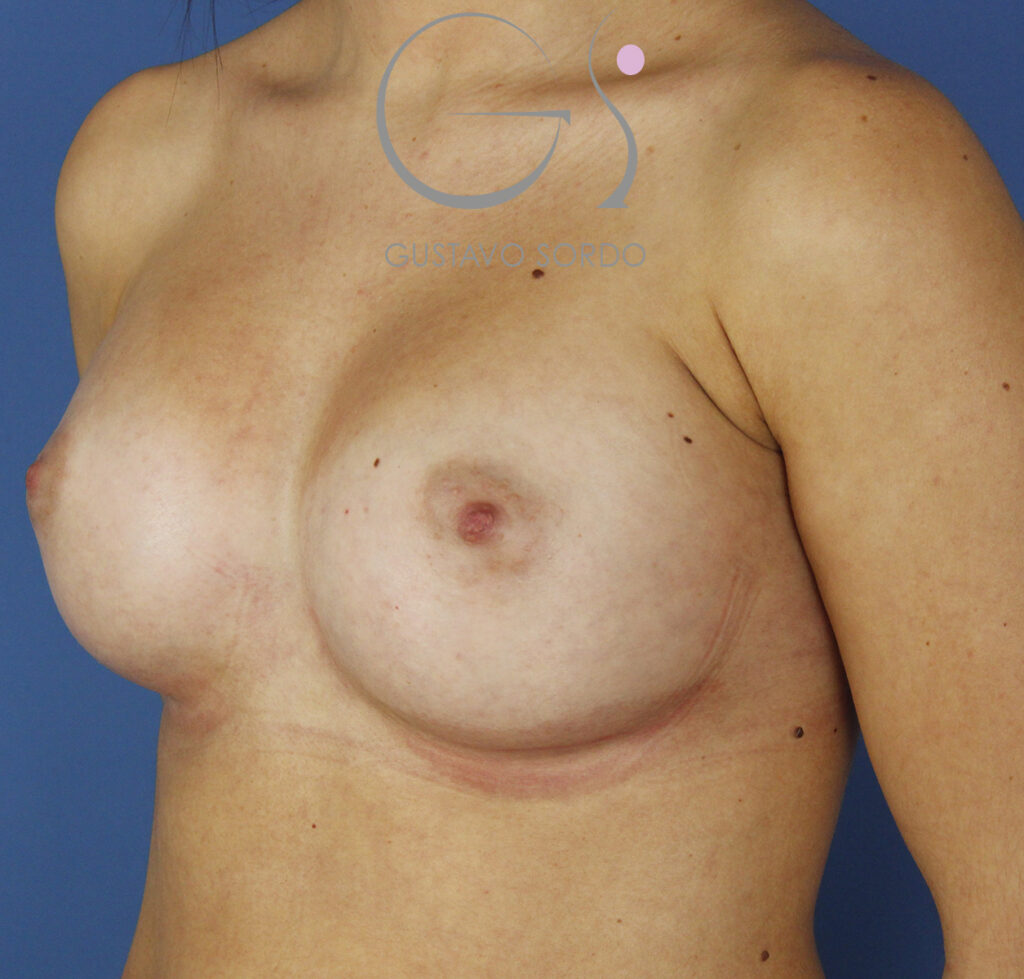
Breast reconstruction before and after
Before breast reconstruction, many patients often experience symptoms of anxiety, insecurity, or sadness due to the loss of their breast. Some use prostheses, or some even prefer to avoid looking in the mirror.
After surgery, most patients report increased confidence, greater satisfaction with their appearance, and a sense of closure after overcoming breast cancer. The aesthetic results can be very satisfying, especially when advanced techniques such as the DIEP flap are used.
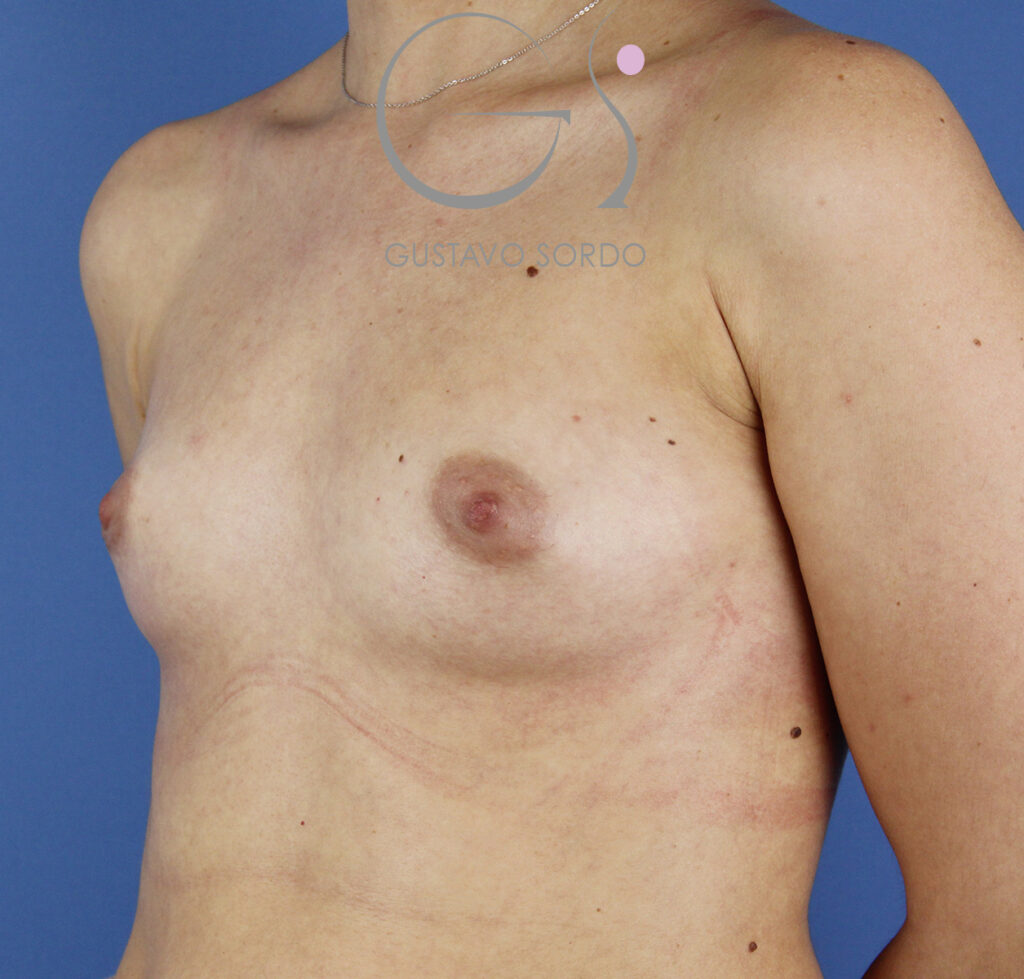
We recommend you take a look at our before and after breast augmentation cases.
Recovery and postoperative care
adequate rest
Physical exertion should be avoided during the first few weeks.
Post-surgical bra
A special bra should be worn to help support the breast and reduce inflammation for a period of time that the surgeon will indicate.
You may be interested in: surgical inner bra.
Lymphatic drainage
In some cases, the use of lymphatic drainage can help reduce swelling.
Medical monitoring
The patient should attend regular checkups with the doctor to assess her healing process and overall recovery.
avoid the sun
Direct exposure to sunlight should be avoided to prevent hyperpigmentation of scars.
Tips before and after surgery
Before the surgery
Several surgeons should be consulted to select the best provider from the available options. The patient should stop smoking and avoid any medications that may affect blood clotting. Additionally, the home should be prepared for a comfortable recovery period, such as providing enough pillows for proper rest and having food readily available.
After surgery
You should follow your doctor's specific instructions strictly, avoid lifting weights for the time prescribed, and use special scar creams (containing silicone) once your doctor has approved them.
Conclusion
Breast reconstruction is a surgical procedure that goes far beyond aesthetics; it's a tool that helps many women regain confidence and emotional well-being. With today's medical advances, there are now multiple options that can be tailored to each individual case.
If you are considering this surgery, you should consult with a medical specialist specializing in reconstructive surgery so they can evaluate the best technique for your case. You should always remember that, in many cases, this procedure may be covered in whole or in part by health insurance or some public health systems.
Dr. Gustavo Sordo is one of the few plastic surgeons in Madrid, specializing in breast augmentation , who uses the "24h Recovery" technique. This technique minimizes surgical complications , achieving natural-looking results. Come visit us at our plastic surgery clinic in Madrid.
The decision to undergo breast reconstruction is entirely personal, but knowing all the available options can help you make the best choice based on your body's needs and what can help improve your emotional health.
Continue reading
Dr. Gustavo Sordo
Specialist in Plastic, Aesthetic and Reconstructive Surgery. Member No. 282858125.
Content clinically reviewed by Dr. Gustavo Sordo. Last review: October 7, 2026.