Should breast implants be replaced every 10 years?

Updated on • Reviewed by Dr. Gustavo Sordo, plastic surgeon
We've all heard that breast implants need to be replaced every ten years. The short answer is no: an implant isn't replaced simply because it's getting older; it's replaced when there's a reason . But the full answer has a nuance that shouldn't be overlooked: implants aren't meant to last a lifetime either. What you really need to know is how long they actually last, what can happen over time, and how to monitor them. That's what this article is about.
If you are considering this operation, in the second breast surgery section you will find how we work, real cases and the price (from €4.500).
Where does the ten-year thing come from?
The figure comes from two sources. On the one hand, from old recommendations by the US FDA regarding silicone gel implants, which advised reviewing and considering replacement around that date. On the other hand, from the studies that manufacturers must submit for an implant to be approved, which follow patients for exactly ten years. Over time, "review at ten years" became "replace at ten years," and that's how it stuck in many people's minds. Today, no health authority recommends replacing an intact implant simply because it's ten years old.
What do the ten-year studies say?
The most robust data comes from FDA approval studies, which follow hundreds of women for a decade and, in some cases, perform regular MRI scans to detect ruptures that cause no symptoms. The results don't say "ten years and it's gone"; they say the risk increases gradually over the years and depends on the implant.
- In the ten-year study of Mentor round cohesive gel implants, the cumulative rate of primary rupture was 24,2%, the rate of severe capsular contracture was 12,1%, and the rate of any reintervention was 25,5% (Caplin and colleagues, 2021).
- In the ten-year study of the Natrelle 410 cohesive gel anatomical implants, confirmed rupture in the MRI group was 5,7%, and capsular contracture increased by about 1% per year from the sixth year onwards (Maxwell et al., 2015).
- In Sientra's ten-year study of 1.788 patients, the rupture rate per patient was 8,6% and the reoperation rate was 31,5%. More than half of those reoperations were for aesthetic reasons, mainly to change size or shape, not due to implant failure.Stevens et al., 2018).
- Outside of manufacturer studies, the Danish cohort that followed implants with repeated MRIs estimated that a modern implant that is intact at three years remains intact in 98% of cases at five years and in 83-85% at ten years, and that the risk of breakage increases with the age of the implant (Hölmich et al., 2003).
The figures vary so much because they don't measure the same thing: some count ruptures per implant, others per patient; some include all women, others only those who had MRIs. But the underlying message is the same in all of them: there's no expiration date; there's a curve that rises slowly over the years . After ten years, most implants are still intact, and some aren't. That's why what matters isn't the timeline, but monitoring.
The silent breakdown: why "noticing something" is not enough
A ruptured cohesive gel implant almost never deflates or changes shape overnight. The gel remains within the capsule that the body forms around the implant, and the breast remains unchanged. In the Danish study, clinical examination only detected 30% of the ruptures that were confirmed by MRI, and half of the implants that appeared intact upon examination were ruptured ( Hölmich et al., 2005 ). In other words, neither the patient nor the surgeon can rely solely on their hands.
The good news is that an intracapsular rupture is not an emergency. The same group followed women with untreated ruptures for two years and found that in most cases nothing changed, that only in a small percentage did the silicone migrate outside the capsule, and that there were no changes in autoimmunity markers ( Hölmich et al., 2004 ). Their conclusion, which I share, is that a rupture should be recognized and monitored, and generally operated on without haste, but it should not be ignored.
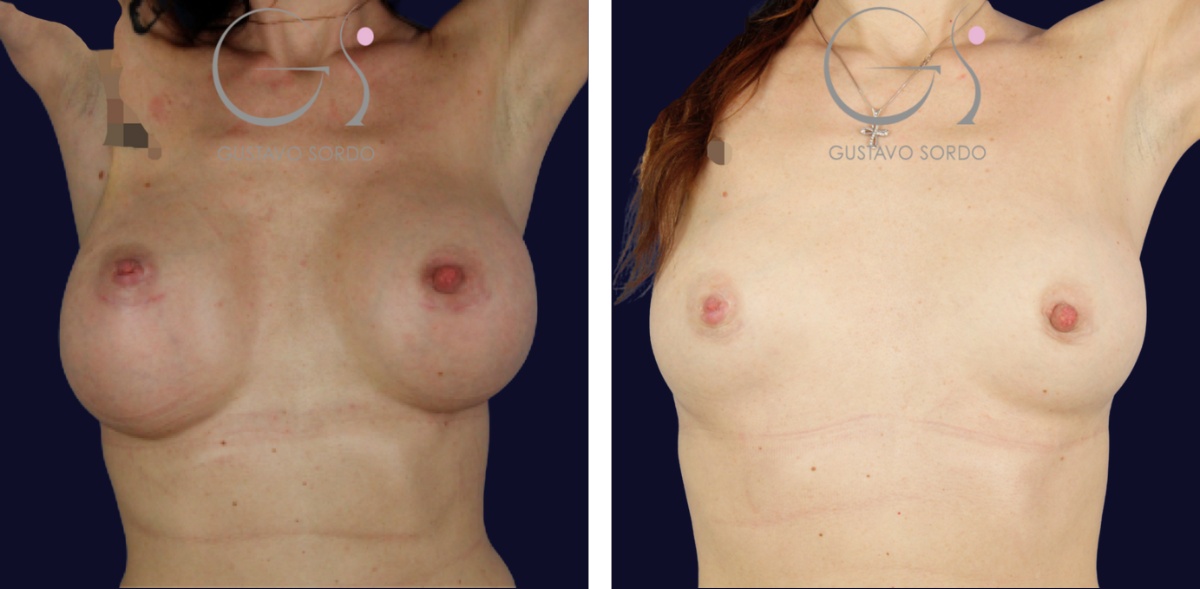
How are implants monitored?
The FDA updated its recommendations in 2021 and 2022: for asymptomatic silicone implants, imaging should be performed five to six years after surgery and then every two to three years, and ultrasound was accepted as an alternative to MRI for this screening ( Le-Petross, Scoggins, and Clemens, 2023 ). The two tests are not equally accurate. MRI is the most precise: in a series of 214 explanted implants, it detected 93% of ruptures with 93% specificity ( Maijers et al., 2014 ). Ultrasound is more accessible and does not require contrast, but it is less accurate: in a prospective study, overall accuracy was 94% for MRI and 72% for ultrasound, although a negative ultrasound result allowed MRI to be avoided in most cases ( Rietjens et al., 2014 ). And in both cases, who performs the procedure matters a great deal: radiologists with experience in implants recognize the signs of rupture almost perfectly, while those without experience only partially recognize them ( Pesapane et al., 2024 ).
In my practice, I do it this way: at each checkup, I examine the breast and use an ultrasound, which also helps me see if an anatomical implant has rotated—something I explain in this article about the rotation of anatomical implants . If the ultrasound is inconclusive, if there are symptoms, or if the implant is quite old, I order an MRI. After five or six years, I follow the FDA's recommended schedule even if there are no problems, and I ask the patient to come in sooner if she notices a change in shape, consistency, pain, or a lump.

The prosthesis check is done with ultrasound in the office itself.
When are implants replaced?
- Rupture confirmed. That's the clear indication. The implant is removed, the capsule is cleaned, and, if the patient wishes, a new one is placed in the same procedure.
- Capsular contracture. When the capsule hardens and deforms the breast or causes pain (Baker grades III and IV). This is the most frequent complication in all long-term studies and one of the leading causes of reintervention.
- Rotation of an anatomical implant. If the rotation is noticeable, it is corrected by changing to a round implant of the same size and adjusting the capsule.
- Changes in the breast itself. Pregnancy, weight fluctuations, or the passage of time can cause the tissue above an otherwise healthy implant to sag. In these cases, the problem isn't the implant itself, and the solution is usually a mastopexy, with or without implant replacement. I explain this on the website of second breast operation.
- Wanting a different size or shape. In fact, it is the most frequent reason for re-intervention in manufacturer studies. It is a legitimate aesthetic decision, not a medical necessity.
What's not on that list is "because the implant is ten years old." An intact implant, with soft breast tissue and a satisfied patient, doesn't require surgery.
What about implant-associated lymphoma?
Implant-associated anaplastic large cell lymphoma (BIA-ALCL) is a very rare disease, primarily linked to highly textured implants, and usually manifests as breast enlargement years after surgery, due to fluid buildup around the implant. There are two schools of thought regarding the management of textured implants that are not causing problems: some propose their removal as a precaution, while others believe that surgery is not justified for a woman without symptoms. The FDA aligns with the latter and does not recommend preventive removal. However, it is essential to consult a doctor immediately if a breast suddenly increases in size, especially after the first year.
What implants do we use in the clinic
We work with cohesive silicone gel implants from manufacturers who publish their long-term follow-up data and offer warranty programs. These programs typically cover implant replacement in case of rupture and, in some cases, a portion of the reoperation costs; the terms and timeframes are set by each manufacturer and vary ( Sullivan, Ryan, and Henderson, 2021 ), so I'll explain them to you with the relevant document in front of you during the consultation. Choosing the implant, volume, and placement is what we decide together during your first breast augmentation visit.
If you've had implants for years and don't know their condition, the first step isn't surgery: it's a check-up with ultrasound. And if you're considering getting them, you can see an approximation of how they would look with the simulator below.
Want to get an idea of how your breasts would look? In the breast augmentation simulator , you choose the breast type most similar to yours and see real cases operated on in the clinic.

Highlighted
- Caplin DA, Calobrace MB, Wixtrom RN, Estes MM, Canady JW. MemoryGel Breast Implants: Final Safety and Efficacy Results after 10 Years of Follow-Up. Plast Reconstr Surg. 2021;147(3):556-566. doi:10.1097/PRS.0000000000007635
- Maxwell GP, Van Natta BW, Bengtson BP, Murphy DK. Ten-year results from the Natrelle 410 anatomical form-stable silicone breast implant core study. Aesthet Surg J. 2015;35(2):145-155. doi:10.1093/asj/sju084
- Stevens WG, Calobrace MB, Alizadeh K, Zeidler KR, Harrington JL, d'Incelli RC. Ten-year Core Study Data for Sientra's Food and Drug Administration-Approved Round and Shaped Breast Implants with Cohesive Silicone Gel. Plast Reconstr Surg. 2018;141(4S):7S-19S. doi:10.1097/PRS.0000000000004350
- Hölmich LR, Friis S, Fryzek JP, et al. Incidence of silicone breast implant rupture. Arch Surg. 2003;138(7):801-806. doi:10.1001/archsurg.138.7.801
- Hölmich LR, Vejborg IM, Conrad C, et al. Untreated silicone breast implant rupture. Plast Reconstr Surg. 2004;114(1):204-214. doi:10.1097/01.prs.0000128821.87939.b5
- Hölmich LR, Fryzek JP, Kjøller K, et al. The diagnosis of silicone breast-implant rupture: clinical findings compared with findings at magnetic resonance imaging. Ann Plast Surg. 2005;54(6):583-589. doi:10.1097/01.sap.0000164470.76432.4f
- Le-Petross HT, Scoggins ME, Clemens MW. Assessment, Complications, and Surveillance of Breast Implants: Making Sense of 2022 FDA Breast Implant Guidance. J Breast Imaging. 2023;5(3):360-372. doi:10.1093/jbi/wbad029
- Maijers MC, Niessen FB, Veldhuizen JFH, Ritt MJPF, Manoliu RA. MRI screening for silicone breast implant rupture: accuracy, inter- and intraobserver variability using explantation results as reference standard. Eur Radiol. 2014;24(6):1167-1175. doi:10.1007/s00330-014-3119-8
- Rietjens M, Villa G, Toesca A, et al. Appropriate use of magnetic resonance imaging and ultrasound to detect early silicone gel breast implant rupture in postmastectomy reconstruction. Plast Reconstr Surg. 2014;134(1):13e-20e. doi:10.1097/PRS.0000000000000291
- Pesapane F, Rotili A, Signorelli G, et al. Retrospective study on the strength of magnetic resonance signs for predicting breast implant rupture: assessing the impact of radiologist expertise at a breast cancer referral center. Radiol Med. 2024;129(12):1802-1811. doi:10.1007/s11547-024-01926-4
- Sullivan B, Ryan I, Henderson PW. Objective Comparison of FDA-Approved Breast Implant Products in the USA: 5-Year Update. Aesthetic Plast Surg. 2021;45(6):2568-2577. doi:10.1007/s00266-021-02395-0
Continue reading
Dr. Gustavo Sordo
Specialist in Plastic, Aesthetic and Reconstructive Surgery. Member No. 282858125.
Content clinically reviewed by Dr. Gustavo Sordo. Last review: October 7, 2026.