Types of mastopexy according to the shape of the breast

Updated on • Reviewed by Dr. Gustavo Sordo, plastic surgeon
Mastopexy is a surgical procedure that lifts, corrects sagging, and reshapes drooping breasts in women . This sagging can be due to various reasons, so each procedure will have different characteristics. Therefore, before performing any cosmetic surgery, a thorough evaluation of each individual is necessary to determine the precise incision points required to restore the breasts to their original position.
Want to get an idea of how your breasts would look? In the breast augmentation simulator , you choose the breast type most similar to yours and see real cases operated on in the clinic.
Types of mastopexy
Depending on the shape of the breasts, different types of mastopexy are performed . Therefore, the first thing we must determine is what type of breasts the woman has. In this sense, we can distinguish four types of breasts according to their shape, appearance, and condition. The most common are:
To choose the technique, we use a very practical criterion: how many centimeters the areola-nipple complex needs to be lifted . If the lift is small, a periareolar incision—a scar hidden at the edge of the areola—is sufficient and very effective. If the lift is greater, a vertical incision is necessary , and in cases of significant sagging or large breasts, an inverted T incision. Forcing a small scar on a large area of sagging is a classic mistake: the scar widens, the areola becomes deformed, and the result doesn't last.
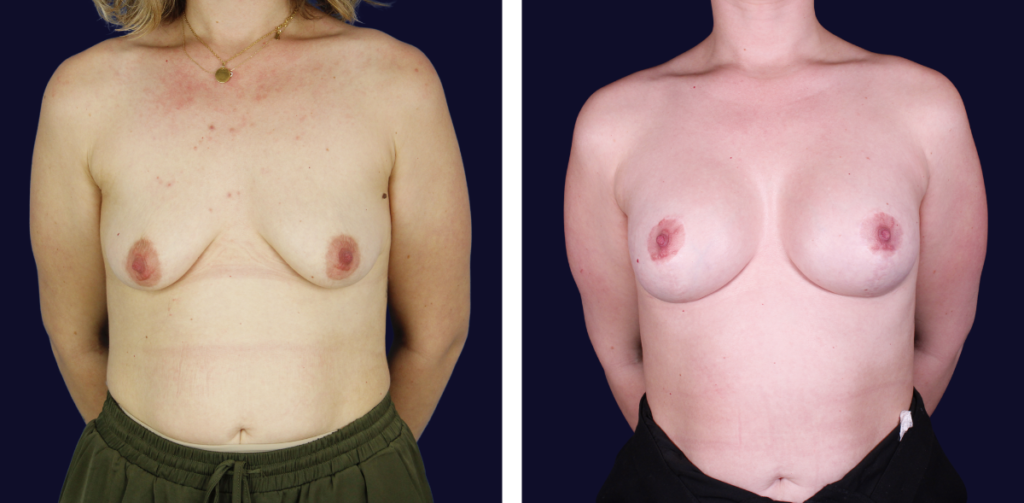
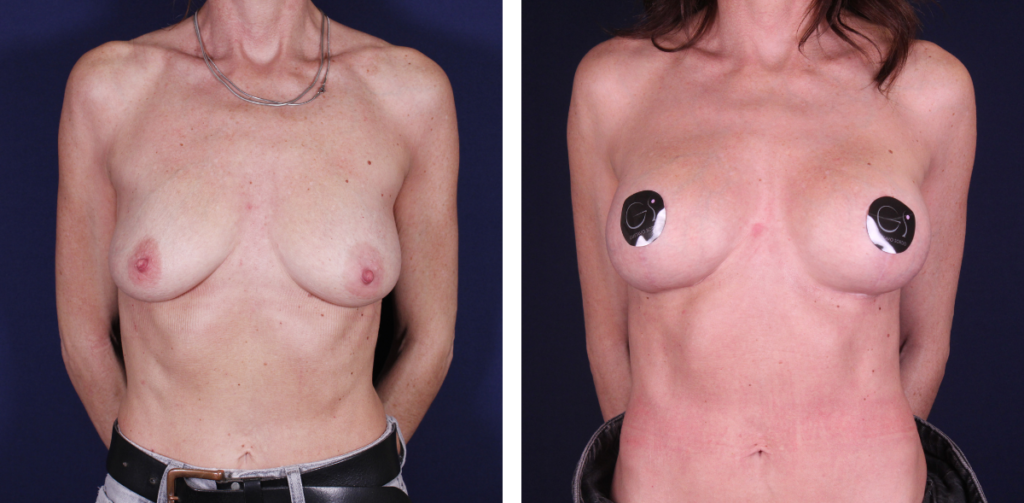
The second criterion is the amount of remaining volume . If the breast is depleted, mastopexy alone results in a flat upper pole, so volume must be added: either with an implant, or with an autologous prosthesis using the Ribeiro technique —remodeling the patient's own glandular tissue and securing it with absorbable Vicryl mesh in the prepectoral plane—combined with some lipofilling for patients who prefer not to wear implants. In all cases, we reconstruct the inframammary fold to act as an internal bra.
1.- Small breasts
In this case, the breasts have little fatty tissue and excess skin. These are generally women who have undergone one or more pregnancies, after which the breast tissue has atrophied substantially. In this case, the mastopexy performed is combined with breast augmentation . During this operation, an implant ( inverted implant ) is placed to add volume, usually under the pectoral muscles. Excess skin is removed, and the breast is lifted over the volume gained with the implant. Many of these women wish to regain the shape and volume their breasts had before their pregnancies.
2.- Big breasts
In this case, the volume of fatty tissue is high, and the nipples and areolas are large. This excess weight causes the breasts to sag, resulting in drooping. To correct this type of breast, surgeons in Madrid often opt for breast reduction surgery . This procedure involves reshaping the nipple, areola, and breast tissue, giving this part of the body a new and correct position, placing them higher than before the surgery. Since there is already excessive volume, breast implants are not usually used.
3.- Tubular breasts or tuberous breasts
Breasts of this type are those that have a cylindrical shape, with nipples and areolas of variable size and an irregular volume distribution in the breast that causes sagging. In these cases, a mastopexy is usually carried out, where the breast is repositioned in the centre of the thorax while an increase in volume is offered by means of anatomical breast implants (with the idea of normalising the volume distribution in the breast). The problem in these cases is twofold: poor volume distribution and also sagging of the breast.
You may also be interested in: scarless mastopexy.
It is up to the surgeon to choose the type of mastopexy that he will perform.
Even if it is necessary to combine this intervention with any other correction, augmentation or reduction. Basically, the mastopexy that needs to be performed will be larger (or involve larger scars) the greater the degree of sagging that the patient has. It is logical to think that the more skin there is left, the more will have to be removed and therefore larger incisions will be needed.
So, if you're unhappy with the appearance or shape of your breasts, it's best to schedule an appointment at Dr. Gustavo Sordo's Plastic Surgery Clinic in Madrid . He will advise you on the best way to achieve a beautiful cleavage without leaving visible scars or significantly impacting your daily life.
Don't miss taking a look at all our before and after mastopexy cases.

Continue reading
Dr. Gustavo Sordo
Specialist in Plastic, Aesthetic and Reconstructive Surgery. Member No. 282858125.
Content clinically reviewed by Dr. Gustavo Sordo. Last review: October 7, 2026.