Can blepharoplasty or eyelid surgery affect vision?

Updated on • Reviewed by Dr. Gustavo Sordo, plastic surgeon
When we think about correcting aspects of our face, doubts often arise. In the case of undergoing eyelid surgery , we might wonder: Can blepharoplasty, or eyelid surgery, affect vision?
This is not an isolated case, as there are many times when we think that cosmetic surgery can have unexpected consequences, and even affect the normal functioning of other organs.
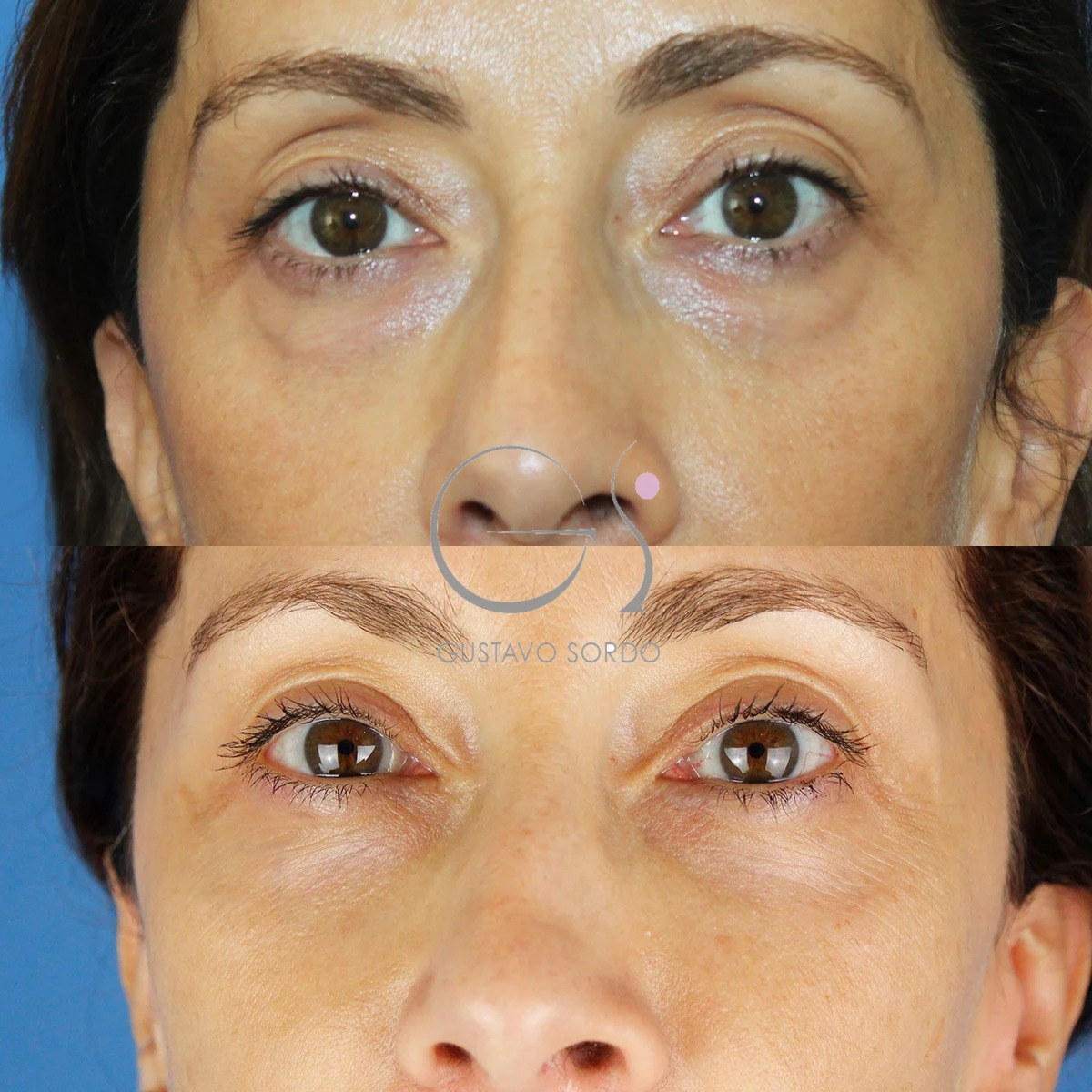
According to Dr. Gustavo Sordo , blepharoplasty surgery can affect a person's vision . However, these changes are always for the better . This is because when the skin of the upper eyelid hangs or droops above the eyelashes, it obstructs the person's field of vision . Therefore, it is necessary to remove it to restore vision.
It should also be noted that in the context of blepharoplasty, no intervention is performed on the eyeball. Therefore, previous diseases related to the patient's vision will not affect blepharoplasty. This intervention consists of removing excess skin from the upper eyelid and fat pads from the lower eyelid.
When, in addition, blepharoplasty is performed using the No touch technique – as happens in the clinic run by Dr. Gustavo Sordo – not only is the patient rejuvenated, but the patient's anatomy is also respected so that it closes over the eye and performs its fundamental function.
Therefore, blepharoplasty performed using the No Touch technique — the safest technique in cosmetic surgery— does not negatively affect the patient's vision . However, it can have a positive effect when the removed skin obstructs the patient's field of vision; after the excess skin is removed, the person will regain their ability to see.
In any case, if you are considering undergoing surgery to correct droopy eyelids and rejuvenate your appearance , visit Dr. Gustavo Sordo's office so he can study your specific case and offer you the best possible solution.
Temporary or modifiable cosmetic surgeries
Other cosmetic surgery procedures do have a temporary effect, although this period can last for decades. This is the case, for example, with the facelift we performed on this patient. This surgery only lasts for ten years . After this time, the person will feel slightly better or the same as before the procedure. Of course, ten years will have passed during which the patient will have enjoyed a much more youthful and healthy appearance.
The situation is similar with liposuction . In this case, the effects of the surgery will last longer if the patient maintains their figure. If a person gains weight after liposuction, they will regain weight sooner in the areas not treated with liposuction than in the treated areas. However , if the person maintains a stable weight, the areas treated with liposuction will not regain volume.
Something similar happens with abdominoplasty , which is also subject to the patient's weight fluctuations. If the patient's weight remains stable, the abdominoplasty will have a lasting, lifelong effect.
Breast implant procedures, such as breast augmentation and breast lift with augmentation, have a very long-lasting effect . However, this is directly related to the durability of the implant and the patient's breast size fluctuations. While implants are designed to last a lifetime , they may require replacement at some point during the patient's life.
To ensure the longevity of the surgery, at Dr. Gustavo Sordo's clinic we use a rapid recovery technique that also protects against capsular contracture, the most frequent cause of reoperation in breast augmentation. Furthermore, Dr. Sordo uses the most prestigious implants available worldwide, minimizing the need for replacements.
Finally, it's important to note that the duration of breast reduction surgery is also related to the patient's weight fluctuations . This is also true for breast augmentations and lifts. If there is significant weight fluctuation, the breasts suffer the consequences of these changes, just as if the surgery hadn't been performed at all.
In addition to rhinoplasty and blepharoplasty, which are permanent, patients who maintain a healthy lifestyle and avoid significant weight fluctuations will prolong the results of their cosmetic surgeries . For more information, consult with Dr. Sordo without obligation.
The clinical response is that a well-indicated and well-performed blepharoplasty does not damage vision ; in fact, when excess skin of the upper eyelid encroaches on the visual field, it improves it. It is also important to distinguish this from a condition that is often confused with it: acquired ptosis , in which what droops is not the skin but the free edge of the eyelid itself, which lies inside the iridocorneal margin . In this case, removing skin solves nothing; we perform the phenylephrine test and, if there is a response, we correct with a tarsoconjunctival Müllerectomy using a sutureless technique with bipolar forceps, which slightly shortens the Müller muscle and opens the eyelid a few millimeters (Simsek et al., 2026, Br J Ophthalmol ). But it is important to explain where the real risk lies, because it exists: in transconjunctival lower blepharoplasty, a Colorado-type microdissection needle is used, positioned close to the eyeball, and in this situation, an unexpected movement by the patient can cause an inadvertent injury.
That's why we emphasize two things so much: a good anesthesiologist and choosing the right type of anesthesia based on the patient's profile, so they remain completely still and calm. Under these conditions, the risk is very low. It is normal—and temporary—to experience blurred vision from the eye ointments, dryness, or tearing during the first few days. What is never normal is intense pain with vision loss: that requires immediate medical attention.
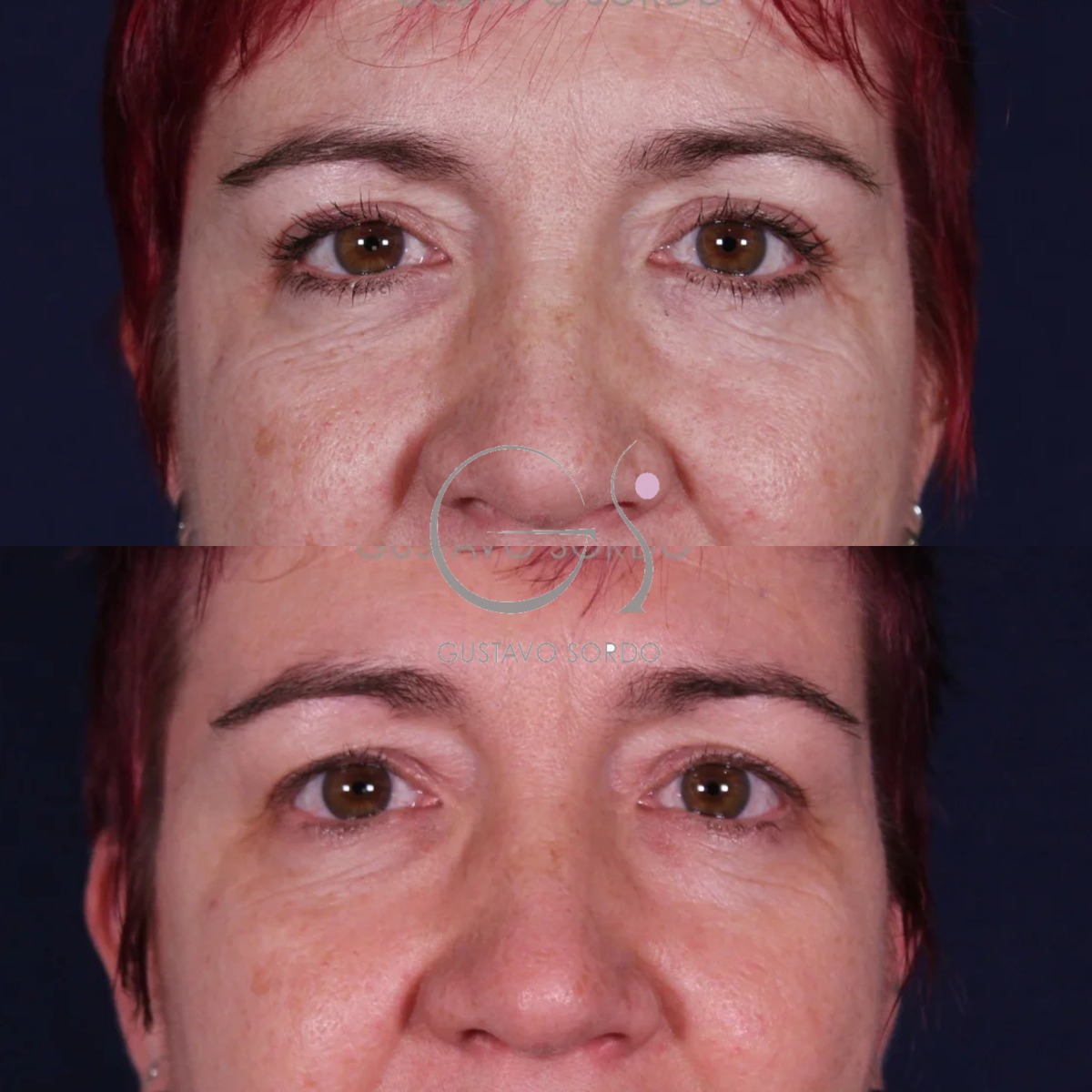
The mistake I see most often: treating what is actually a drooping eyebrow as an eyelid.
There's a point of confusion that needs clarifying right here, because it affects the field of vision and because it's the most frequent misdiagnosis I see in second opinion consultations. When a patient says their "eyes feel heavy" or that "their gaze feels closed," the problem could be in three different areas, and each area requires a different approach.
I analyze the eyes like a three-story building : the forehead and eyebrows, the upper eyelid, and the lower eyelid. Each floor has its own analysis and treatment, and confusing them is what produces results that worsen what they were meant to fix.
The specific mistake is this : if you remove skin from the upper eyelid of a patient whose eyebrow has drooped, you don't open up their gaze— you lower the eyebrow even further and close it more . The skin of the upper eyelid and the eyebrow are connected: removing skin pulls the eyebrow downward. In an eyebrow that was already drooping, this aggravates the problem instead of solving it, and it can also leave insufficient skin to properly close the eye.
Therefore, before considering an upper blepharoplasty, the first thing I assess is the eyebrow's position . If the main problem is drooping of the upper third of the face, the solution isn't the eyelid: it's lifting the eyebrow. And there I have two approaches, which I choose depending on the patient's reason for seeking help. If they're looking for complete facial rejuvenation, I perform an endoscopic brow lift , which I usually do as part of a cervicofacial lift. If they're specifically concerned about their eyes, I perform a direct brow lift with periosteal fixation , an outpatient procedure with a quick recovery, following the technique described by Fakih-Gomez.
According to PubMed, this direct suspension technique has a prospective series of 45 patients with 97,8% symmetry and a natural appearance at three months (Fakih-Gomez N, et al. Deep Plane Direct Brow Lift . Aesthetic Plast Surg. 2025;49(9):2385-2398. DOI: 10.1007/s00266-025-04775-2 ). One detail I always explain: the scar is located just above the eyebrow and truly begins to improve after three months ; it is better camouflaged the fuller the eyebrow, and anyone with eyebrow alopecia can have microblading done afterward without any problem.
The practical conclusion for what this article is about: when the visual field is truly limited, it is important to determine what is limiting it—eyelid skin, free edge due to ptosis, or drooping eyebrow—because operating on the wrong structure not only does not improve vision, it can worsen it.
Continue reading
Dr. Gustavo Sordo
Specialist in Plastic, Aesthetic and Reconstructive Surgery. Member No. 282858125.
Content clinically reviewed by Dr. Gustavo Sordo. Last review: September 27, 2026.