How to remove drooping eyelids with blepharoplasty

Updated on • Reviewed by Dr. Gustavo Sordo, plastic surgeon
Drooping eyelids can appear sad and characteristic of older people. However, this is not always the case. Drooping or aging eyelids (whose scientific name is blepharochalasis or dermatochalasis ) can be caused by many factors, generally due to the passage of time, the effects of gravity, sun exposure, and smoking.
It's also important to note that droopy eyelids are sometimes accompanied by other similar conditions, such as fat deposits, volume loss, or drooping eyebrows . For all of these, plastic surgeons perform a procedure called blepharoplasty. How can droopy eyelids be corrected with blepharoplasty?
How does blepharoplasty correct a droopy eyelid?
There are many ways to restore a youthful appearance to a person's eyelids. All of them have been developed over many years and require the work of experienced professionals who have received expert training.
The newest of all is the "No Touch" blepharoplasty, a system applied by Dr. Gustavo Sordo at his Madrid clinic, which consists of removing bags from the lower eyelid without leaving a visible scar in the area.
To achieve this, the patient's anatomy is studied, a procedure is performed that respects the eyelid's anatomy , and tungsten microdissection needles are used to help control bleeding throughout the process. The key lies in accessing the fat pads of the lower eyelid from the conjunctiva to avoid leaving a scar.
In this way, "No Touch" blepharoplasty achieves faster and more natural results than other similar procedures. These include procedures where the eyelids end up excessively open, the eyes appear skeletal, or the eyelids cannot close completely because the eyelid's anatomy has not been respected.
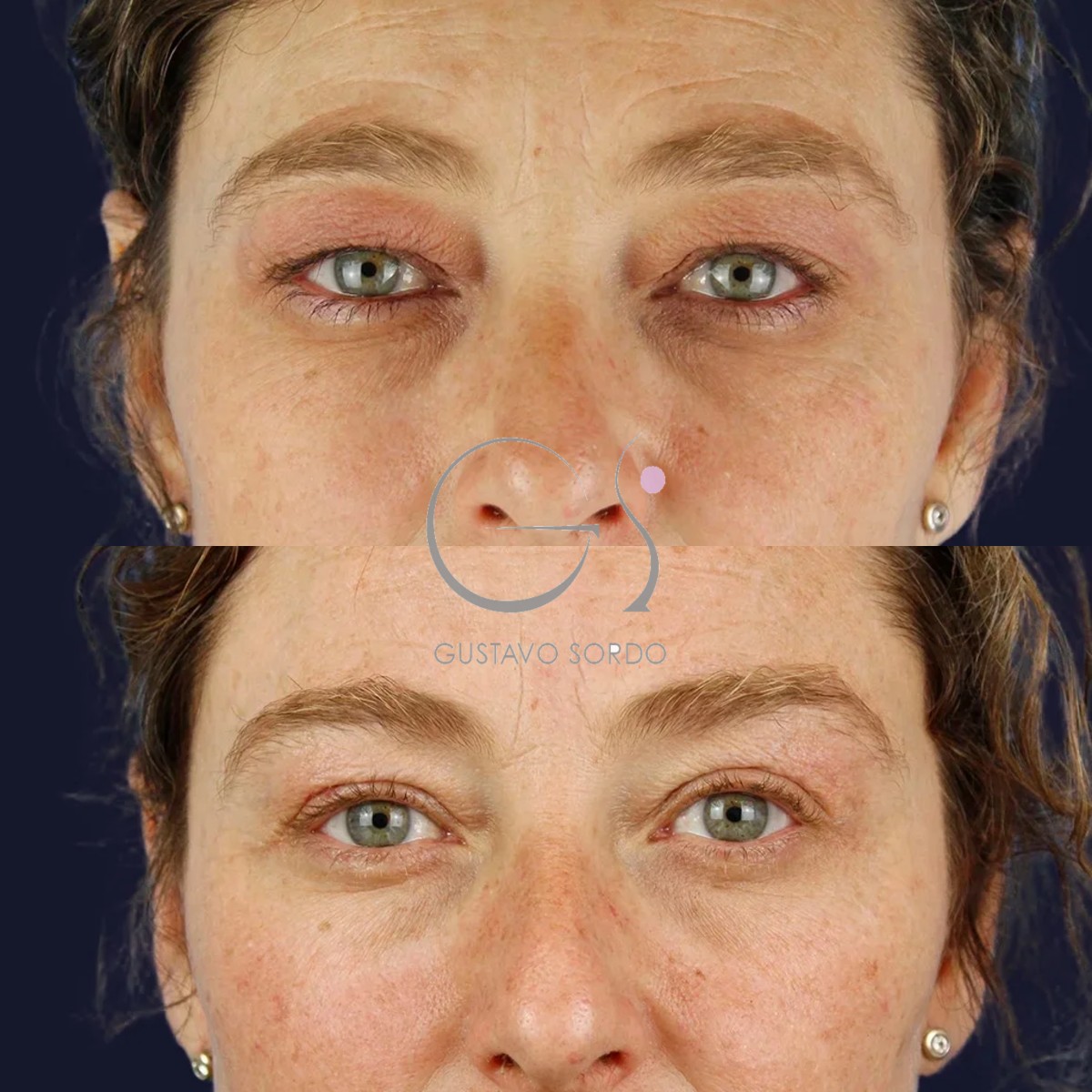
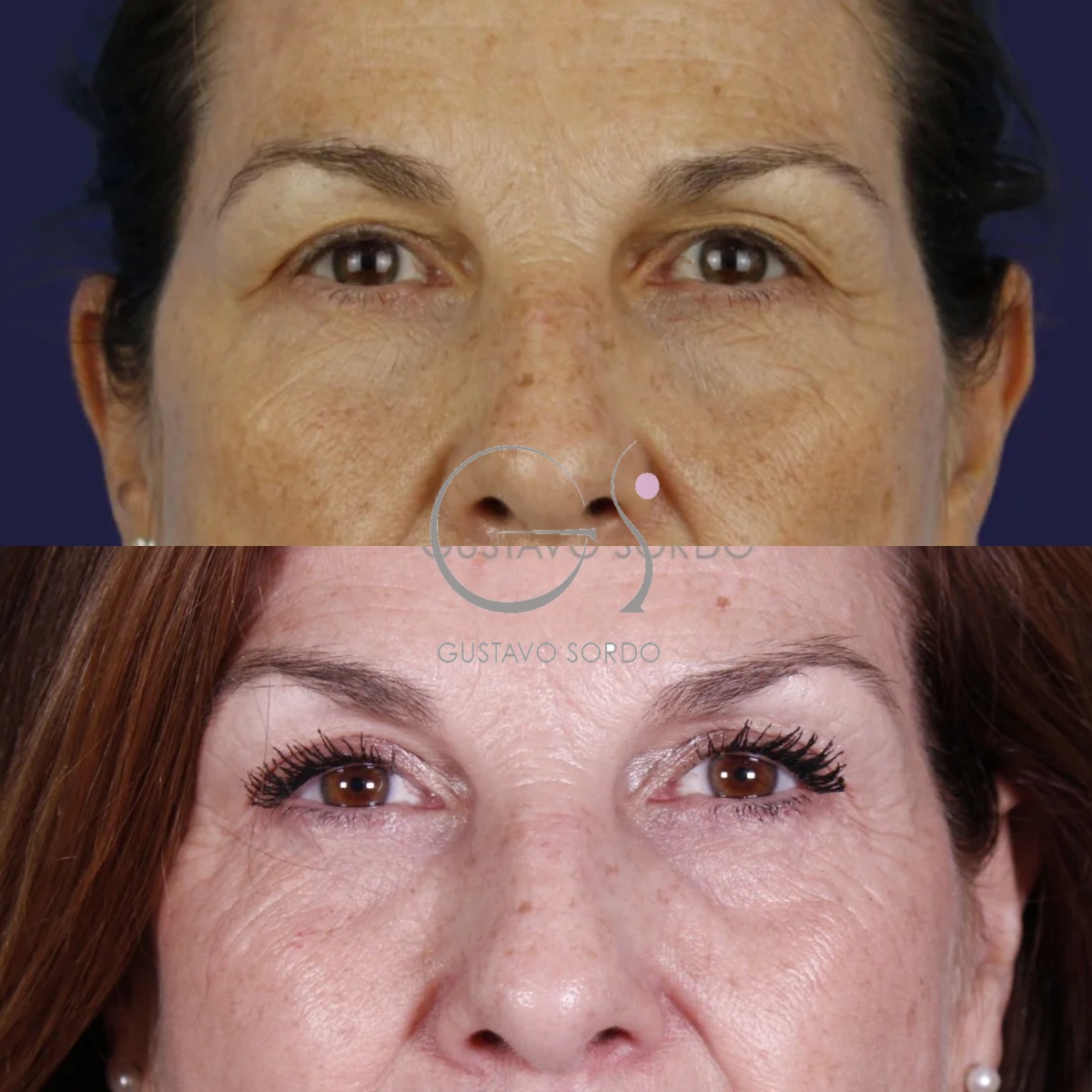
When a droopy eyelid obstructs vision
It's also important to keep in mind that droopy eyelids can affect the vision of those who have them. Therefore, if you find yourself in this situation, it's best to schedule an appointment at Dr. Gustavo Sordo's clinic and receive a diagnosis from the best blepharoplasty specialists in Madrid.
Before operating on a drooping upper eyelid, one question must be answered: is the eyelid drooping, or is the eyebrow? If the eyebrow is drooping , simply removing skin from the eyelid won't solve the tired look and may even worsen it by lowering the eyebrow further. Therefore, we always assess the upper third of the face as a whole, and in some cases, a brow lift—or a combination of brow lift and blepharoplasty—is the appropriate treatment, not just the eyelid.
Caution: not all droopy eyelids are skin.
The other important distinction is between dermatochalasis (excess skin, which is what blepharoplasty corrects) and true ptosis , which is a problem with the levator muscle and requires a different surgery. And here's a nuance that completely changes the treatment: in acquired ptosis —the kind that appears with age, not the congenital kind—when the free edge of the eyelid is inside the iridocorneal margin , we perform the phenylephrine test . If it responds well, the correction is a tarsoconjunctival Müllerectomy using a sutureless technique with bipolar forceps, which slightly shortens the Müller muscle and opens the eyelid a few millimeters, with a very attractive result. Published series with a positive phenylephrine test achieve approximately 92% surgical success (Simsek et al., 2026, Br J Ophthalmol ), and sutureless variants achieve average eyelid margin elevations of about 3 mm with symmetry within 1 mm in 96% of bilateral cases (Bair et al., 2025, Orbit ). Confusing these two diagnoses is the most frequent cause of disappointing results: skin is removed, but the eyelid continues to cover the pupil. Therefore, the initial examination is as important as the technique.
Dr. Gustavo Sordo
Specialist in Plastic, Aesthetic and Reconstructive Surgery. Member No. 282858125.
Content clinically reviewed by Dr. Gustavo Sordo. Last review: September 27, 2026.