Rhinoplasty on thick skin with a raised bridge: before and after
Case fact sheet
- Patient: Female, 28 years old
- Reason: aesthetic: a finer tip and a more stylized nose
- Starting nose: poorly defined bridge and tip, with oily and very thick skin, acne, and weak cartilages with little support
- Technique: ultrasonic rhinoplasty structural: reduction of the trestle with a piezoelectric scalpel, spacer grafts (spreader grafts), septal extension graft, SMAS tip resection, domal cephalic suture and closure of dead spaces by replacing ligaments scroll down and Pitanguy
- Septum and turbinates: septoplasty and turbinates in the same surgery
- Skin: protocol with retinoids and oral isotretinoin at a low dose maintained for one year
- Entry: 1 night
- Anesthesia: general type TIVA
- Duration: 3 hours long.
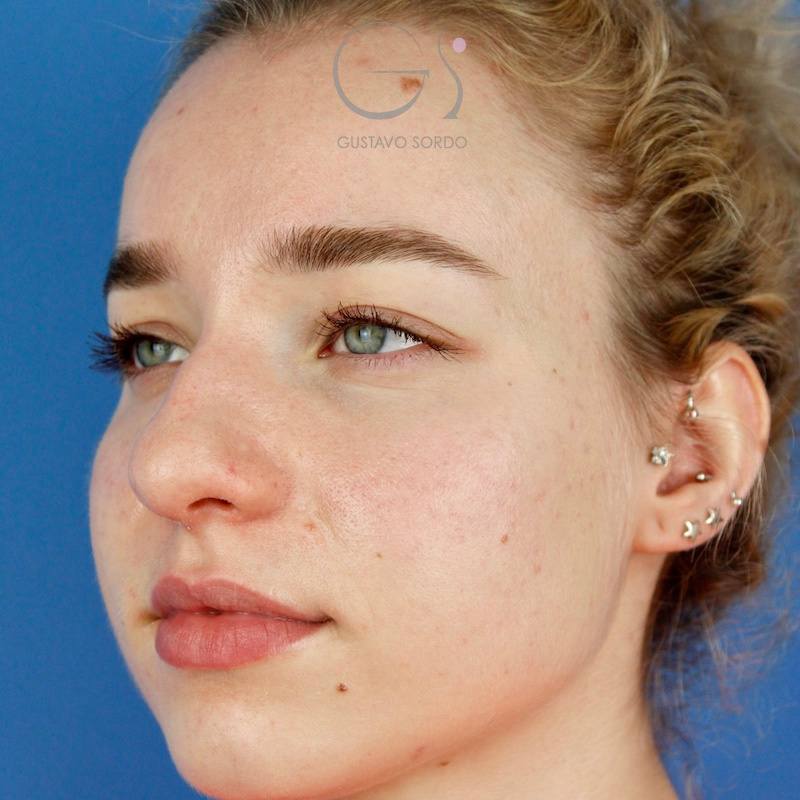
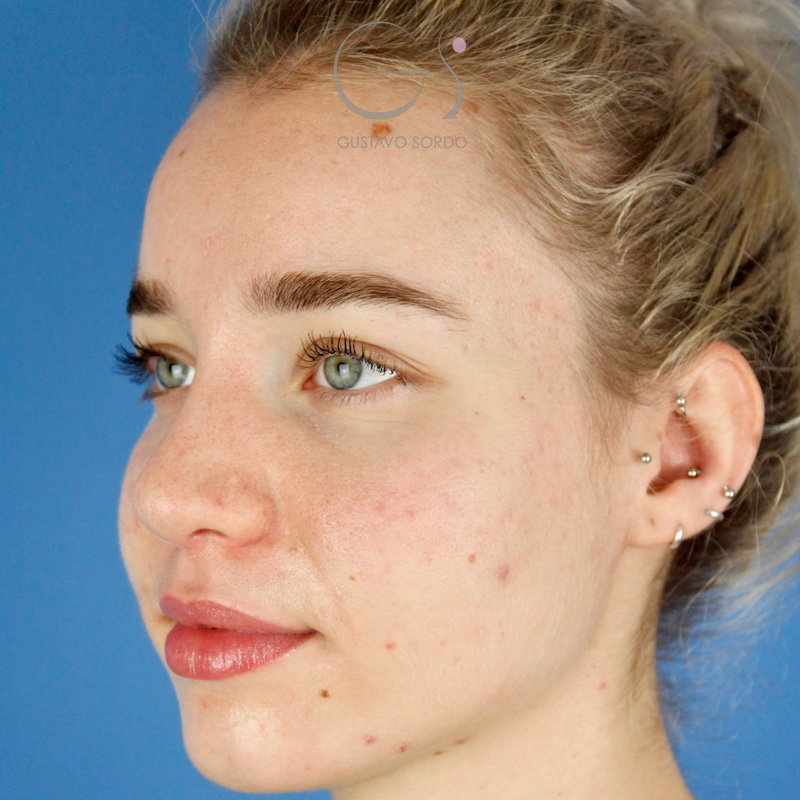
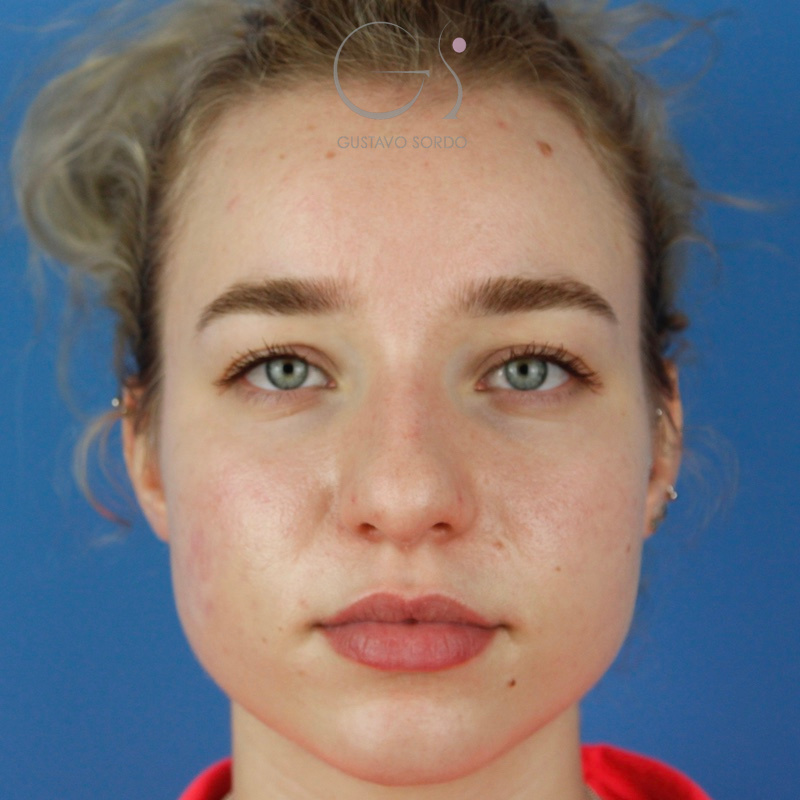
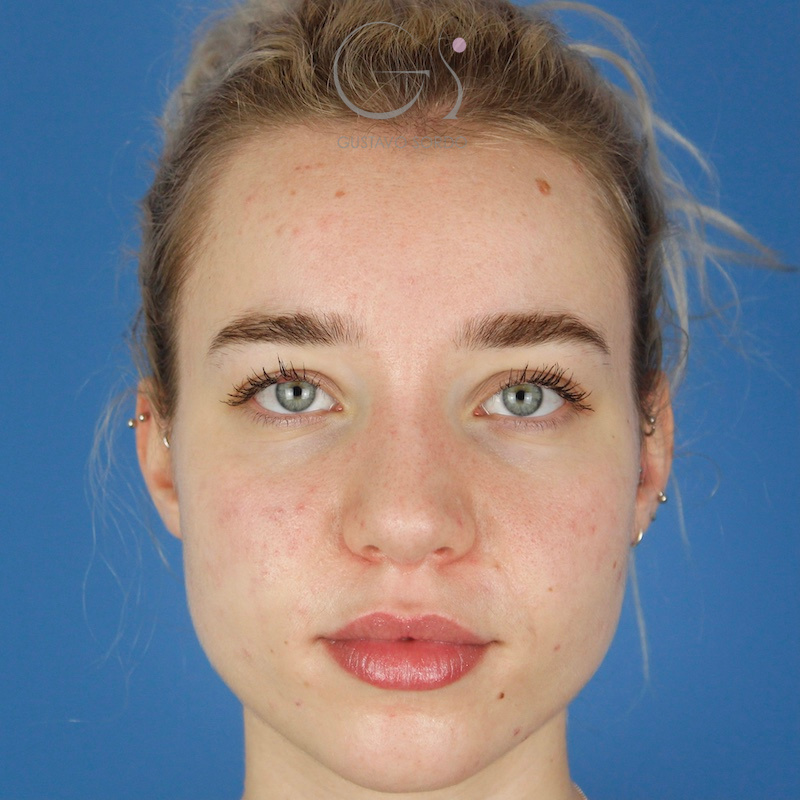
A 28-year-old woman with a prominent bridge and a poorly defined tip on very thick, oily skin. She requested a finer tip and a more refined nose. It's one of the most difficult noses to operate on because the thick skin hides the work done on the cartilage. That's why I followed the four steps I apply to these types of noses and, in addition, closed the dead spaces at the tip.
The four steps on a thick-skinned nose
Many patients are unaware that rhinoplasty on thick skin is a challenge. They often request a thinner tip and a more refined shape, while the surgeon is faced with very thick, fatty skin and weak cartilage with little support. In these cases, I follow four steps:
- Prepare the skinwith a retinoid protocol. Less oily and less inflamed skin adapts better to the new structure.
- Thinning the skin A SMASectomy of the tip involves removing part of the tissue under the skin of the tip. This is not a harmless procedure, as it can compromise the vascularization of the tip, and should only be performed by expert hands.
- Refine the cartilage with a domal cephalic suture, which narrows the domes, the part of the cartilages that forms the tip.
- Add support with a septal extension graft, so that the tip pushes from within against the thick skin and its definition is visible.
In this patient, I performed all four procedures. And there is a fifth step that is very important in these skin types: closing the dead spaces by replacing the scroll ligaments and the Pitanguy ligament. A dead space under thick skin fills with scar tissue and obscures the definition.
In addition, she took low-dose oral isotretinoin for a year to reduce oiliness in her skin and treat acne, thus giving her nose more definition. It's a medication that should only be taken when prescribed, with a doctor's prescription and supervision.

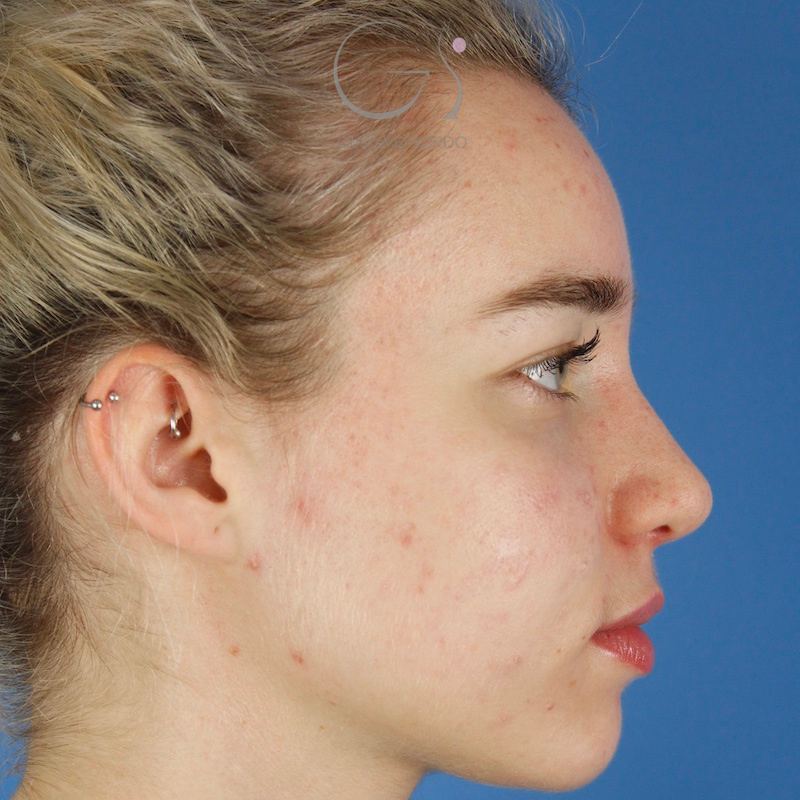
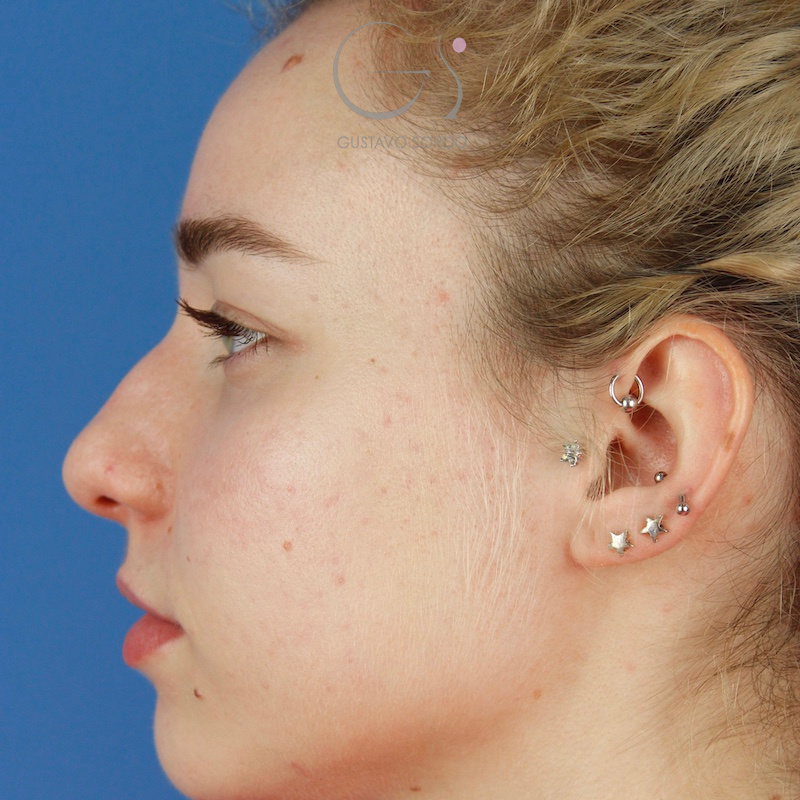
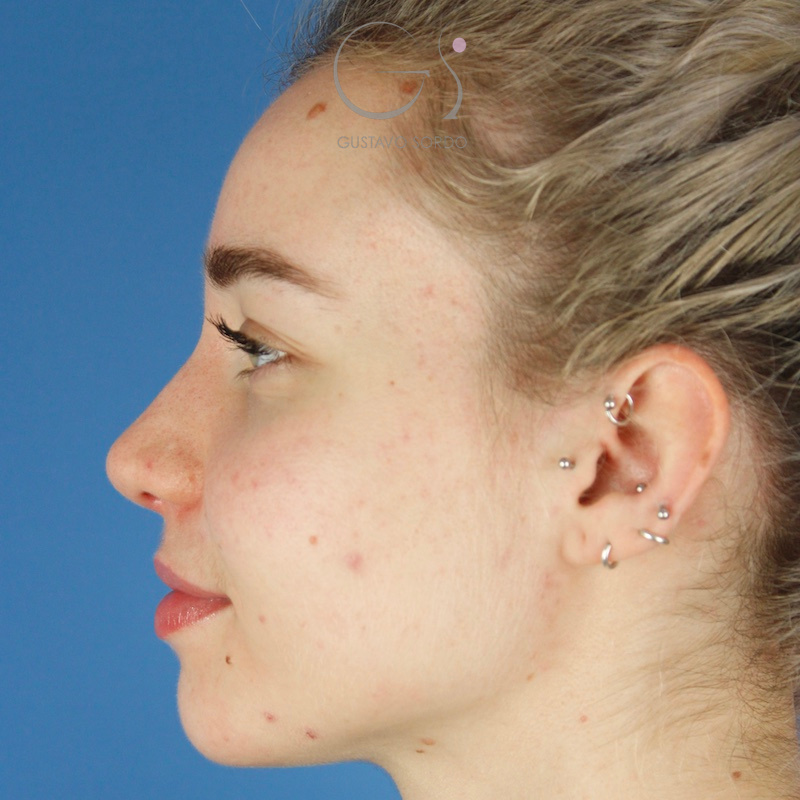
Comment by Dr. Gustavo Sordo
Reason for consultation
She asked for a finer tip and a more stylized nose.
What I observed when evaluating it
A bridge and an undefined tip, with oily, very thick skin, acne, and weak cartilage with little support. It's the most difficult combination: the thick skin hides what's done to the cartilage.
What was important to preserve
Naturalness. With skin like this, thinning by removing cartilage doesn't work: the tip sinks under the skin. It was necessary to build, not just reduce.
My surgical approach
Structural ultrasonic rhinoplasty following the four steps: preparing the skin, thinning it with a tip SMASectomy, refining the cartilage with a cephalic domal suture, and providing support with a septal extension graft. On the dorsum, hump reduction and spacer grafts.
Why I chose this technique
With thick skin, simply thinning the cartilage isn't enough: the skin must be thinned and, above all, support provided so that the tip can push from within. And dead spaces must be closed by replacing the scroll and Pitanguy ligaments, so that scarring doesn't fill in the defined areas.
What I did during surgery
I reduced the bridge of the neck with a piezoelectric scalpel and placed spacer grafts to reconstruct the dorsum. At the tip, I performed a SMASectomy, cephalic dorsal suture, and septal extension graft, and closed the dead spaces by replacing the ligaments. In the same surgery, I performed the septoplasty and turbinate reduction. Afterward, I prescribed low-dose oral isotretinoin for one year.
What is observed in the result
The profile: the ridge disappears and the back becomes straight. And the point, more defined and better projected despite the thick skin.
More rhinoplasty cases on thick skin . Regarding dead space at the tip, the article on the supratip , and how I perform rhinoplasty in Madrid , can be found on his website.
Case operated on by Dr. Gustavo Sordo
Specialist in Plastic, Aesthetic and Reconstructive Surgery. Member No. 282858125.
Before you compare yourself to this photo
If you're comparing results to get an idea, keep in mind that the starting point is just as important as the technique. How is a nose studied before surgery, in rhinoplasty in Madrid.
Do you want to know if this can be done in your case?
The first consultation is with Dr. Sordo, either at the Chamberí clinic or via video consultation. You'll leave knowing if you're a candidate, which technique is right for you, and how much it costs.
Dr. Gustavo Sordo · Member No. 282858125 · Plastic, Aesthetic and Reconstructive Surgery · Madrid