Tuberous breasts with periareolar mastopexy and anatomical breasts of 295 cc: before and after
Case fact sheet
- Patient: Female, 35 years old
- Starting chest: grade 2 tuberous breasts
- Intervention: Breast augmentation with periareolar mastopexy — June 2023
- Technique: Periareolar mastopexy, release of lower pole adhesions with radial cuts (scoring) and anatomical implants in subpectoral pocket, dual plane III
- Implants: Mentor anatomical implants (ref. 334-1155), 295 cc in both breasts
- Result: photos one year after the operation
- Surgeon: Dr. Gustavo Sordo
Grade 2 tuberous breasts corrected with a periareolar mastopexy and 295 cc anatomical implants, placed behind the pectoral muscle in a dual-plane III technique. The bands constricting the lower pole were released with radial incisions to allow the breast to expand. More on tuberous breast correction in Madrid . The photos are from the one-year follow-up appointment.
Photos one year after the operation
The same six views were taken before surgery and at the one-year follow-up, with the same lighting and framing: frontal, frontal with arms raised, oblique, and profile views. The profile and oblique views best show how the lower pole has filled and the current height of the areola.


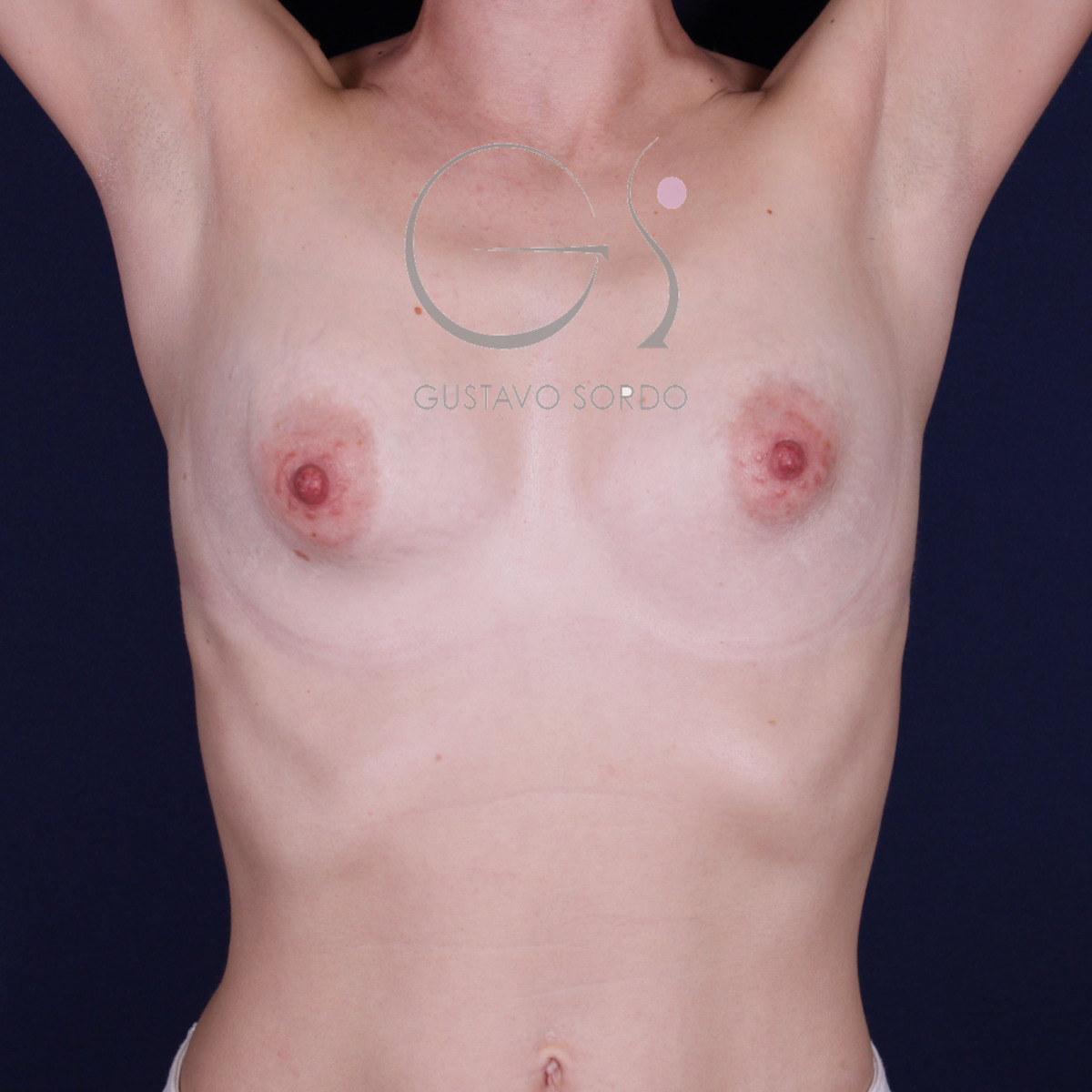


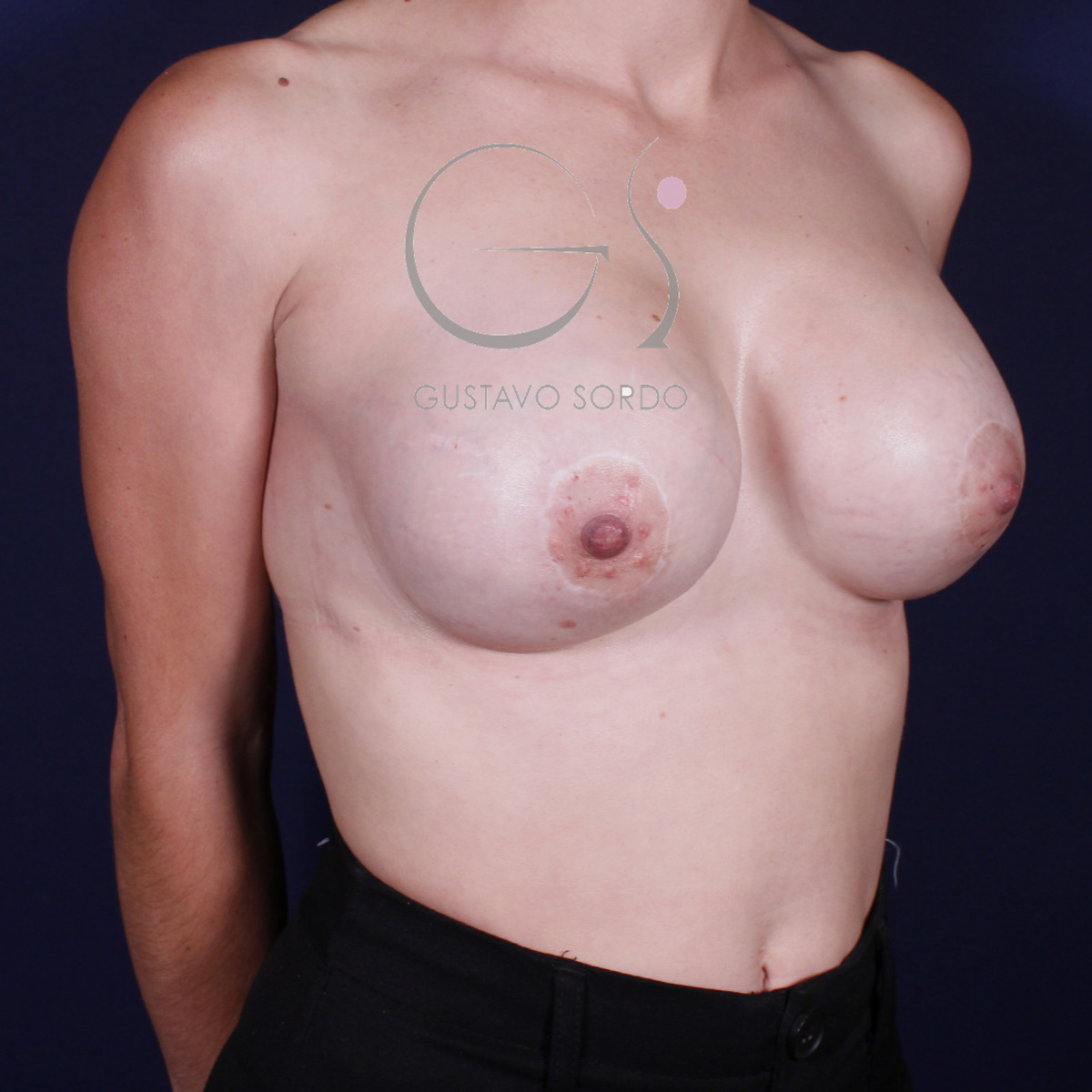


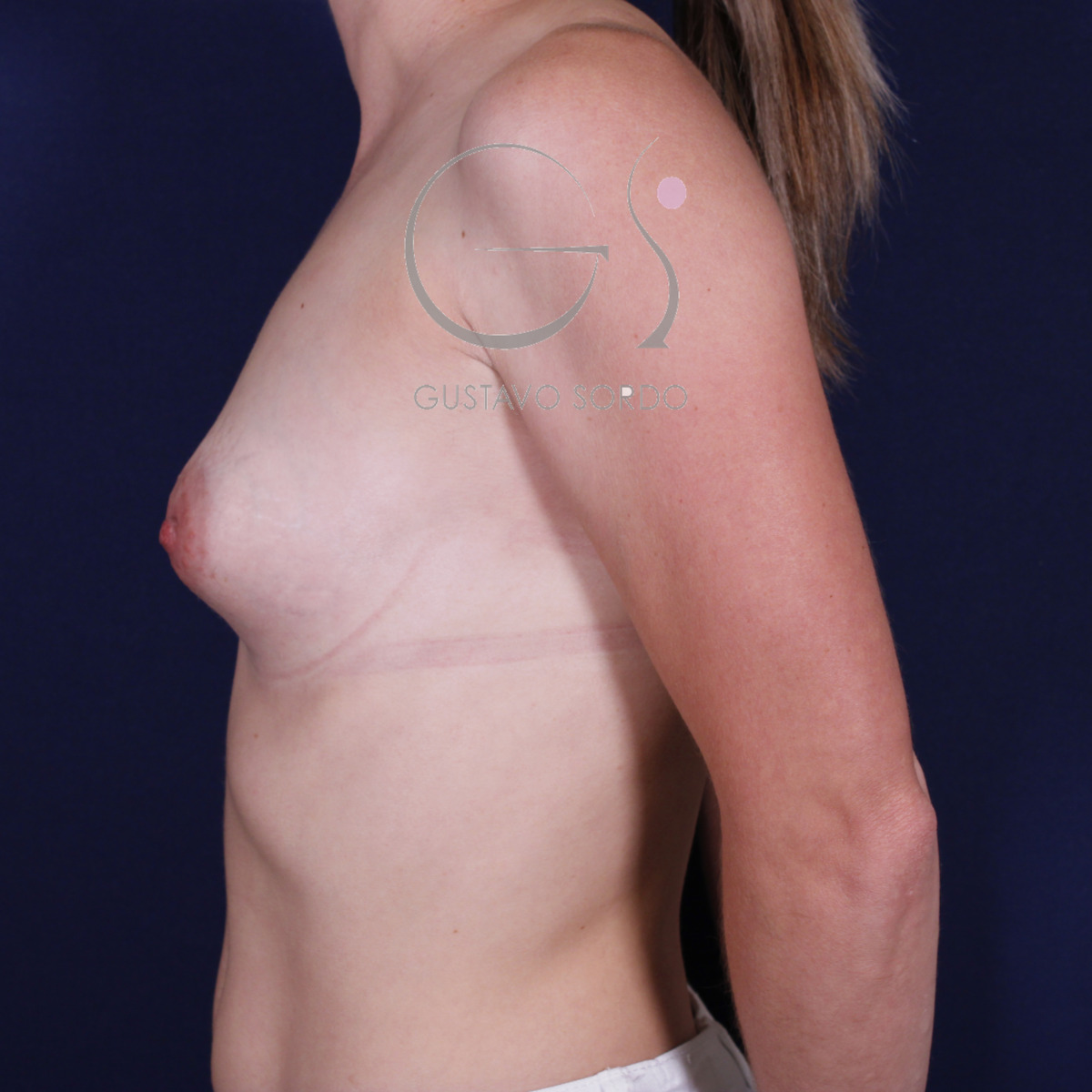

Making
Grade 2 tuberous breast
In tuberous breasts, the base is narrow, and the lower pole, the bottom half of the breast, is short and compressed by fibrous bands (bands). In grade 2, the lack of tissue affects the entire lower half, and the areola tends to appear large and bulging. Therefore, simply adding volume is not enough; this part of the breast must be opened up.
Periareolar mastopexy
An incision around the areola allows its size to be reduced and it to be repositioned at the correct height. The scar remains at the edge of the areola, where the skin color changes.
Radial scoring of the flanges
The fibrous bands that constrict the lower pole are cut radially, like the spokes of a wheel, from the inner surface of the gland. This releases the tissue, allowing it to spread over the implant.
295 cc anatomical implants
The anatomical implant is teardrop-shaped, with more volume at the bottom. It was chosen here for that reason: to expand the lower pole, which was precisely what was lacking.
The pocket: subpectoral, in dual plane III
The implant is placed behind the pectoral muscle. In the dual-plane design, described by John B. Tebbetts, the upper part of the implant is covered by the muscle, and the lower part rests beneath the glandular tissue. In type III, the glandular tissue is separated from the muscle further up, so the muscle rises and the implant directly pushes the lower pole, which is what a tuberous breast requires.
If you want to compare with other patients, you can see more cases of tuberous breasts before and after , other augmentations with implants from 280 to 330 cc or more cases with anatomical prostheses.
Case operated on by Dr. Gustavo Sordo
Specialist in Plastic, Aesthetic and Reconstructive Surgery. Member No. 282858125.
If you're looking at this case for a specific reason.
A beautiful breast isn't the biggest, but the one that fits comfortably on your chest without stretching the skin or sagging with age. ( Breast augmentation .)
Do you want to know if this can be done in your case?
The first consultation is with Dr. Sordo, either at the Chamberí clinic or via video consultation. You'll leave knowing if you're a candidate, which technique is right for you, and how much it costs.
Dr. Gustavo Sordo · Member No. 282858125 · Plastic, Aesthetic and Reconstructive Surgery · Madrid