Facial lifting and rejuvenation
Facial harmonization: what you need to know before getting fillers
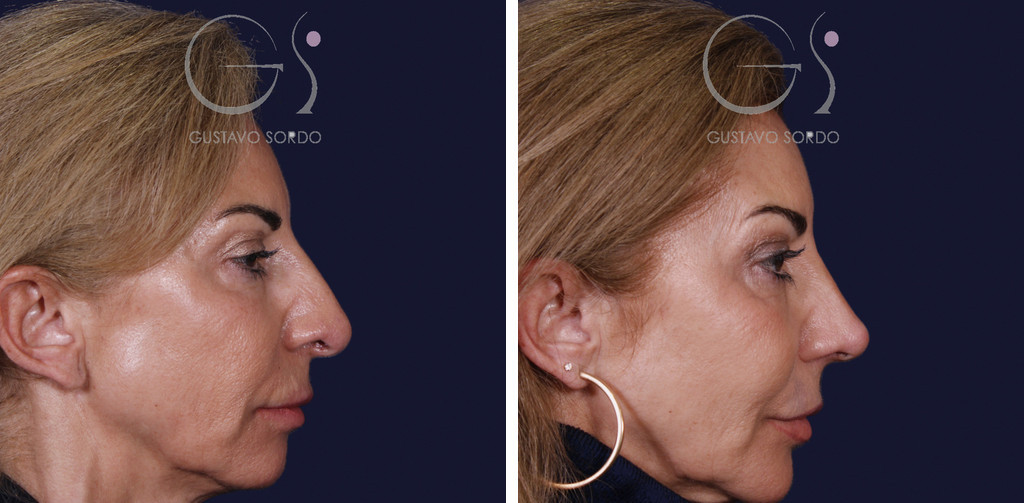
Reviewed by Dr. Gustavo Sordo, plastic surgeon
Facial harmonization is all the rage. For some years now, many people have been getting hyaluronic acid injections to improve their cheekbones, temples, chin, jawline, or under-eye circles, and increasingly common are large sessions, with multiple vials injected at once, promising to "harmonize" the entire face in an afternoon. This article isn't a guide to areas treated and prices. It's what I explain to those who ask me in consultations, as a plastic surgeon who later encounters these faces in the operating room.
If you're worried about sagging skin or a tired face, the surgical alternative is the deep plane facelift ; here we discuss what happens with fillers.
First of all: hyaluronic acid is not reabsorbed as you may be told.
This is the marketing idea: "If you don't like it, it disappears in a year." This isn't true, or at least not entirely. According to studies indexed in PubMed, in a series of 33 patients who underwent MRI scans years after midface injections, the hyaluronic acid was still present in all 33 : in 21 of them, between 2 and 5 years had passed since the last injection, in 12 more than 5 years, and in some cases up to 15 years (Master M et al. Plast Reconstr Surg Glob Open . 2024, DOI ). There are published cases of material found in the chin two years later, dispersed in the fat and not visible on ultrasound (Mariluis CA et al. 2026, DOI ), and of hyaluronic acid injected into the temple that ended up in the upper eyelid two years later (El Feghaly C, Tawa P. 2026, DOI ).
What is reabsorbed is the visible effect. The product, for the most part, remains. And each session builds upon the previous one.
If done correctly and in expert hands, it can work very well. The problem is repetition.
I'm not against hyaluronic acid. A well-prepared harmonization treatment, using a small amount and performed by a doctor who understands anatomy, can produce beautiful results. The problem arises over time: repeated treatments, year after year, on a material that hasn't dissolved, eventually result in an overly plump face, with exaggerated cheekbones and jawline, and an expression that no longer looks natural. It's a pattern that's easily recognizable, and the person who has it is usually the last to notice, because the change has been gradual.
What surgeons are starting to see: facelifts on full faces
This is my own opinion, based on what I see in surgery, and I say it as such. More and more patients are coming to my office wanting a facelift, and they've had years of cosmetic procedures. All that material that has accumulated in the face is there when we open it up: in the planes that need dissection, around the structures that need to be repositioned. It's starting to become a problem for surgeons, and that's why, when there have been previous fillers, we prescribe hyaluronidase at the clinic before planning surgery, to remove as much as possible. In the nose, it's even more important: hyaluronic acid leaves tissue with poorer vascularization, which complicates subsequent rhinoplasty.
The subscription model
There's a reason why many clinics don't mention any of this. Facial harmonization is a recurring treatment: you have to return every few months, and each visit is another session. The patient becomes, without anyone calling it that, a hyaluronic acid subscriber . And those who make a living from injections have the incentive to inject, and to inject more and more. In most cases, it's not malicious intent; it's the standard practice. But it's important to know this before starting, because the first session is almost never the last.
The alternative: permanently change what gets filled in over and over again
My approach to facial harmonization is different. Faces aren't harmonized by permanently injecting hyaluronic acid into the patient; many of those corrections that are repeated every year have a definitive surgical solution , and often a cheaper one in the long run.
The clearest example is the chin. It's one of the most frequently augmented areas, and one of the least sensible to augment: what's lacking is bone, not soft tissue. With a chin augmentation using an implant , which we secure with a single PDS suture (a resorbable suture) to prevent displacement, the chin is permanently projected. Someone who has been getting hyaluronic acid injections in their chin for two or three years has already spent the equivalent of one implant that, in all likelihood, will last a lifetime, and saves them from having to get injections every few months.
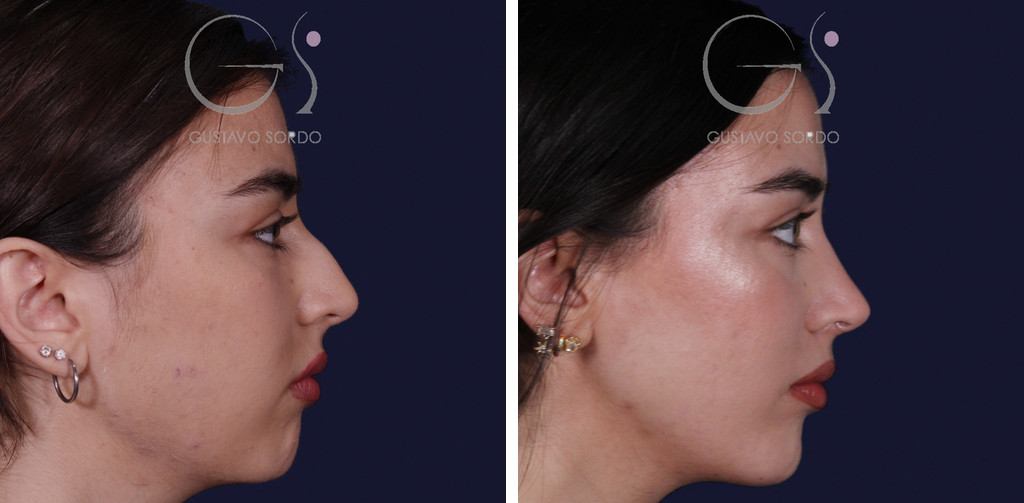
The same applies to the profile. It's very common for a nose to appear large because the chin is receding, and in that case, what corrects the profile isn't fillers or "rhinoplasty": it's rhinoplasty , either alone or combined with mentoplasty in the same procedure. The nose, lips, and chin function as a system, which is why we plan using 3D simulation on the patient's own face to see what each feature contributes before making any decisions. And when the problem is sagging, the descent of the tissues, no filler will solve it: a deep plane facelift will.
The complication that really matters: vascular occlusion
Hyaluronic acid not only causes swelling and bruising. If the product enters an artery, it can block it. If that artery supplies blood to the skin, necrosis can occur. And if the material flows retrogradely to the ophthalmic artery, it can cause vision loss. It is uncommon, but it has been documented and is not just an anecdote: a review of the global literature compiled 233 cases of vision loss after facial filler injections, and in 172 of them, the damage was severe in at least one eye (Kato JM, Matayoshi S. Arq Bras Oftalmol . 2022, DOI ).
The area of greatest risk is the nose, followed by the glabella (between the eyebrows): in the last few years analyzed, 35% of reported cases involved injections in the nose (Lee W et al. J Cosmet Dermatol . 2019, DOI ). However, the forehead, temples, cheekbones, and nasolabial folds are also dangerous areas because the arteries in the face are interconnected and their course varies from person to person. Most reported cases of blindness are irreversible (Carruthers JDA et al. Plast Reconstr Surg . 2014, DOI ).
If you're still going to get a facial harmonization treatment
Two things, in this order. First, make sure the clinic is reputable : that the person administering the injection is a doctor, that they understand facial vascular anatomy, and that they work in an accredited healthcare facility. Second, ask if they have emergency hyaluronidase available . This is the enzyme that dissolves hyaluronic acid, and it's the only thing that can be done in an emergency if the product enters an artery; when it's needed, it's needed within minutes, not the next day. Ask before you even get on the examination table. And make sure you know who to call if, a few hours later, you experience disproportionate pain, your skin turns white or mottled, or you notice anything unusual in your vision: that's not a bruise, it's an emergency.
Botton line
Hyaluronic acid lasts much longer than promised, and repeated treatments eventually take their toll, both on the face and in the operating room. Before becoming a subscriber, ask yourself if what you're getting filled every year has a permanent solution: in the chin and profile, it almost always does. And if you do get injections, make sure it's at a reputable clinic with hyaluronidase readily available.
FAQ
How long does facial harmonization with hyaluronic acid last?
The visible effect usually lasts between one and two years, depending on the area treated and the product used. The material itself, however, does not: MRIs performed years later can still detect it in most patients. This is why the sessions accumulate.
Which is better, facial harmonization or surgery?
A structural defect, such as a receding chin or a disproportionate nose, is permanently corrected with surgery, and filling it in each year becomes more expensive and less effective. Sagging and descent of the tissues are corrected with a facelift, not with volume. Fillers have their place in small, targeted corrections, using minimal amounts.
Can I have a facelift if I've had hyaluronic acid injections?
Yes, but it's best to mention it during the consultation, and if there's a lot of material, treat it beforehand with hyaluronidase. Anything that wasn't removed will still be there during the surgery.
Continue reading
Dr. Gustavo Sordo
Specialist in Plastic, Aesthetic and Reconstructive Surgery. Member No. 282858125.
Content clinically reviewed by Dr. Gustavo Sordo. Last review: October 2, 2026.