Facial lifting and rejuvenation
Drooping eyebrows: the three ways to correct them (neuromodulators, Fakih direct lifting and endoscopic forehead lift)
Updated on • Reviewed by Dr. Gustavo Sordo, plastic surgeon
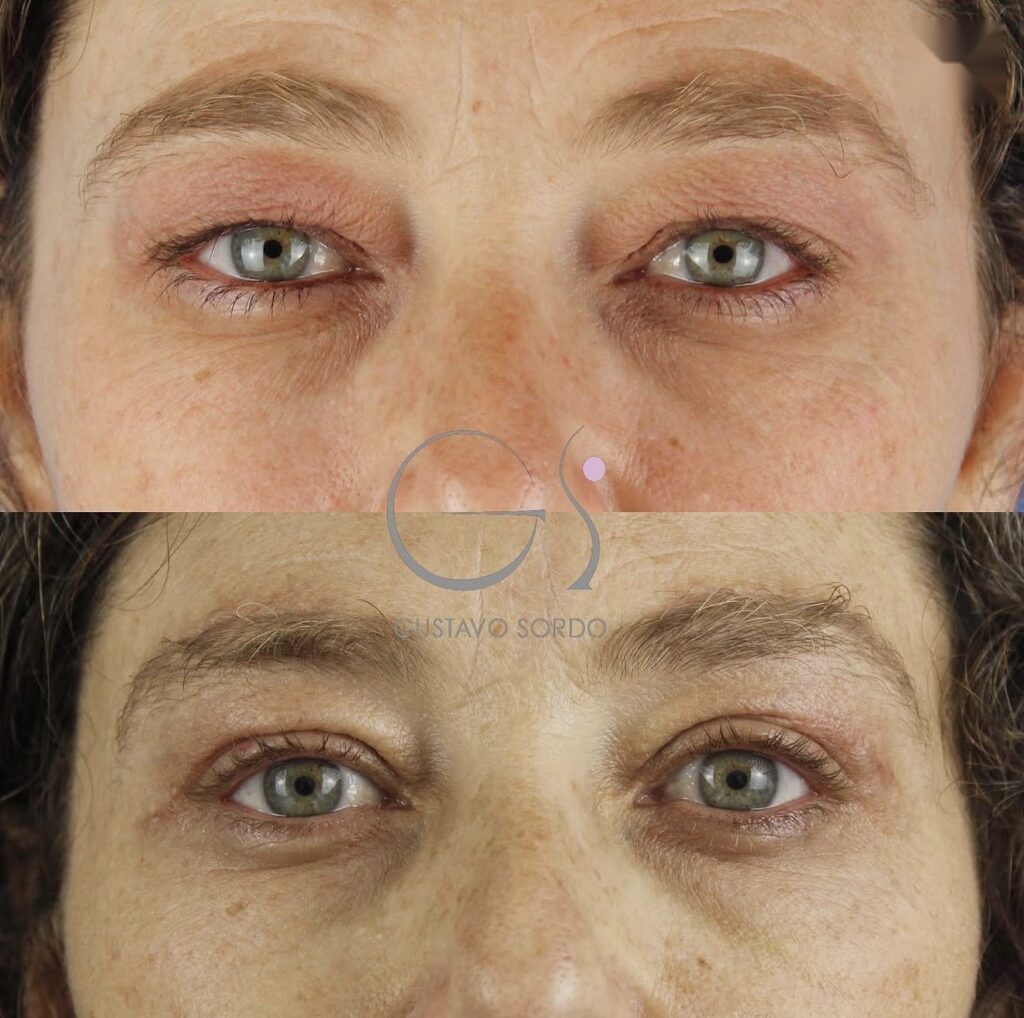
Many patients come to our clinic for eyelid surgery and leave with a different diagnosis: what's drooping isn't their eyelid, it's their eyebrow. The difference is important because removing skin from the upper eyelid of an eyebrow that has already drooped makes it appear even more sunken and accentuates a tired expression. That's why, before recommending blepharoplasty, the first thing we do is assess the eyebrow's position. And if it needs to be lifted, we perform the procedure in three different ways at our clinic, depending on how much it has drooped and what other procedures are being performed.
First of all: the eyebrow doesn't lower completely
It's worth knowing something that might surprise you: with age, the inner and middle parts of the eyebrow don't droop, they rise. According to PubMed, when measuring eyebrow position in women aged 20 to 30 and 50 to 60, the eyebrows of older women were higher at the inner corner and above the pupil. What is lost is the lateral arch, the tail of the eyebrow , which in youth is higher than the center (Matros E, Garcia JA, Yaremchuk MJ. Plast Reconstr Surg . 2009, DOI ). This explains why the completely raised eyebrows from some older surgeries looked surprising and didn't rejuvenate the appearance. What needs to be raised, almost always, is the tail. And with moderation: we aim to correct a droop, not create a new eyebrow.
1. Neuromodulators: for mild decreases and to maintain
The simplest way to raise the tail of the eyebrow a few millimeters is to relax the muscles that pull it downwards—the outer part of the orbicularis oculi—and let the frontalis muscle, which pulls it upwards, do the work. This is what a properly administered neuromodulator does , and in the clinic, Dr. Alejandro Mendieta administers it with small injections at specific points. The effect has been described for years: according to PubMed, in a trial with 79 women treated in the glabella (between the eyebrows), medium and high doses produced an immediate elevation of the tail of the eyebrow, followed by the center, with the maximum effect at 12 weeks (Carruthers A, Carruthers J. Dermatol Surg . 2007, DOI ). This elevation of one to three millimeters lasts four to five months and serves two purposes: to correct mild drooping in young people, and to maintain the results of eyebrow surgery by relaxing the muscles that would otherwise cause the eyebrows to droop again.
When the eyebrow has truly descended, with the eyelid crease covered by the skin hanging from the eyebrow, the neuromodulator falls short. The tissue needs to be lifted, not just relaxed.
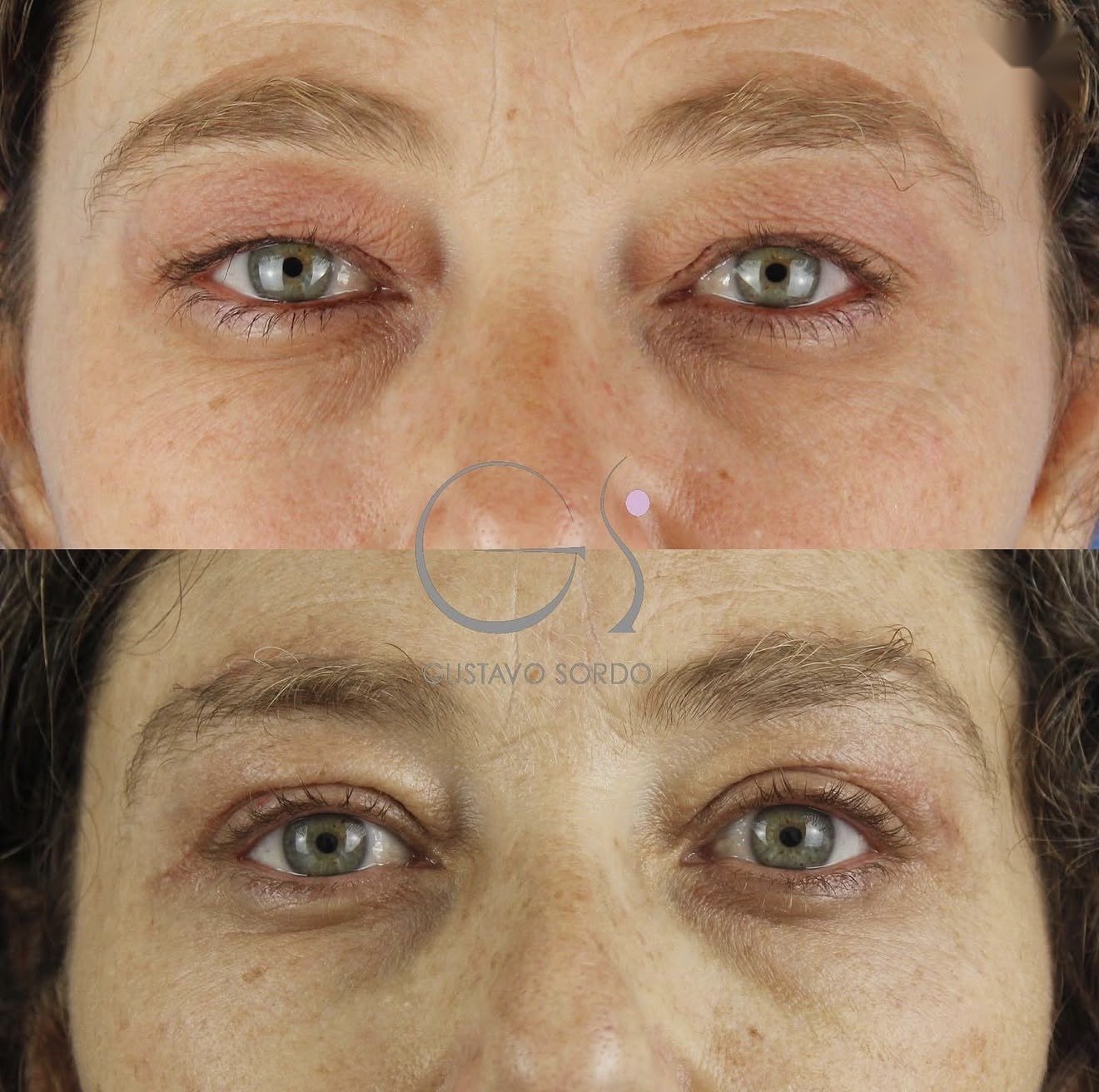
2. Direct eyebrow lift (Fakih technique): within blepharoplasty
This is the method we use to raise the eyebrow in most patients who undergo eyelid surgery. In the same procedure as blepharoplasty , through a hidden incision at the upper edge of the eyebrow, the eyebrow is detached from the bone, the tail is repositioned, and it is secured to the periosteum with internal sutures. The Fakih-Gomez technique also addresses the orbicularis oculi, the muscle that lowers the eyebrow, to stop it from pulling, and suspends the eyebrow fat to prevent it from sagging again. According to PubMed, in his series of 45 patients with a mean age of 48, 97,8% achieved a symmetrical and stable eyebrow position, with minimal scarring and transient sensory discomfort that resolved within three to five months (Fakih-Gomez N, Martins L et al. Aesthetic Plast Surg . 2025, DOI ).
The advantage is that it doesn't require an additional surgery: it's simply another step within the blepharoplasty procedure, using the same anesthesia and recovery time. It can also be performed on its own, without eyelid surgery, when the only issue is the eyebrow. If the patient uses neuromodulators, we request that they be in place at least two weeks before surgery, so that the depressor muscles are relaxed post-operatively and the eyebrow settles into its final position.
3. Endoscopic frontal lifting: within the deep plane lifting
When a drooping eyebrow is part of a face that has aged overall, with a heavy forehead, a descended midface, and a sagging neck, we treat it within the framework of a deep plane facelift , using an endoscopic forehead lift : four or five one-centimeter incisions hidden in the scalp. With a camera, the entire forehead is detached from the bone, the ligaments that support the eyebrow laterally are released, the glabella muscles are weakened, and the forehead is fixed in its new position. There is no visible scar, and the lift is comprehensive. The precision of the technique lies in releasing more or less ligament depending on the needs of each side: according to PubMed, in a series of 50 patients with asymmetrical eyebrows, adjusting the ligament release on each side achieved symmetry in 88% of cases after one year, without permanent nerve damage (Bair H, Cheng TS, Ramesh S. Aesthetic Plast Surg . 2026, DOI ).
The three options are combined. An endoscopic brow lift can simultaneously involve direct suspension of the brow tail, and neuromodulators administered after surgery help maintain the result. I explain this in more detail in the article on brow lifts.

How we choose
Slight drooping of the eyebrow tail in a young person, without excess eyelid skin: neuromodulators. Drooping eyebrow with excess skin on the upper eyelid, which is the most frequent case between 45 and 60: blepharoplasty with direct brow lift. Drooping eyebrow within a face that needs a facelift: endoscopic forehead lift within the deep plane, with or without added direct suspension. What we don't do is a single upper blepharoplasty on a drooping eyebrow, because it lowers it further, nor do we lift the entire eyebrow, because the center of the eyebrow doesn't need to be raised.
FAQ
How can I tell if it's my eyelid or eyebrow that's drooping?
Stand in front of a mirror and gently lift your eyebrow with a finger to the edge of your eye socket. If your eyelid opens up and your gaze becomes more open, the problem was your eyebrow. If there's still excess skin, it's your eyelid, or both.
Is the scar from the direct brow lift noticeable?
It is hidden along the upper edge of the eyebrow, following the hairline, and is well concealed, especially in thick or tattooed eyebrows. In the published series on the technique, the scars are described as barely visible.
How long does a brow lift last?
The neuromodulator lasts four or five months. The surgical one, whether direct or endoscopic, is stable for years; neuromodulators after surgery help maintain it.
If you have drooping eyebrows, the consultation will assess how far the outer corner of the eyebrow has descended, whether there is excess skin on the eyelid, and the overall condition of your face. This will determine whether neuromodulators are sufficient, whether blepharoplasty with eyebrow suspension is the appropriate treatment, or whether a deep plane facelift with endoscopic brow lift is necessary . You can view blepharoplasty and eyebrow cases from the clinic.
Continue reading
Dr. Gustavo Sordo
Specialist in Plastic, Aesthetic and Reconstructive Surgery. Member No. 282858125.
Content clinically reviewed by Dr. Gustavo Sordo. Last review: September 27, 2026.