Updated on • Reviewed by Dr. Gustavo Sordo, plastic surgeon
Symmastia is a little-known but significant condition that affects the appearance of the breast. Although it can occur naturally or as a result of breast surgery, this alteration can cause aesthetic and emotional discomfort in those who suffer from it. Understanding what symmastia is, what its causes are, and how it can be corrected is key to finding effective solutions. In this article, we will explore this condition in depth and the options available to treat it.
What is breast symmastia?
Synmastia , or more popularly uniseno , is the anatomical alteration consisting of the loss of the intermammary groove, that is, the lack of separation between the breasts.
Symmastia can be congenital (natural) or acquired. The congenital form is rare and is due to genetic or anatomical factors that affect breast development during puberty. On the other hand, acquired symmastia occurs as a complication of breast augmentation surgery, where the implants may shift towards the midline of the chest.
Why does symmastia occur? Causes
Symmastia can be caused primarily by two factors:
- Natural cause of the patient. They are patients who present gigantomastia o breast hypertrophy severe enough for them to show a united chest in the sternum area due to tightness and sagging of the breasts, which over time ends up joining the breast in the central area.
- Iatrogenic cause. That is, the symmastia produced after a breast enlargement operation that has not been performed correctly. In this case they are implants that are placed above the pectoral muscle; since an overdissection of the pocket in the sternum area was performed, The spaces that must accommodate the implants in the center have been communicatedThe result obtained is frankly bad because the two prostheses are connected in the neckline area without showing two separate, watertight compartments, each with its implant, respecting the patient's anatomy and showing a natural image.
Symptoms or signs
Visible signs
Symmastia is characterized by the abnormal joining of both breasts at the midline of the sternum, creating a "bridged" or "single-breasted" appearance. This is most evident when breast implants shift toward the center, eliminating the natural space between the breasts. In some cases, the skin over the sternum may appear stretched or tight, especially when wearing tight bras or adopting certain positions.
Physical symptoms
In addition to the visual aspect, patients may experience discomfort such as localized pain, a feeling of pressure in the chest, or discomfort when moving their arms. In severe cases, tissue compression can cause inflammation or skin irritation. Some women also notice that the implants feel unstable or shift easily.
clinical diagnosis
The diagnosis is made by a plastic surgeon through a physical examination and, occasionally, imaging studies such as ultrasound or MRI. The position of the implants, tissue integrity, and possible causes, such as previous surgeries or the use of inappropriate surgical techniques, are evaluated.
How is it diagnosed?
Diagnosis of symmastia is clinical and does not usually require imaging studies. A specialized plastic surgeon will evaluate the appearance of the breast, the position of the implants (in case of acquired symmastia) and the quality of the surrounding tissues. In some cases, ultrasounds or MRIs may be performed to assess the position of the implants or detect possible associated complications.
Symmastia is one of the most difficult complications to correct after breast augmentation because the problem is not the implant itself, but the pocket : the two spaces have become connected in front of the sternum, and the tissue in that area is detached and unsupported. Repairing the pocket with sutures alone has a high recurrence rate because the traction of the implant will reopen it.
Therefore, in these cases, our usual solution is a plane change combined with micropolyurethane implants . The micropolyurethane shell acts like Velcro: it adheres to the tissue and keeps the implant in place, preventing it from migrating back toward the midline. We also reconstruct the sulcus and midline with sutures and, when the tissue is of poor quality, we reinforce it with mesh. It is a demanding revision surgery, and it is best approached with a clear plan rather than successive touch-ups.
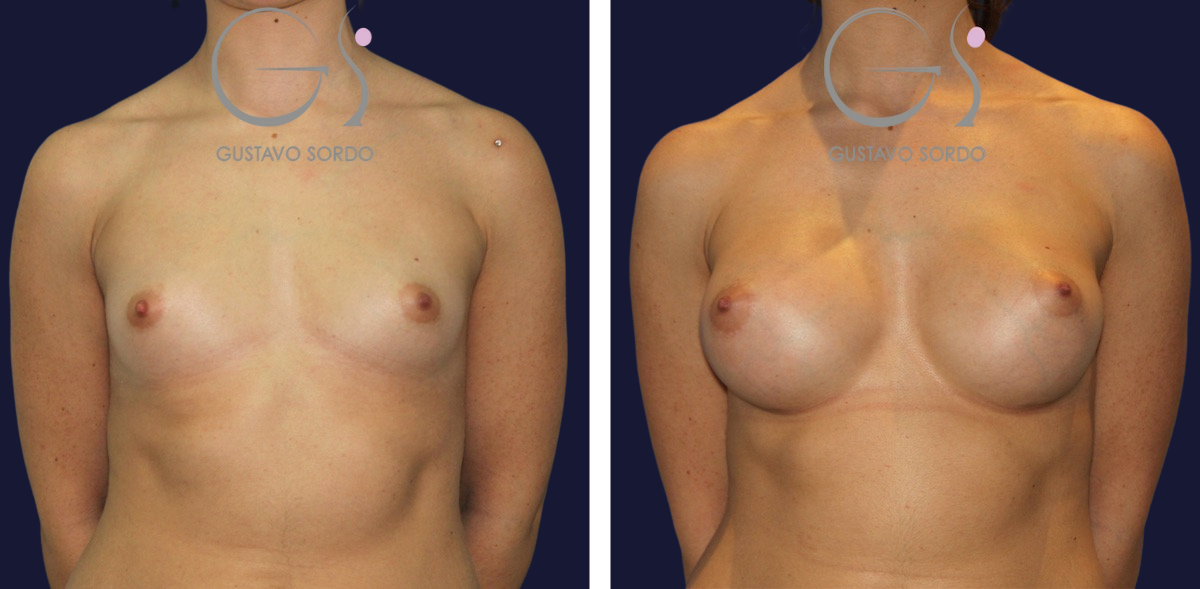
How can symmastia be corrected?
Iatrogenic symmastia will be corrected by replacing the implants and changing their placement . Therefore, implants that were in the subglandular plane will be moved to the subpectoral plane.
If, on the other hand, iatrogenic symmastia occurred with implants placed in the subpectoral plane, we will create a neosubpectoral pocket by reconstructing the pectoral muscle anchors (dual plane breasts) in the sternum using sutures, and closing the two pockets with sutures as well. This way, we will create two completely separate pockets, each housing its own implant in a separate breast, for a natural result.
In conclusion, while symmastia can occur naturally as a result of breast hypertrophy , it is more frequently caused by poorly performed breast augmentation surgery. This generally occurs due to the placement of subglandular implants that connect in the sternum area or the creation of an excessively large pocket connecting the two implants in the midline.
When we want to surgically correct this at our Plastic Surgery Clinic in Madrid , in a second breast augmentation , our goal will be the anatomical reconstruction of the separate, watertight pockets in each breast . If the implant is currently placed subglandularly, it will be sufficient to reposition it subpectorally . However, if it is already subpectoral, we will need to reconstruct the boundaries of each implant pocket to create two separate spaces.
For more information on symmastia and how to correct it with breast surgery , consult with the plastic , aesthetic and reconstructive surgeon in Madrid , Dr. Sordo.
You might be interested in: dual plane advantages and disadvantages.
How much does symmastia correction cost?
The price of corrective surgery varies depending on the complexity of the case, the geographical location, and the surgeon's experience. However, at our clinic, symmastia correction starts at €8.600. This price typically includes implant revision, chest wall reconstruction, and the surgeon's fees. In cases where implant removal is necessary or the surgery needs to be combined with a mastopexy (breast lift), the cost may increase.
Recovery and postoperative care
Rest and limitation of activity
My approach isn't to immobilize, quite the opposite: after 24 hours, I ask patients to raise their arms overhead and bring their shoulder blades together for 30 seconds, once an hour. From the third day onward , I also recommend a 30-minute walk each day. From day 7, the 1 kg weight limit is lifted, and movement is unrestricted: the arms can be moved as desired, without repeating the exercise every hour. Exercise is avoided for the first month ; after a month, patients begin with gentle, progressive cardio and isometric exercises that don't involve the pectoral muscles. Heavy isometric pectoral exercises are avoided for six months , except in cases of subfascial plane surgery, where they can be resumed after a month. It's also advisable to sleep on your back with your torso slightly elevated to reduce pressure on the operated area.
Use of compression garments
A medical bra or elastic band helps keep the implants in their correct position, minimizing the risk of recurrence, so its use is usually necessary for several weeks.
Medical monitoring
Postoperative checkups are key to detecting early complications, such as infections or displacement, and the surgeon can adjust the recovery plan based on each patient's progress.
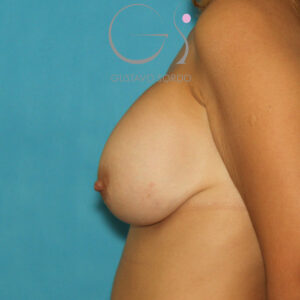
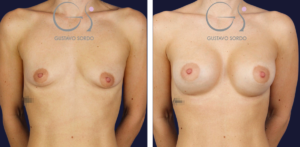
Breast Symmastia: Before and After
After surgical correction, the results are usually evident, as the natural separation between the breasts is restored and symmetry is improved. In complex cases, a second procedure may be required to fine-tune details. Patients report observing how the reconstruction of the sternal space restores a harmonious silhouette, although the final result is not seen until several months later, once the reduction has subsided.
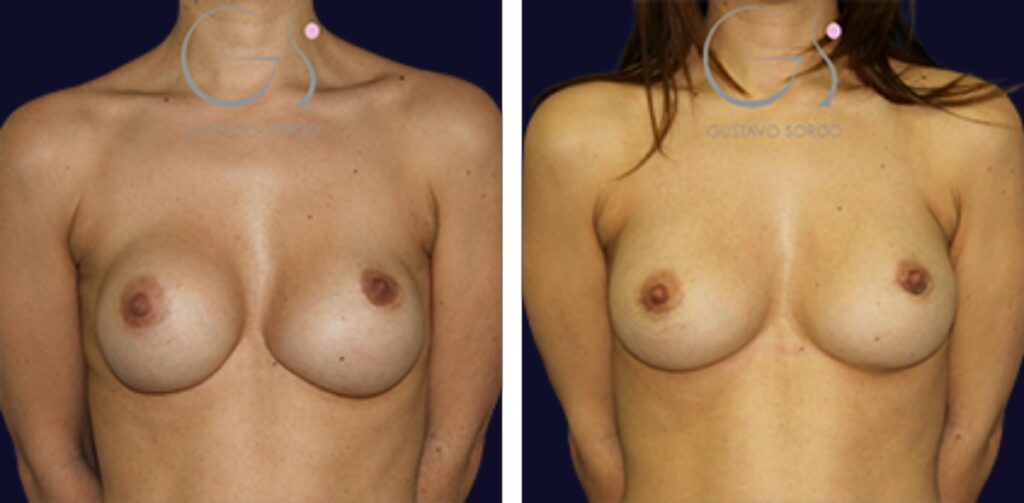
We recommend you check out all our before and after breast augmentation photos.
Can symmastia be prevented?
Yes, in cases of primary surgery, i.e., the first implant placement, an experienced surgeon and appropriate techniques (such as the use of support mesh or submuscular pocket designs) should be chosen to reduce risk.
Avoiding implants that are too large for the patient's anatomy and strictly following the postoperative care guidelines are also essential. In patients with an anatomical predisposition (narrow chest), the physician should consider customized alternatives.
Frequently Asked Questions (FAQs)
How serious is symmastia?
Depending on the degree, it can be mild if it's merely cosmetic, or severe if it involves pain or functional complications. It always requires medical evaluation.
Can it appear naturally?
It's rare, but possible in women with very loose tissues or congenital abnormalities. Most cases are postoperative.
Can symmastia be corrected without surgery?
No. Surgery is required to reposition the implants and reinforce the chest wall.
Can I avoid symmastia if I follow the postoperative care properly?
In general, doing so reduces the risk, but does not eliminate it completely, since the surgical technique is the main factor.
Is it possible to use implants again after correction?
Yes, although sometimes changing the size or type of implant is recommended to prevent recurrence.
Conclusion
Symmastia is a treatable complication that requires specialized care. Correcting it not only improves aesthetics but also improves the patient's quality of life. Choosing a qualified surgeon and following postoperative care are essential for optimal results. If you suspect you have this condition, do not hesitate to consult a professional to evaluate your options.
Continue reading
Dr. Gustavo Sordo
Specialist in Plastic, Aesthetic and Reconstructive Surgery. Member No. 282858125.
Content clinically reviewed by Dr. Gustavo Sordo. Last review: September 13, 2026.








 Clinic chat