Nubian Nose: What It Is and How to Correct It
Updated on • Reviewed by Dr. Gustavo Sordo, plastic surgeon
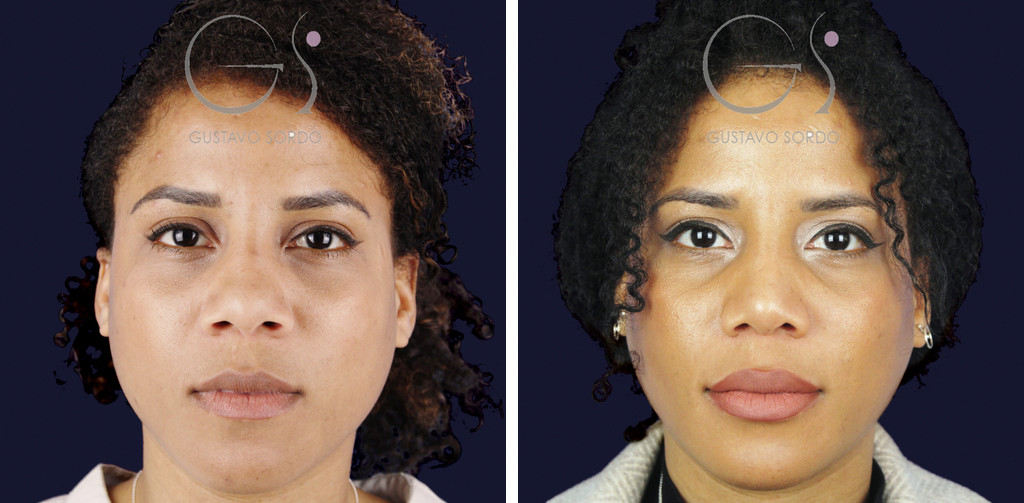
When a Black or Latina patient tells me in a consultation that her nose "looks wide" or "lacks definition," she's often describing what's popularly known as a Nubian nose. It's not a medical diagnosis or a closed category: it's a descriptive term, used primarily in educational materials, to refer to a nasal pattern historically associated with populations from the Nile Valley and Northeast Africa, although in practice I see very similar features in Latino and mixed-race patients. In this article, I'll explain what characterizes this type of nose, how I evaluate it, what treatment options exist, and, above all, how I work to improve it without erasing the patient's identity.
If you are considering correcting it, here we explain rhinoplasty in Madrid at our clinic.
For a nose with African features, ethnic rhinoplasty in Madrid starts at €15.000 and includes the complete skin care protocol.
Want to get an idea of what your nose would look like? In the rhinoplasty simulator , you choose the type of nose most similar to yours and see real cases operated on in the clinic.
What is meant by a Nubian nose?
There is no single, definitive medical definition of a "Nubian nose"—and I think it's important to state this clearly from the outset. It's a term used in general terms to encompass a range of characteristics that can appear together or separately, with considerable variation from patient to patient. What is true, and I see it constantly in my practice, is that the clinical presentation is very similar to that of many Latino or mixed-race patients: a wide nasal base, a poorly projected bridge, and an undefined tip.
For me, the starting point is not "correcting a type of nose," but understanding that each patient brings a particular combination of features, and that the goal is not to impose an external aesthetic pattern, but to work on what that person actually has in front of the mirror.
Cultural identity: surgery so you can still be yourself
It is absolutely essential to maintain the patient's essence, their natural appearance, and their distinctive features. In consultations, we use anatomical models and simulations so that the patient can anticipate the actual result before deciding whether to undergo the procedure. It's not about creating a nose from another race or standardizing beauty, but about adapting it to each specific case: maintaining the essence while improving what truly bothers the patient—the width, the lack of definition, the tip, the nostrils. In my clinic, we summarize it in a phrase I often repeat: we perform surgery so you can remain yourself.
Characteristics of a Nubian nose
Although not all of these characteristics appear together in every patient—and this is key, because each combination changes the surgical approach—these are the ones I see most frequently:
- Broad nasal base, with the wings often exceeding the width marked by the inner canthi of the eyes
- Low or poorly projecting back
- Rounded tip, with less definition
- Thick skin and abundant subcutaneous tissue
- More flexible supporting cartilages, with less structural strength
The most common thing I see in my practice is a nose that appears wide because it has very little height on the bridge. I like to explain it with an analogy: think of the nose as a Canadian tent. If the tent poles are very short, viewed from above the tent looks completely flat, without any topography, and very wide. But if we replace those poles with longer, sturdier ones, the tent becomes more streamlined, thinner, and viewed from above, it appears as a silhouette with relief, like a mountain range. When we raise the bridge with augmentation rhinoplasty, something similar happens: paradoxically, while we make the nose "bigger" in height, we make it look thinner from the front because the skin is stretched over a more defined structure.
It is also very common to find a rounded tip combined with a wide base that extends beyond the inner corners of the eyes: if we draw two imaginary vertical lines downwards from those corners, the nasal alae will fall outside that margin. In these cases, alar reduction (alarplasty) is usually necessary.
Does a Nubian nose need correction?
Not always. It's a natural anatomical variation, and when it doesn't cause any aesthetic or functional discomfort, there's no need for surgery. When it does come to the doctor, the reasons are usually aesthetic—width, lack of definition—although, as I explain below, it's common to also find a functional component that the patient hadn't previously identified. The decision is always personal, and my job is to offer realistic expectations, never to push toward surgery.
How is a Nubian nose analyzed before rhinoplasty?
The most important thing when addressing this case is to explain to the patient that everything we do in profile affects the frontal view, and vice versa. Since there is usually a lot of skin and little cartilage, we need to fill that excess skin with structural elements. It is essential that the patient understands that the profile must gain height and projection—including the tip—so that the frontal view appears narrower. Explaining this relationship between the frontal and profile views is fundamental during the consultation, and for this we use anatomical models that the patient can touch and physically understand.
Can a Nubian nose cause breathing problems?
Yes, quite frequently—although it's important to distinguish between two things. On the one hand, we often find insufficiency of the external nasal valve because, with less cartilage, the alar cartilages don't offer enough resistance to airflow: when inhaling, negative pressure is generated inside the nasal cavity, which can cause alar collapse. Interestingly, by lifting the nose with high radix spreader grafts, we also improve the internal nasal valve, increasing tissue resistance and, consequently, airflow.
On the other hand, alterations of the turbinates and septum do not correspond to ethnic or racial traits: any patient can have them, with any type of nose, and they must always be assessed and treated independently of the aesthetic approach.
Rhinoplasty techniques for a Nubian nose
When there is excess skin and insufficient cartilage, the solution cannot be reductionist: the relationship between container and contents must be reversed, enlarging the contents so that the container—the skin—can be reshaped over it. In most cases, costal cartilage is the ideal material for this.
To lift the dorsum, I use high radix spreader grafts: laminated rib cartilage sheets, shaped using the Eren Taştan technique (oblique split method), and secured with ultrasonically carved rails. This allows for a virtually custom-made lift of the entire nose, from the root to the supratip, with highly predictable and robust results, unlike standard laminated grafts or cartilage powder fillers, which are much more unpredictable. Furthermore, this type of graft allows for the simultaneous correction of associated deviations. According to PubMed, Froilán Páez—a surgeon specializing in these nasal support techniques—is a co-author, along with Cristian Cordero, of a recent publication on structural support of the nasal ala using anchored grafts (“The Armadillo-Anchored Rim Ring Graft”), confirming his active and published work in this field of nasal surgery ( Páez Salazar et al., 2026 ).
At the tip, the maneuver that most significantly alters the outcome in my experience is the septal extension graft. In the variant I use, the alar cartilages are positioned against a horizontal stop to tighten the lateral crura. With a double septal extension graft, the alar cartilages are tightened and placed in an optimal position. From there, small subalar rib grafts (lateral crural strut grafts) improve the external valve and further refine the tip. In all cases, the principle is the same: without projection, there is no definition.
When the alar base extends beyond the inner canthi of the eyes, I perform alarplasty following very strict rules: the scar must be placed precisely within the patient's natural crease so that it is not visible, and the upper limit of the resection must never extend beyond the midline of the alar lobe. According to PubMed, a long-term study by Kridel and Castellano, with 124 patients followed for 20 years, confirms that these alar base reduction techniques—wedge excision, nasal floor excision, and VY advancement, used alone or in combination—are effective in reducing alar flaring and narrowing the nasal base ( Kridel & Castellano, 2005 ). The calculation of the skin to be resected must be exhaustive, and the suturing extremely precise, to avoid any asymmetry between both sides. It is one of the most crucial parts of the entire procedure—it is performed at the end, when the surgeon is usually most tired, so I try to reach that stage with the maximum possible concentration.
Thick skin in Nubian nose rhinoplasty
Thick, oily skin is, in my opinion, a decisive factor in the final outcome. According to PubMed, Roxana Cobo, in an invited discussion on the effect of isotretinoin on nasal skin thickness and elasticity, supports the idea that controlling cutaneous fat production reduces postoperative inflammation and retained edema in the skin, since excess sebum production generates chronic inflammation ( Cobo, 2022 ). On the other hand, Aaron Kosins, in a study with ultrasound evaluation of 75 patients, objectively demonstrated that non-Caucasian patients tend to have a thicker nasal soft tissue layer and proposed a reliable method for measuring this thickness before surgery.
In practice, what we do with oral retinoids is to "degrease" the patient's skin, to achieve a thinner coverage that better transmits to the outside the changes we have made inside the nasal structure.
Risks and possible complications
Calcification and integration of the rib graft. It is essential to determine if the rib cartilage is calcified before harvesting it. For this, we use ultrasound in the operating room, which allows us to identify the least calcified rib in real time and harvest that one. Complete vascular integration of the rib graft is key to the long-term outcome; therefore, at my clinic, we use the hyperbaric chamber at HLA Moncloa Hospital, with five sessions beginning on the same day as the surgery.
Retrocolumellar perforation. This is one of the most feared complications in rhinoplasty. Maintaining the integrity of the membranous septum is critical: protecting it also means protecting the septal extension grafts and ensuring a fully vascularized infrastructure.
Asymmetry in alarplasty. If the rules for placing the scar in the natural crease and the upper limit on the mid-horizontal line of the alar lobe are not followed, there is a risk of asymmetry between both sides. That is why I dedicate as much concentration as possible to this part of the surgery, even at the end of a long procedure.

Harmonize your nose without sacrificing your identity with Dr. Gustavo Sordo
If you have these types of features and are concerned about width, definition, or breathing, I invite you to schedule a consultation. We will assess your case individually, using simulations and anatomical models, always respecting your identity and unique characteristics.
Make an appointment with Dr. Gustavo Sordo
Frequently Asked Questions (FAQs)
Is a Nubian nose the same as a wide nose?
Not exactly. It's a descriptive term that encompasses several features—wide base, low back, rounded tip, thick skin—but not all of them always appear together.
Is it possible to refine a Nubian nose without changing its identity?
Yes. The goal is never to standardize or westernize the nose, but to stylize it while respecting the features that define the patient, with the help of simulation and anatomical models.
Does alarplasty leave visible scars?
If the scar is placed in the natural groove and respecting the upper limit on the mid-horizontal line of the alar lobe, the scar is very well concealed.
Why are cartilage grafts used?
Because there is usually a lot of skin and little cartilage of the rib cage. The costal cartilage expands the internal structure so that the skin can be stretched over a more defined base.
Does thick skin prevent you from getting a defined tip?
It makes it more difficult, but not impossible. With good cartilage infrastructure and, in many cases, oral retinoids, it's possible to achieve definition even in thick skin.
How long does it take to see the final result?
It depends on the thickness of the skin: in thick skin the final result takes longer to become defined because it needs more time to adapt to the new internal structure.
Can aesthetic improvement be combined with respiratory correction?
Yes, it's very common. Nasal valve insufficiency usually improves at the same time as we lift the nasal dorsum with structural grafts, in the same procedure.
Conclusion
The Nubian nose is not a fixed medical category, but rather a pattern with considerable internal diversity that shares characteristics with other ethnic and mixed-race noses. Treating it properly requires understanding the relationship between profile and frontal views, providing the cartilage infrastructure that is often lacking, caring for the skin, and above all, respecting the patient's identity. As I like to say in consultations: the goal is never to change you into someone else, but to help you look your best by being yourself.
Continue reading
Dr. Gustavo Sordo
Specialist in Plastic, Aesthetic and Reconstructive Surgery. Member No. 282858125.
Content clinically reviewed by Dr. Gustavo Sordo. Last review: October 7, 2026.