Polyurethane implants: why I use them, in what cases, and what the evidence says

Polyurethane is the implant that is least explained and most often criticized, almost always for reasons that ceased to be true forty years ago. I have been using it for some time in specific cases—especially for tuberous breasts —and I believe it deserves a complete explanation: why it behaves differently, in which cases I choose it, what it requires in return, and what the literature says, including the uncomfortable aspects.
What exactly is a polyurethane implant?
It's not a "polyurethane" implant. It's a silicone gel implant, with its standard silicone shell, to which a micron-thick layer of polyurethane foam is added on the outside . That's why you'll also see it referred to as micropolyurethane . The filling and shell are the same as always; what changes is the surface that comes into contact with the tissue.
The polyurethane implants I use are from Silimed . Few manufacturers work with this surface, which partly explains why it's not a commonly used implant: it's handled differently, and not all surgeons use it.
And that surface changes the behavior of the entire implant. It's not a more aggressive texture: it's something else entirely . A textured surface has a relief etched into the silicone; polyurethane foam is an open mesh in which the tissue grows from within.
Why it sticks: the Velcro effect
The tissue surrounding the implant grows within the pores of the foam. As a result, the implant adheres to the breast wall . And from this come the three things that interest me about it:
- It does not rotate. An anatomical implant that rotates deforms the breast. Polyurethane implants don't rotate because they are fixed in place.
- It does not move. It doesn't go down, it doesn't turn sideways when lying down, it doesn't come together in the center.
- The capsule is organized differently. Instead of an aligned sheet of collagen that can contract like a girdle, a more disordered and more vascularized tissue forms, which contracts much less.
That last point is described in the laboratory: the capsules around the polyurethane have more cellularity, more vascularization and more VEGF expression than those of a textured implant, and the collagen does not align in parallel (according to PubMed, Vieira et al., Plastic and Reconstructive Surgery , DOI ).
Where do I place it: subfascial plane
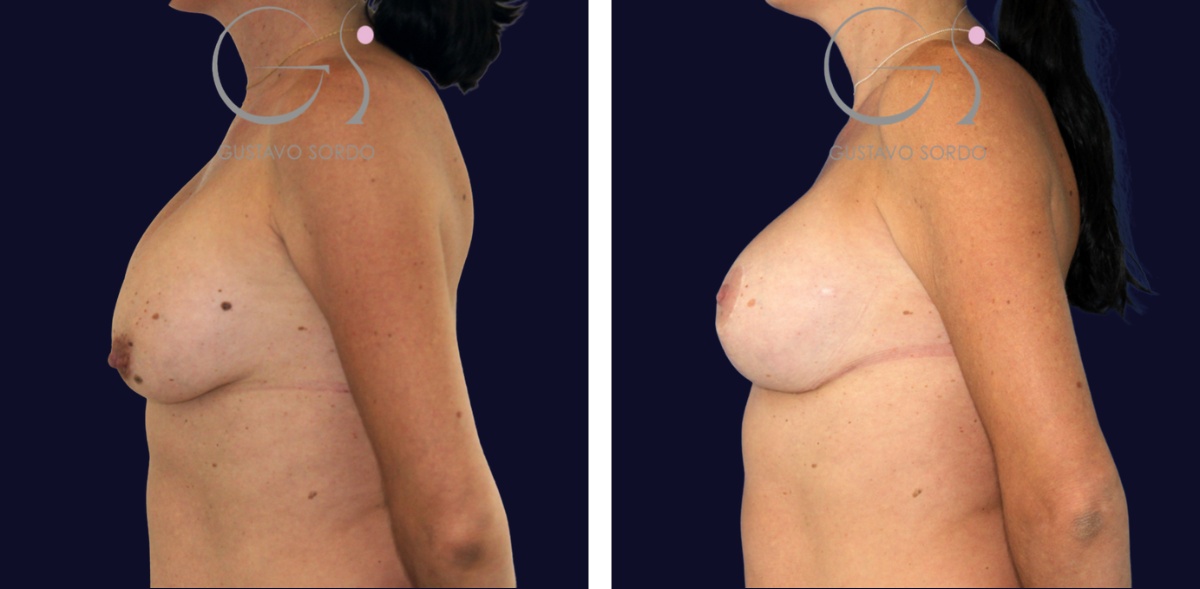
I place the polyurethane in front of the muscle, in the subfascial plane , between the gland and the pectoral fascia. It makes sense: if the implant is going to adhere, I want it to adhere to a plane that won't move with each contraction of the pectoral muscle.
Placing it subfascially has three practical consequences. First, there's no movement : the implant doesn't deform when the pectoral muscle contracts, something that's very important to anyone who trains. Second, the implant's shape is projected outwards —and this is key to tuberous breasts, which I'll explain now. Third, the postoperative recovery of the pectoral muscle is different because I haven't touched the muscle itself.
The requirement is sufficient coverage. I measure this with the pinch test of the upper pole: if the pinch is at least 1,5-2 cm deep, it's subfascial. If the tissue is thin, the implant will be visible, and then the correct choice is submuscular with another covering.
In what cases do I indicate it?
Tuberous breast
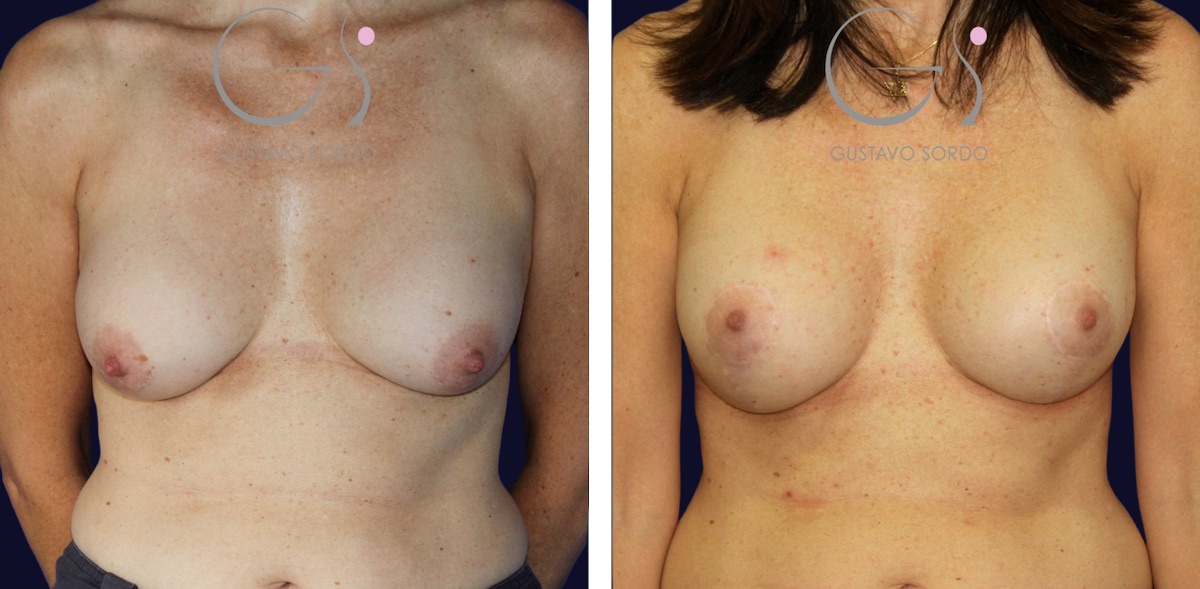
This is my primary recommendation, and the reason is geometric. In tuberous breasts, the problem isn't volume: it's that the base of the breast is narrow and the lower pole hasn't developed , with a ring of dense tissue constricting it. This lower pole needs to be opened up, and above all, the new shape needs to be visible from the outside.
And that's where other implants fall short. An implant that moves within a pocket only partially transmits its shape, because the overlying tissue adjusts on its own. An implant that is bonded to the skin transmits all the necessary shape modification to the outside. That's why I use micropolyurethane in a subfascial position, generally with an anatomical implant, which expands the lower pole better than a round one. The complete details—the degrees of expansion, the step-by-step technique, and eight real cases—are on the tuberous breast correction page.
Reductions and mastopexies in which the patient wants a prosthesis
Some patients come in with large or sagging breasts and, in addition to reduction or lift, want to maintain fullness in the upper pole. When combining implants with breasts that have undergone skin repositioning, stability is more important than ever: it's undesirable for the implant to move within tissue that has just been reorganized. Polyurethane works very well in this scenario.
Recurrent capsular contracture
When a patient has already experienced a contracture and undergoes further surgery, the goal is no longer solely cosmetic: it's to prevent recurrence. In my experience, polyurethane is the tool that makes all the difference in these cases, and I use it in irradiated areas or in patients with a history of contracture after reconstruction.
What he asks for in return: drainage
Polyurethane is not an easy implant to place. It's technically more complex ; the foam adheres immediately and doesn't forgive a poorly made pocket, because once it's in place, it can't be repositioned. And it requires something that my other augmentations don't: drainage for four or five days.
The drainage system is there to prevent fluid from accumulating at the interface between the foam and the tissue while integration is taking place. It's not a complication or a sign that anything is wrong; it's part of the protocol for this specific implant. It's good to know this before making a decision, as it can change in the first few days.
What does the evidence say about contracture?
The numbers here are good, and it's important to present them with some context. According to PubMed:
- In a systematic review of eighteen studies, in primary increase The capsular contracture was from 0,4-1% with polyurethane compared to 2-15% at six years with textured implants; in reconstruction, 1,8-3,4% versus 10-15% (Duxbury and Harvey, JPRAS, DOIThe authors themselves warn that polyurethane studies have a shorter follow-up period, and this must be taken into account.
- In a series of 131 patients and 255 breasts with modern polyurethane, the contracture was of 1,2%, and all appeared before the 31st month (Pompei et al., Aesthetic Surgery Journal, DOI).
- In immediate prepectoral reconstruction, polyurethane prevented rotation and malposition. The same study points out, and it's fair to say, somewhat more reintervention and early implant loss (Catanuto et al., DOI).
What happens to polyurethane after five years?
It's often said that after five years the polyurethane "disappears," leaving a normal prosthesis inside. That's half true, and the other half matters.
The longest follow-up study to date—thirty years, 382 patients—found that polyurethane is only visible to the naked eye during the first five years . But under a microscope, it was still present in all capsules after thirty years . In other words: it doesn't disappear, it biodegrades and integrates into the capsule (Castel et al., Archives of Plastic Surgery , DOI ).
That same study also reveals another important point: the protection is not permanent . Baker II-III contractures appeared between the ages of nine and ten, and Baker IV between twelve and twenty-one, with an inverse correlation to the amount of polyurethane remaining. Where foam remained undegraded, no contractures occurred.
Translated into what matters to a patient: polyurethane buys many years of peace of mind against contracture, more than any other surface, but no breast implant is for life and this one is no exception.
Implant-associated lymphoma (BIA-ALCL): what you need to know
If I'm going to tell you about the advantages of polyurethane, I have to tell you this. BIA-ALCL is a rare T-cell lymphoma that can appear in the capsule surrounding an implant, and it has been associated primarily with rough surfaces. It's an ongoing issue, and I want to explain it with the real numbers, not just the ones that best suit my needs.
The numbers, and why they fluctuate so much
The range acknowledged in the literature itself goes from 1 in 300 to 1 in 30.000 . That the interval is so wide is not a mistake: it's simply that the denominators are different . When calculated based on implants sold, one number is obtained; when calculated based on actual patients followed, the result is considerably higher.
- In the Australian and New Zealand registry, about salesthe risk was 1 each 1.947 for Silimed polyurethane and 1 in 36.730 for a Siltex-type fine texture (Loch-Wilkinson et al., DOI). In the previous analysis, polyurethane appeared to pose a risk 23,4 times that of Siltex (Magnusson et al., DOI).
- In a prospective cohort of 1.501 aesthetic patients followed for years, the prevalence was 1 each 300, and 6,9 cases per 1.000 carriers of a macrotextured Allergan BIOCELL (Kolasiński et al., DOI). The authors interpret this as meaning that in series with a sales denominator the problem was being underestimatednot that the risk is different.
- There is a serious counter-argument, and it must be given: it has been argued that Polyurethane should not be lumped in with macro-textured materials.because foam is a different surface and the adhesion and capsule formation mechanism is not like that of a textured surface (Hamdi, DOI). It is a discussion that remains open.
That which truly reassures
It's not the number. It's how the disease behaves:
- Show your face. 90% debut as a late seroma —the breast swells with fluid, typically around the ninth year—. It is not a silent finding: it is noticeable and visible on an ultrasound.
- It is diagnosed early. In the Australian series, the 87,5% It was diagnosed at stage I.
- Stage I is treated with surgery. The treatment involves removing the implant and the entire capsule, and most patients are cured. The reported deaths have been linked to delays in diagnosis (Groth and Graf, Aesthetic Plastic Surgery, DOI).
- To put the magnitude into perspective: about 35 million of implant carriers worldwide, at the time of that review there were 573 cases described and 33 deaths.
That's why no scientific society or regulatory agency recommends removing an implant from a patient without symptoms . What they do recommend, and I agree, is follow-up : annual check-ups and ultrasounds. If a breast becomes swollen years after surgery, that's investigated, not left to chance.
My reasoning here is simple: in tuberous breasts, polyurethane does something that no other implant does as well, and I explain why. If a patient, with this information, prefers another implant surface, that's a reasonable decision, and we look for the alternative. What I don't find defensible is only telling the positive side.
The post-operative period, with dates
Except for the drainage, the recovery follows my usual pattern, and has a specific advantage because it occurs in a subfascial plane:
- At 24 hours: Raise your arms straight up and bring your shoulder blades together for 30 seconds, once every hour, and walk for 30 minutes a day. Starting on the 7th The 1 kg weight limit is lifted and movement is unrestricted: the arms can be moved whenever desired, without repeating the exercise every hour. My guideline is not to immobilize, it's the opposite.
- Day 4 or 5: The drain is removed.
- Until the drain is removed, arm movement is not forced; from that moment on, normal movement is permitted.
- First month: without sport.
- Per month: Gentle, progressive cardio and isometric exercises. And here's the advantage: as the implant goes subfascial, Isometric pectoral exercises can also begin after a month.and not after six months as when the implant is placed under the muscle.
Price
At our clinic, breast augmentation with polyurethane implants costs €6.752 . When a breast lift is also necessary —common in tuberous breasts—a mastopexy is performed, and the price ranges from €8.600 with implants to €9.000 with polyurethane, and up to €10.400 if it is a revision procedure that also requires capsule removal. A simple polyurethane implant replacement costs €4.500 . These are the complete prices, from the initial consultation to follow-up appointments.
When I'm not using it
It's not an implant for everyone, and saying so is part of explaining it properly:
- When the covering fabric is scarce. If the pinch test of the upper pole is fine, the implant will be visible. In that case, the correct placement is the submuscular plane.
- When the patient, having been informed, prefers another surface. It's your decision, and there are reasonable alternatives.
- When what is needed is not an implant. There are mild cases of tuberous breasts that are better resolved with lipofilling and release of the constrictive ring than by placing a prosthesis.
Botton line
Polyurethane is an implant that adheres well, and from this single property come its three advantages—it doesn't rotate, it doesn't shift, and the risk of capsular contracture is significantly reduced—and its two drawbacks: it requires drainage for four or five days and is part of the ongoing debate surrounding BIA-ALCL. In tuberous breasts, the balance seems clear to me, because this is where adherence performs at a level that no other surface can match. In a standard augmentation with good coverage, there is more than one suitable option, and the discussion is different.
If you are considering breast surgery and would like us to review your specific case—which plane, which implant, and why—we can discuss it in a consultation using 3D simulation on your own body.
Continue reading
Dr. Gustavo Sordo
Specialist in Plastic, Aesthetic and Reconstructive Surgery. Member No. 282858125.
Content clinically reviewed by Dr. Gustavo Sordo. Last review: September 29, 2026.