Updated on • Reviewed by Dr. Gustavo Sordo, plastic surgeon
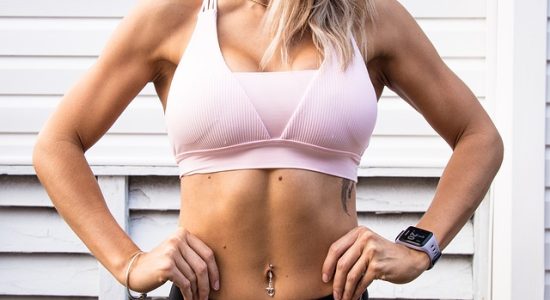
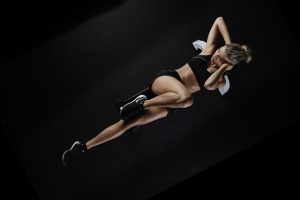
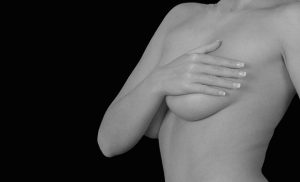
Many women active in sports face the dilemma of choosing between maintaining their activity level and fulfilling their aesthetic desires. It is common for female athletes, during their initial consultation at Dr. Gustavo Sordo's Plastic Surgery Clinic in Madrid , to inquire about the compatibility of having breast implants placed submuscularly and engaging in intensive sports.
Benefits of the submuscular position for athletes
The submuscular breast implant, that is, placed under the pectoral muscle, has several advantages that are especially relevant for athletes:
- Lower risk of capsular contracture: Studies published in specialized plastic surgery journals have shown that submuscular placement decreases the risk of capsular contracture, a hardening of the area around the implant that can be painful and distort the appearance of the breast.
- More natural look: Since the implant is covered by an additional layer of muscle tissue, the result tends to look more natural, something that may be preferred by women who desire aesthetic changes without radically altering their figure.
- Implant protection during physical activities: The muscle provides an additional layer of protection for the implant during physical activities, which can be crucial for women involved in contact sports or those that require intense body movements.
This is a common question among patients who train seriously, and the answer is nuanced. The submuscular implant has a specific disadvantage for those who exert force: dynamic animation or distortion , meaning the implant deforms when the pectoral muscle contracts. Therefore, in athletic patients, when the pinch test of the upper pole is sufficient—at least 1,5-2 cm of pinch—we prefer the subfascial plane , in front of the muscle: there is no dynamic animation, recovery is faster, and the athletic movement is not affected.
The Preservé technique is particularly well-suited for this , as it creates space with a balloon without cutting the muscle or damaging the breast ligaments, using local anesthesia and sedation, and allowing for arm movement on the same day. Submuscular placement remains the right choice when there is little supporting tissue, as it prevents the implant from being visible. In this case, the difference is significant and can be illustrated with numbers: intense isometric pectoral exercises should be postponed for six months , while subfascial placement can be resumed after one month . Everything else—gentle, progressive cardio and isometric exercises that don't involve the pectoral muscles—begins after one month in both cases.
Special Considerations for Extreme Athletes
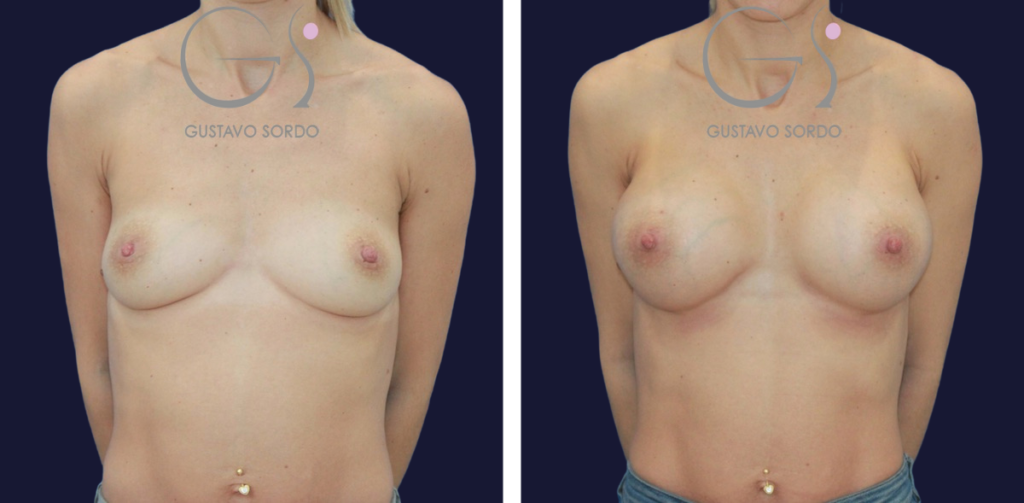
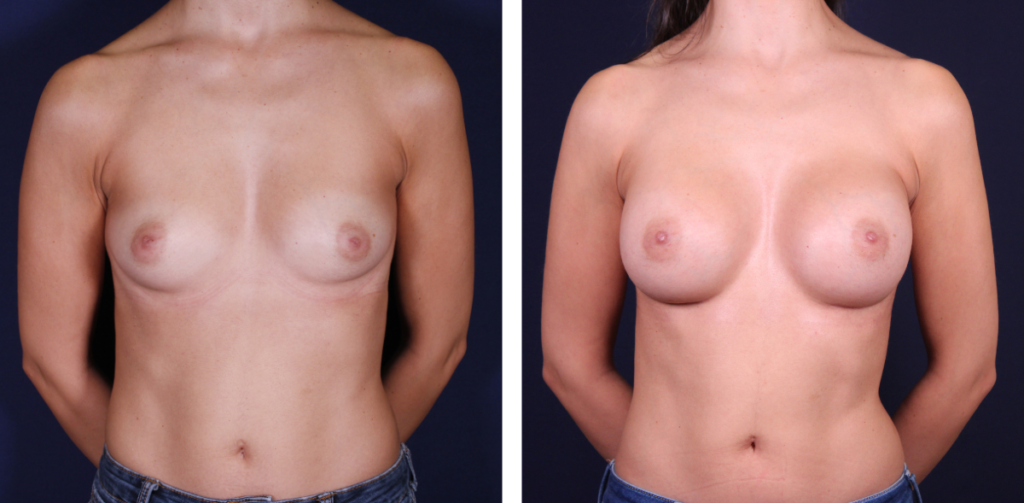
We recommend you check out all our before and after breast augmentation cases.
For those who participate in high intensity sports, such as bodybuilding or activities that involve extensive use of the pectoral muscles, there are additional considerations:
- Possible impact on sports performance: Although rare, some athletes may experience a feeling of discomfort or limitation in movement, especially in sports that require a wide range of arm movements.
- Alternatives to submuscular implant: In these cases, the option of subglandular or suprapectoral implants could be considered, especially using polyurethane implants, known for their ability to minimize capsular contracture even when placed over the muscle.
Therefore, to the question of whether breast implants can be placed in a submuscular position if one does a lot of sports, the answer is yes , since it is a protective factor against capsular contracture that we should not give up and that presents significant scientific evidence that it is the best position in which breast prostheses can be placed.
For more information on submuscular breast implant placement, its advantages, and everything related to breast augmentation in Madrid , do not hesitate to contact the plastic, aesthetic, and reconstructive surgeon, Dr. Sordo.
Continue reading
Dr. Gustavo Sordo
Specialist in Plastic, Aesthetic and Reconstructive Surgery. Member No. 282858125.
Content clinically reviewed by Dr. Gustavo Sordo. Last review: September 4, 2026.








 Clinic chat