Hybrid Rhinoplasty: What it is, Advantages and Future
Updated on • Reviewed by Dr. Gustavo Sordo, plastic surgeon
More and more patients are coming to my office asking about "preservation rhinoplasty" or "hybrid rhinoplasty" after seeing it on social media, but few really know what it involves or why more and more surgeons are incorporating it into their daily practice. In this interview, I explain, in my own words, how nasal surgery has evolved in recent years and why hybrid rhinoplasty has become my preferred approach.
More information about nose surgery in Madrid can be found on the procedure's page.
What is hybrid rhinoplasty?
Hybrid rhinoplasty is, in reality, the combination of two philosophies that for years were considered alternatives: traditional structural rhinoplasty and preservation rhinoplasty, both assisted by ultrasound. Instead of choosing a single technique for all patients, I now have a range of five or six preservation techniques, in addition to structural rhinoplasty, which remains an excellent tool in many cases. The challenge, and where the true value of this approach lies, is knowing how to choose the most appropriate technique for each nose.
From traditional rhinoplasty to preservation surgery: why the approach has changed
Two factors have driven this change. On the one hand, a much deeper understanding of nasal anatomy than we had a few decades ago. On the other, the possibility of applying preservation techniques that are not actually new—some were described more than a hundred years ago—but which we can now perform with modern means, such as ultrasound. This combination of anatomy and technology is what has made it possible for preservation to go from being a historical curiosity to a real option in the operating room.
Advantages of preserving nasal anatomy: stability and naturalness
The great advantage of preserving the original anatomy of the nose is that it avoids the need for grafting the bridge after removing the dorsal hump, as is the case in many classic structural rhinoplasties. By maintaining the patient's natural anatomy, it is not necessary to resort to reconstructive grafts after removing the nasal "roof," so there is a much lower chance of those grafts being reabsorbed or shifting over time. This translates into more stable and, in general, more natural results.
Who is a good candidate for preservation rhinoplasty?
Preservation rhinoplasty can generally be applied in primary rhinoplasties, that is, in patients who have not previously undergone nasal surgery. It works particularly well in those who already have a harmonious dorsum that only requires minor modifications, such as refining a subtle hump, and it also yields very good results in cases of axial nasal deviation. Therefore, it is not a universal technique for every nose: part of my work as a surgeon is to assess during the consultation whether each patient's anatomical pattern makes them a candidate for preservation, a structural technique, or a hybrid combination of both.
When the back needs to be narrowed: the dorsal split
The clearest definition of hybrid rhinoplasty is Robotti's: the tip is structurally altered, and the bridge is preserved . And that's exactly how I use it. But classic preservation has a limitation that's important to know: it leaves the bridge as it is. It's suitable when the bridge is already aesthetically pleasing and only needs to be lowered; it doesn't allow for narrowing it . Many wide bridges, or those with asymmetries in the mid-vault, were excluded for this reason.
The dorsal split technique, developed by Sergio Furtado with Robotti and Çakır, overcomes this limitation: the mid-vault is opened along the anatomical plane of the septal T, and its width and symmetry are reconfigured without breaking the bone-cartilage connection at the keystone , which is what provides stability to the preservation. It combines the best aspects of component separation in structural rhinoplasty with the key advantage of preserving this flexible joint, and expands the indications to dorsals that classical preservation did not allow ( Furtado, Robotti, Sousa Vieira, Çakir, and Milicic, Aesthetic Plast Surg, 2024 ).
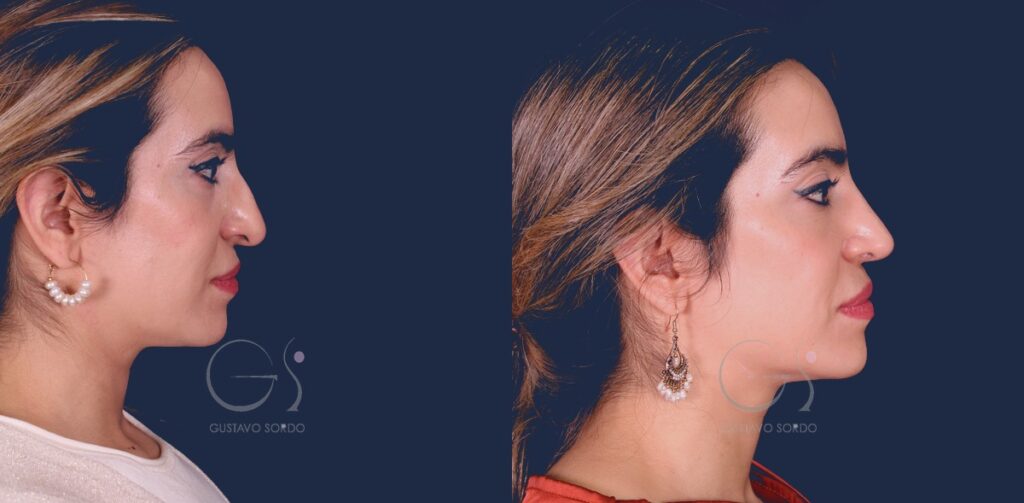
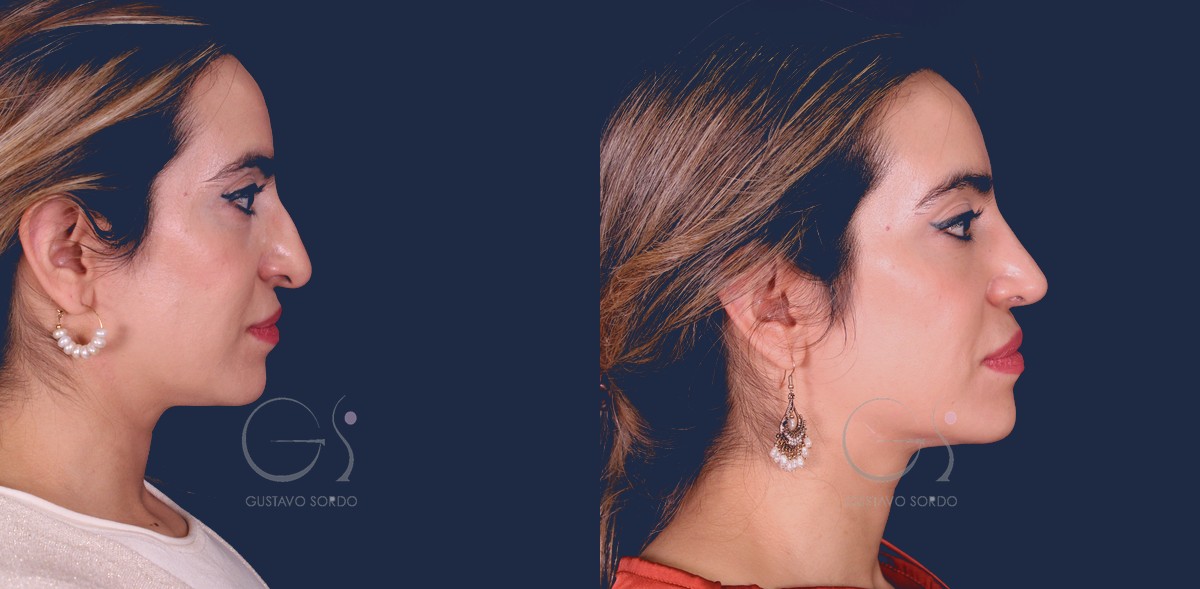
This case illustrates it well: a nose with ethnic features, thick, oily skin, and a square tip in the basal view. It didn't require dorsal augmentation, so no rib was used: an ethnic rhinoplasty is not the same as an augmentation rhinoplasty. I performed a hybrid technique with a dorsal split for the bridge and an armadillo tip for the tip. What you need to look at in the photos is that the bridge hasn't just lowered; it's thinned , and the tip has gone from square to defined. With skin like this, the skin itself is crucial: however thin the underlying structure may be, if the skin isn't prepared before surgery, the result will appear thickened, and this preparation is an integral part of the procedure. In this case, the preparation involved oral isotretinoin in the preceding months, under medical supervision and blood tests, to reduce sebum production and thin the skin. It worked well, and the result reflects this.
The use of isotretinoin in rhinoplasty for thick skin is increasingly well-documented, and it is worthwhile to read it in full. A systematic review of seven studies found improved tip definition, less postoperative edema, and greater patient satisfaction, with mild adverse effects, primarily dryness of the mucous membranes and lips ( Ghazizadeh, Barati, Tabrizi, Jabbari, and Hooshmandinia, J Cosmet Dermatol, 2025 ). Two other reviews from the same year are more cautious: the benefit is clearly seen in the first six months and tends to equalize with the control group at one year, and the study designs are so different that efficacy is not yet established ( Rammal and Mogharbel, Aesthetic Plast Surg, 2025 ; Kandathil, Rossi-Meyer, Saltychev, and Most, Facial Plast Surg Aesthet Med, 2025 ). Therefore, it's not a treatment for everyone, nor does it replace traditional technique: it's considered for thick, oily skin, which is frequently seen in Latin noses and, in general, in ethnic rhinoplasty . The decision is made during a consultation, and the patient undergoes follow-up. What remains most important for the final result is a firm underlying structure.
The role of ultrasonic rhinoplasty in the hybrid technique
Ultrasonic rhinoplasty contributes significantly to the preservation philosophy, because in practice, the two often go hand in hand: they are almost a perfect complement to each other. Working with ultrasound means intervening on the bony and cartilaginous structure of the nose with a device called a Piezotome, also known as an ultrasonic scalpel. But it's important not to lose sight of the essential point: the instrument alone does not define the result. What truly matters is the technique we apply afterward with that handpiece, whether it's preservation, structural, or a hybrid technique.

Recovery: Are there differences compared to traditional rhinoplasty?
In general, the differences in recovery are minimal. Traditional or structural rhinoplasty has been performed with ultrasound for some time, and recovery was also very rapid thanks to this technique. Therefore, today, both the preservation approach and the ultrasound-assisted structural approach have relatively similar recovery times, a far cry from the image of prolonged swelling and bruising that many patients still associate with classic rhinoplasty using a hammer and chisel.
Natural results: what patients are looking for today
In surgery, there is a clear trend among some patients who demand more natural and less "operated" results: noses that still look like their own, just enhanced. But there is also another group of patients who are not entirely satisfied with such subtle results and seek more dramatic changes. As surgeons, we must be prepared to meet either demand, and that is where having a wide range of techniques—preservation, structural, or hybrid—makes all the difference.
Long-term stability of preservation rhinoplasty
There is growing consensus in the literature and clinical practice that a preserved nasal dorsum is less likely to present future problems, such as inverted V-shaped skeletonization or graft displacement—complications that can occur more frequently after complete dorsal reconstruction. This is one of the reasons why, whenever the patient's anatomy allows, I prefer preservation to reconstruction.
The future of rhinoplasty: where is the hybrid technique headed?
I believe hybrid rhinoplasty is a very safe approach that more and more surgeons will be turning to; in fact, it's where I find myself today, and it's a truly comfortable and versatile approach, capable of safely addressing virtually all types of noses. Furthermore, technologies like hyperbaric oxygen therapy are already helping us improve the survival rate of rib grafts in secondary or revision rhinoplasties, which are the most complex. Looking ahead, I'm convinced that in the future we'll have materials created specifically for each patient and we won't need to take rib grafts again, which will further simplify these types of surgeries.
Have your case evaluated by Dr. Gustavo Sordo
Every nose is different, and choosing between preservation, structural, or hybrid rhinoplasty depends on your anatomy, your expectations, and the desired result. If you'd like to know which technique is best suited for you, I invite you to schedule a consultation with us for a comprehensive examination.
Make an appointment with Dr. Gustavo Sordo
Frequently Asked Questions (FAQs)
What is the difference between hybrid rhinoplasty and preservation rhinoplasty?
Preservation rhinoplasty is a family of techniques that avoids reconstructing the nasal dorsum after removing the dorsal hump. Hybrid rhinoplasty goes a step further: it combines these preservation techniques with structural rhinoplasty techniques and ultrasound guidance, choosing the most appropriate combination for each patient instead of always applying the same protocol.
Is hybrid rhinoplasty suitable for all types of noses?
Preservation rhinoplasty works particularly well in primary rhinoplasties, where the dorsum is already harmonious and only requires minor adjustments, and in cases of axial deviation. For other cases, such as noses that have undergone more extensive surgery or more pronounced humps, it may be necessary to combine it with structural techniques. Therefore, an individual consultation is essential before deciding on the approach.
What is a Piezotome and what is it used for in rhinoplasty?
The Piezotome, or ultrasonic scalpel, is the instrument we use to work on the bony and cartilaginous skeleton of the nose using ultrasound waves, instead of the traditional hammer and chisel. It allows for more precise and controlled work, although the final result depends primarily on the surgical technique used.
Is recovery from a hybrid rhinoplasty faster than from a traditional rhinoplasty?
Ultrasound-assisted structural rhinoplasty already offered a fairly rapid recovery, so the differences with the hybrid or preservation approach are generally minimal. Both approaches have relatively similar recovery times when performed with ultrasound.
Does preserving nasal anatomy lead to more stable long-term results?
There is a growing consensus that a preserved back is less likely to present future complications, such as inverted V skeletonizations or graft displacement, compared to backs completely reconstructed with grafts.
Where is rhinoplasty headed in the coming years?
Hybrid rhinoplasty is gaining ground as a safe and versatile approach, capable of addressing virtually all types of noses. Furthermore, technologies such as hyperbaric oxygen therapy are already improving the survival rate of rib grafts in secondary rhinoplasties, and in the future, patient-specific materials are likely to reduce the need for rib grafts.
Conclusion
Hybrid rhinoplasty is not a single technique, but rather a way of understanding nasal surgery: combining the best of preservation, structural surgery, and ultrasound, choosing the strategy that best suits each patient's anatomy and expectations. It is currently one of the safest and most versatile approaches for achieving natural and long-lasting results.
Continue reading
Dr. Gustavo Sordo
Specialist in Plastic, Aesthetic and Reconstructive Surgery. Member No. 282858125.
Content clinically reviewed by Dr. Gustavo Sordo. Last review: October 2, 2026.